The short answer
Human growth hormone (hGH) is a long molecule — 191 building blocks, called amino acids, strung together like beads. It does several different things in the body, and for a long time researchers wanted to know whether those jobs could be separated: could you take just the part that deals with fat handling, and leave the rest behind?
Work published in the early 1990s traced that particular activity to the very end of the chain — the last stretch, beads 177 through 191. Cut that tail off, and you have a short peptide people came to call the growth hormone fragment. AOD-9604 is that same tail with one extra bead — an amino acid called tyrosine — attached to the front end. That single addition is essentially the whole difference between the two names.
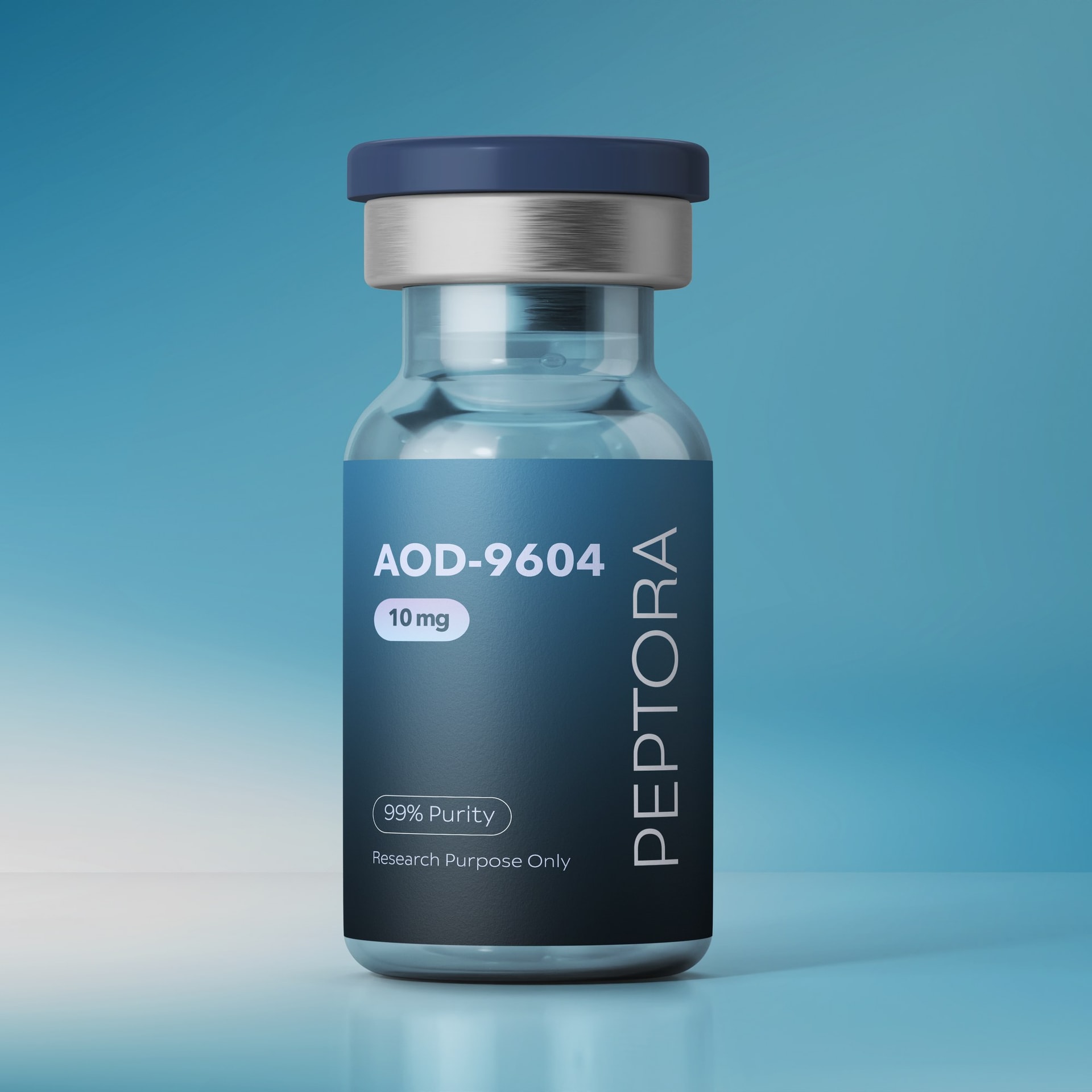
Explore research-grade AOD-9604
99%+ pure, a certificate of analysis with every batch — for laboratory research use only.
View AOD-9604The quick version
A tail, not a hormone
Growth hormone is 191 beads long. Both of these are just the last ~15.
The one difference
AOD-9604 carries an extra tyrosine bead at the front. That is the change the name marks.
Why the tail at all
Published work traced growth hormone's fat-handling activity to this region, so it was studied alone.
Lab use only
Peptora supplies AOD-9604 as a research chemical — never for people or animals.
How the tail was found
The trail starts at Monash University in Australia. In 1993, Wu and Ng published work on a synthetic version of the last stretch of human growth hormone — the sequence hGH 177-191 — and reported that it showed antilipogenic activity (meaning activity related to reducing fat *formation*) comparable to that of the whole hormone in their rat fat-tissue experiments.
That was the key idea: the whole 191-bead hormone might not be needed. If one short region carried this particular activity, then studying that region alone would let researchers ask much cleaner questions. The same Monash group, working with the company Metabolic Pharmaceuticals, went on to develop the tyrosine-tagged version and gave it the code name AOD-9604.
What the published animal work reported
Most of the AOD-9604 literature is preclinical — rodent studies, not human trials. Three papers from the Monash group form the core of it:
- Zucker rats, 2000. Daily oral treatment over 19 days was reported to reduce body-weight gain compared with controls, with increased lipolytic activity measured in fat tissue and — notably — no adverse effect on insulin sensitivity, unlike whole growth hormone.
- Obese mice, 2001. Both whole hGH and AOD-9604 were reported to reduce body-weight gain and increase fat oxidation. The paper also reported that AOD-9604 does not compete for the growth hormone receptor and did not induce cell proliferation the way whole hGH did.
- Knockout mice, 2001. A follow-up looked at the beta-3 adrenergic receptor pathway and concluded the fragment's lipolytic actions were not working directly through that receptor, even though treatment raised its expression.
That second finding is the one worth pausing on. If AOD-9604 does not bind the growth hormone receptor at all, then whatever it is doing is happening through some other route — which is precisely the sort of open question that keeps a compound in the research literature. The authors described this as evidence that growth hormone can behave like a pro-hormone, a larger molecule whose pieces have activities of their own.
Side by side
| AOD-9604 | HGH Fragment 176-191 | |
|---|---|---|
| What it is | hGH 177-191 plus an N-terminal tyrosine | The same C-terminal tail region of hGH |
| Extra building block | Yes — one tyrosine at the front | No |
| Where the name comes from | Development code from Metabolic Pharmaceuticals | Descriptive — just the residue numbers |
| Formal development record | Reached phase 2 investigation for obesity | None as a distinct named compound |
| Binds the growth hormone receptor? | Published work reports it does not | Not established |
| Anti-doping status | Prohibited by WADA; detection methods published | Treated within the same class |
So when a supplier lists both names as though they were rival compounds, the honest answer is that the published chemistry puts them one building block apart, in the same region of the same hormone. AOD-9604 is the one with a real development history and published detection chemistry attached to it. Peptora carries research-grade AOD-9604 with a batch-specific certificate of analysis.
Where the compound went next
AOD-9604 was investigated as a possible obesity treatment and reached phase 2 studies, as summarized in a 2004 drug-development review. It did not go on to become an approved medicine for that use. It has since turned up in other, unrelated laboratory contexts — for example a 2015 animal study in a collagenase-induced osteoarthritis model. That is early animal work in a completely different research area, not a clinical conclusion.
There is one more strand of literature that is genuinely useful to know about. Because the peptide circulated outside of formal research, anti-doping scientists developed methods to detect it. A 2015 paper in *Drug Testing and Analysis* validated a urine detection method and mapped six of the peptide's breakdown products — and it is that paper that gives the clearest published statement of AOD-9604's exact composition. A separate 2014 report described identifying AOD-9604 in unlabeled preparations seized by Belgian authorities, which is a blunt reminder of why documented purity matters.
Purity and handling
Short fragments like these are easy to get subtly wrong — a missing residue at one end changes the molecule, and you would not see it by eye. That is exactly what analytical testing is for. Every batch Peptora supplies is checked to 99%+ purity by HPLC — a machine that separates a sample into its parts so you can see exactly how much of it is the peptide you ordered — and confirmed by LC-MS, a second test that measures the molecule's mass and so proves it is the right sequence.
AOD-9604 arrives lyophilized (freeze-dried) and is reconstituted — mixed with bacteriostatic water — before research use. Warm the sealed vial to room temperature first, add the water slowly down the side, swirl rather than shake, and keep the mixed solution cold and out of light. Full steps are in the reconstitution guide, and what a certificate of analysis means explains the paperwork.
Scientific references
The sources below are listed for background, from PubMed. They describe research on the molecules themselves — not the laboratory research product Peptora supplies. Two older entries predate routine DOI assignment and are linked by PubMed ID instead.
- 1Wu Z, Ng FM. Antilipogenic action of synthetic C-terminal sequence 177-191 of human growth hormone. Biochem Mol Biol Int. 1993;30(1):187-196. PMID: 8358331.
- 2Ng FM, Sun J, Sharma L, Libinaka R, Jiang WJ, Gianello R. Metabolic studies of a synthetic lipolytic domain (AOD9604) of human growth hormone. Horm Res. 2000;53(6):274-278. doi:10.1159/000053183 (PMID: 11146367).
- 3Heffernan MA, Thorburn AW, Fam B, et al. Increase of fat oxidation and weight loss in obese mice caused by chronic treatment with human growth hormone or a modified C-terminal fragment. Int J Obes Relat Metab Disord. 2001;25(10):1442-1449. doi:10.1038/sj.ijo.0801740 (PMID: 11673763).
- 4Heffernan M, Summers RJ, Thorburn A, et al. The effects of human GH and its lipolytic fragment (AOD9604) on lipid metabolism following chronic treatment in obese mice and beta(3)-AR knock-out mice. Endocrinology. 2001;142(12):5182-5189. doi:10.1210/endo.142.12.8522 (PMID: 11713213).
- 5Wilding J. AOD-9604 Metabolic. Curr Opin Investig Drugs. 2004;5(4):436-440. PMID: 15134286.
- 6Cox HD, Smeal SJ, Hughes CM, Cox JE, Eichner D. Detection and in vitro metabolism of AOD9604. Drug Test Anal. 2015;7(1):31-38. doi:10.1002/dta.1715 (PMID: 25208511).
- 7Vanhee C, Moens G, Deconinck E, De Beer JO. Identification and characterization of peptide drugs in unknown pharmaceutical preparations seized by the Belgian authorities: case report on AOD9604. Drug Test Anal. 2014;6(9):964-968. doi:10.1002/dta.1687 (PMID: 24976118).
Explore research-grade AOD-9604
99%+ pure, a certificate of analysis with every batch, fast U.S. shipping — for laboratory research use only.
View AOD-9604Key takeaways
- Human growth hormone is 191 amino acids long. Both "AOD-9604" and "HGH Fragment 176-191" refer to the short tail at the end of that chain, not to the hormone itself.
- Published anti-doping chemistry describes AOD-9604 as hGH 177-191 with one extra amino acid — a tyrosine — added at the N-terminus. That single addition is the practical difference between the two names.
- The idea came from work at Monash University in the early 1990s, which traced growth hormone's fat-handling activity to this tail region and studied the tail on its own.
- Published rodent studies reported reduced body-weight gain and increased fat oxidation, and — importantly — that AOD-9604 does not compete for the growth hormone receptor.
- AOD-9604 reached phase 2 investigation for obesity but did not become an approved medicine. It is prohibited in sport and has published urine detection methods.
- Peptora supplies AOD-9604 as a laboratory research chemical at 99%+ purity with a batch-specific certificate of analysis — never for people or animals.
Frequently asked questions
This article is intended solely as an educational summary of publicly available scientific literature. Products offered by Peptora are supplied exclusively for laboratory research purposes and are not approved for human or veterinary use. The information presented should not be interpreted as medical advice, treatment recommendations, or clinical guidance.