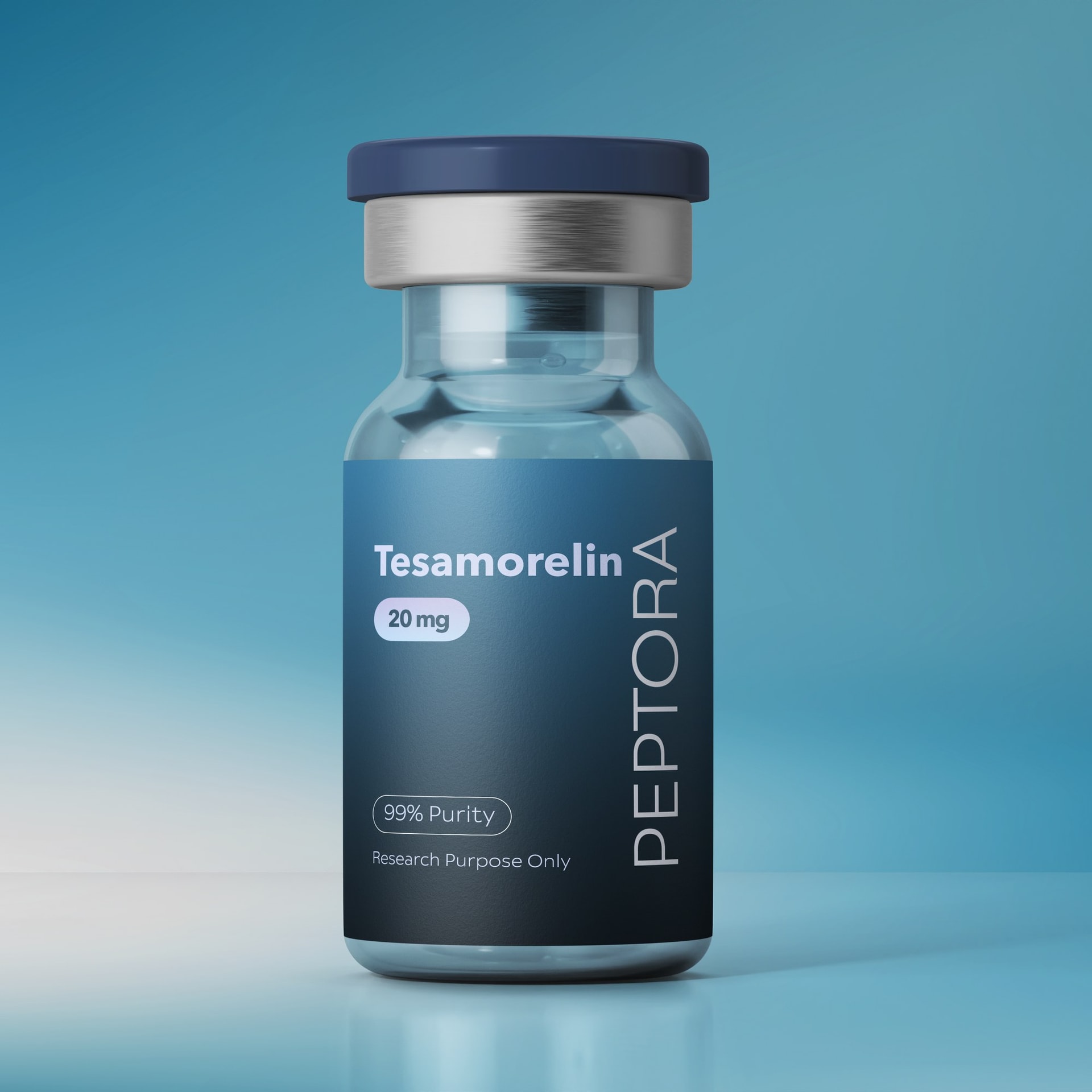

What is Tesamorelin?
Tesamorelin is a lab-made copy of a natural body signal called GHRH (growth-hormone-releasing hormone). Think of GHRH as a "go" message the brain sends to a small gland just below it — the pituitary — telling it to release some of its own growth hormone. Natural GHRH is a short chain of 44 building blocks (called amino acids). Tesamorelin keeps that whole chain but adds one small chemical part (a trans-3-hexenoyl group) that, in lab studies, makes the copy last longer before the body breaks it down. That extra staying power is the main reason scientists study Tesamorelin instead of plain GHRH.
Because it works one step before growth hormone itself — nudging the gland rather than adding hormone directly — Tesamorelin belongs to a family researchers call GHRH analogs ("analog" just means a close copy). They all fit the same docking spot, the GHRH receptor, to prompt the gland's own release. One important note up front: the version Peptora sells is a research chemical for the laboratory only. It is not a medicine, and it is not for use in people or animals.
The quick version
A copy of a body signal
Tesamorelin is a lab-made, longer-lasting copy of GHRH — the body's own "release growth hormone" message.
Growth hormone & IGF-1
Studied for how nudging the gland changes its growth-hormone output and a follow-on marker called IGF-1, in lab models.
Metabolism & fat research
Often the focus of experiments about deep belly fat and how the body handles fat.
99%+ pure
Double-checked by lab testing (HPLC + LC-MS) and shipped with a certificate for every batch — research use only.
What it's made of, and why it lasts longer
Natural GHRH is a chain of 44 building blocks (amino acids), and most of its "switch-on" power sits in the front of the chain. Tesamorelin keeps the whole 44-block chain and adds one small change that, in lab studies, helps it stay in one piece for longer:
- The full GHRH chain — Tesamorelin is built on the complete 44-block GHRH sequence, not a shortened piece of it.
- One added part — a small chemical group (called trans-3-hexenoyl) is attached to one end. In lab studies it helps the copy resist the enzymes that would normally chop it up.
- Longer staying power — that extra durability is what sets Tesamorelin apart from plain, unmodified GHRH in research.
That puts Tesamorelin among the GHRH copies researchers mention most often — a group that also includes the shorter Sermorelin piece and CJC-1295. They all fit the same docking spot; they mainly differ in how long the chain is and what changes were added to help them last.
How it works, in plain terms
What scientists study comes down to one docking spot and the chain of events it kicks off:
- The docking spot (GHRH receptor) — Tesamorelin fits the same docking spot on the gland's growth-hormone-making cells that natural GHRH uses.
- The gland's own growth hormone — in research, landing on that spot is tied to the gland releasing its own growth hormone, rather than growth hormone being added from outside.
- A follow-on signal (IGF-1) — once growth hormone is out, the liver makes a second messenger called IGF-1, which scientists often measure as a sign the system switched on.
A theme that comes up again and again: GHRH copies work early in the chain — they ask the gland to release its own growth hormone in natural bursts, while the body's normal on/off controls keep working. That's a big part of why Tesamorelin interests researchers as a tool for understanding the system.
How it compares to similar peptides
Tesamorelin is easiest to understand next to the other peptides scientists use to study growth hormone. There are two main groups: GHRH copies, which fit the GHRH docking spot, and a second type (growth-hormone secretagogues, or GHRPs), which fit a completely different docking spot:
| Compound | Group | Notes |
|---|---|---|
| Tesamorelin | GHRH copy | A longer-lasting copy of the full GHRH chain; studied for how it fits the GHRH docking spot. |
| Sermorelin | GHRH copy | A shorter piece of GHRH (the first 29 blocks) — the smallest piece that still works fully. |
| CJC-1295 | GHRH copy | A changed version of that shorter piece; some forms add a part that helps it last much longer. |
| Ipamorelin | Different type (GHRP) | Fits a separate docking spot (the ghrelin spot) — a different route, often studied alongside GHRH copies. |
The key difference is which docking spot they fit: GHRH copies (Tesamorelin, Sermorelin, CJC-1295) fit the GHRH spot, while Ipamorelin fits a separate one (the ghrelin spot). Because the two types nudge the gland by different routes, scientists often study them together — which is why Peptora offers both Tesamorelin and a Tesamorelin + Ipamorelin blend, each with its own certificate of analysis.
What scientists actually study it for
In the lab, Tesamorelin usually comes up in a few connected areas:
- Growth-hormone release — how nudging the docking spot changes the gland's own growth-hormone output, and its natural burst pattern, in lab models.
- IGF-1 signal — the follow-on IGF-1 marker scientists measure to tell the system switched on.
- Body composition — measurements in early studies, with deep belly fat (called visceral fat) a common thing to track.
- How the body handles fat — fat-handling and blood-fat measurements described in the studies.
Tesamorelin and Ipamorelin: why they're studied together
Because a GHRH copy and the other type (a GH secretagogue) fit two different docking spots, researchers often pair them to see how the two routes work together. Tesamorelin covers the GHRH-spot side; Ipamorelin covers the ghrelin-spot side. In the studies, the pair is used as a way to prompt growth-hormone release from two directions at once.
Peptora offers this pair as a ready-made Tesamorelin + Ipamorelin blend as well as standalone Tesamorelin, so a study can use whichever setup it needs. Every option is supplied for laboratory research use only.
Purity and testing (why the certificate matters)
In research, your results are only as trustworthy as the material you start with. Every batch of Tesamorelin from Peptora is checked to 99%+ purity by HPLC, confirmed by a second test (LC-MS) that proves it's the right molecule, and run through a full quality-control panel before it ships. Every order comes with a certificate of analysis (COA) for that exact batch.
That paperwork is standard here, not an add-on. To learn what the numbers on a certificate actually mean, see the guide on purity and certificates of analysis and the testing standards overview.
How it's handled in the lab
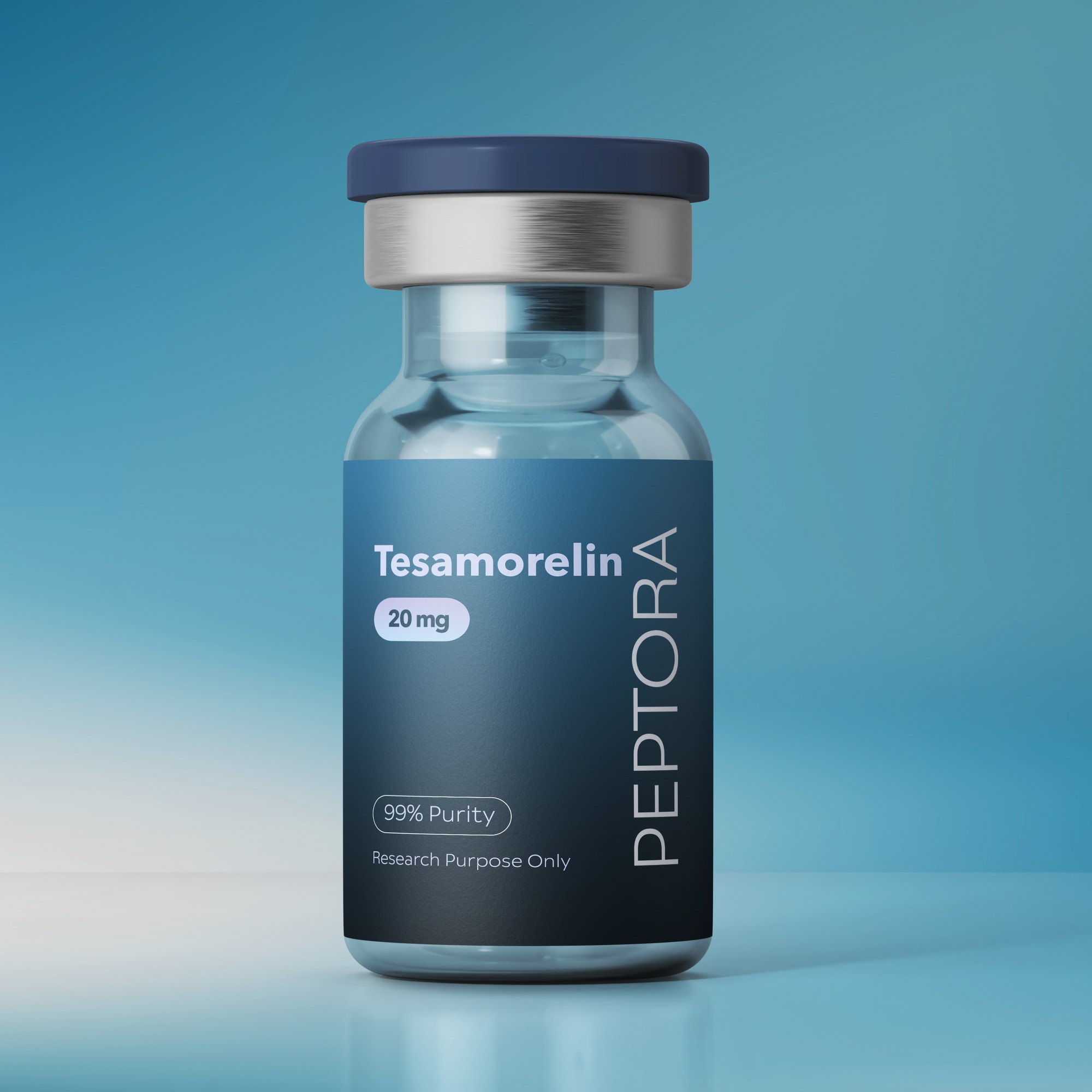
Tesamorelin ships as a freeze-dried powder in a 20 mg vial. Before it's used in research, it's mixed with bacteriostatic water — a special sterile water, sold separately. A little care keeps the peptide intact so the results stay reliable:
- 1Let the sealed vial warm up to room temperature before opening it.
- 2Add the water slowly down the side of the vial, then swirl gently — don't shake.
- 3Wait until the powder is fully dissolved before drawing anything out.
- 4Keep the mixed solution in the fridge, away from light.
Step-by-step details are in the reconstitution guide and the storage guide. Doing these the same way every time is one of the easiest ways to keep research consistent.
Scientific references
Tesamorelin (also called TH9507) is the active ingredient in an approved medicine called Egrifta, and it has been tested in human trials run by Theratechnologies and in NIH-funded university studies — first for deep belly fat in people with HIV, and later for fatty liver. The sources below are here for background, from PubMed and ClinicalTrials.gov. They describe research on the compound itself — not the laboratory research product Peptora supplies.
- 1Falutz J, et al. Metabolic effects of a growth hormone-releasing factor in patients with HIV. N Engl J Med. 2007;357(23):2359-2370. doi:10.1056/NEJMoa072375 (ClinicalTrials.gov: NCT00123253).
- 2Falutz J, et al. Effects of tesamorelin (TH9507), a growth hormone-releasing factor analog, in HIV-infected patients with excess abdominal fat: a pooled analysis of two multicenter, double-blind placebo-controlled phase 3 trials with safety extension data. J Clin Endocrinol Metab. 2010;95(9):4291-4304. doi:10.1210/jc.2010-0490.
- 3Falutz J, et al. Effects of tesamorelin, a growth hormone-releasing factor, in HIV-infected patients with abdominal fat accumulation: a randomized placebo-controlled trial with a safety extension. J Acquir Immune Defic Syndr. 2010;53(3):311-322. doi:10.1097/QAI.0b013e3181cbdaff.
- 4Stanley TL, et al. Effect of tesamorelin on visceral fat and liver fat in HIV-infected patients with abdominal fat accumulation: a randomized clinical trial. JAMA. 2014;312(4):380-389. doi:10.1001/jama.2014.8334 (NCT01263717).
- 5Stanley TL, et al. Effects of tesamorelin on non-alcoholic fatty liver disease in HIV: a randomised, double-blind, multicentre trial. Lancet HIV. 2019;6(12):e821-e830. doi:10.1016/S2352-3018(19)30338-8 (NCT02196831).
- 6Mangili A, Falutz J, Mamputu JC, et al. Predictors of treatment response to tesamorelin, a growth hormone-releasing factor analog, in HIV-infected patients with excess abdominal fat. PLoS One. 2015;10(10):e0140358. doi:10.1371/journal.pone.0140358.
Explore research-grade Tesamorelin
99%+ pure, a certificate of analysis with every batch, fast U.S. shipping — for laboratory research use only.
View TesamorelinKey takeaways
- Tesamorelin is a lab-made copy of GHRH — the body's own "release growth hormone" signal — built on the full 44-block GHRH chain with one small part added so it lasts longer.
- Scientists study how it fits the GHRH docking spot on the pituitary gland, where landing on that spot is tied to the gland releasing its own growth hormone and a follow-on signal called IGF-1.
- It's part of the GHRH-copy family alongside sermorelin and CJC-1295. Ipamorelin works a different way (a separate docking spot) and is often studied together with it.
- In research it shows up in lab models of growth-hormone release, IGF-1, body composition (including deep belly fat), and how the body handles fat — for laboratory research only.
- Peptora's Tesamorelin is a freeze-dried 20 mg powder, 99%+ pure (checked by HPLC and LC-MS) with a certificate of analysis, mixed with bacteriostatic water before it's used in the lab.
Frequently asked questions
This article is intended solely as an educational summary of publicly available scientific literature. Products offered by Peptora are supplied exclusively for laboratory research purposes and are not approved for human or veterinary use. The information presented should not be interpreted as medical advice, treatment recommendations, or clinical guidance.