
About this glossary
Here's the simple version: peptide research has its own set of words, and the same few keep coming up — in how-it-works explainers, on certificates of analysis, and across every compound guide in the Research Hub. This glossary gathers the ones you're most likely to meet and explains each in plain English, sorted into building-block words, how-it-works words, and quality-and-handling words.
Every entry is a simple, factual definition of how the word is used in science. When a word connects to a compound Peptora covers, the definition links to that guide — for example GLP-3 RT, NAD+, or GHK-Cu — so you can see the word in action.
New to research peptides?
Start with the guides that show every word in context — how things work, compound profiles, and lab standards, all written for research use only.
Explore the research guidesMolecule & structure terms
Start here: the words that describe what a peptide actually is and how it's put together. These come up in every other section, so they're the natural foundation for the rest of the glossary.
| Term | Definition |
|---|---|
| Peptide | A short chain of amino acids (the tiny building blocks of proteins) joined together. Peptides are usually chains shorter than about 50 amino acids; longer chains are called proteins. |
| Amino acid | The basic building block of peptides and proteins. There are 20 common ones, and the order you string them in is what makes each molecule unique — like letters spelling different words. |
| Peptide bond | The chemical link that joins one amino acid to the next, like a coupler between train cars. |
| Residue | A single amino acid sitting inside a chain. "Residue" is just the name for each link once it's joined to its neighbors. |
| Amino acid sequence | The exact order of amino acids in a peptide — its recipe. That order decides how the molecule folds up and behaves. |
| Peptide vs. protein | A size label, not a strict rule: short chains (roughly under 50 building blocks) are peptides, while longer, folded chains are proteins. |
| Analog (analogue) | A peptide whose recipe has been tweaked from a natural one to change how it acts — for example, to make it last longer. Think of it as a remix of the original. |
| Molecular weight (Da / kDa) | How heavy the molecule is, measured in units called daltons (Da) or kilodaltons (kDa). Bigger peptides weigh more. |
Mechanism & receptor terms
These are the how-it-works words — the ones that describe how a peptide talks to the body's signaling system in research. Four of them unlock most of the others:
Four terms that unlock the rest
Receptor
The docking spot a peptide plugs into. When it plugs in, a signal fires.
Agonist
A molecule that plugs into a receptor and switches it on, causing a response. Like a key that starts the engine.
Antagonist
A molecule that plugs into a receptor and blocks it without switching it on. Like a key that fits the lock but won't turn.
Secretagogue
A substance that tells the body to release something else, such as a hormone. (Say it "seh-KREE-tuh-gog.")
| Term | Definition |
|---|---|
| Receptor | A docking spot, usually on the surface of a cell, that a peptide plugs into to set off a response. Many research peptides are studied for which receptors they plug into. |
| Ligand | Any molecule that plugs into a receptor. A peptide acting on a receptor is one kind of ligand. |
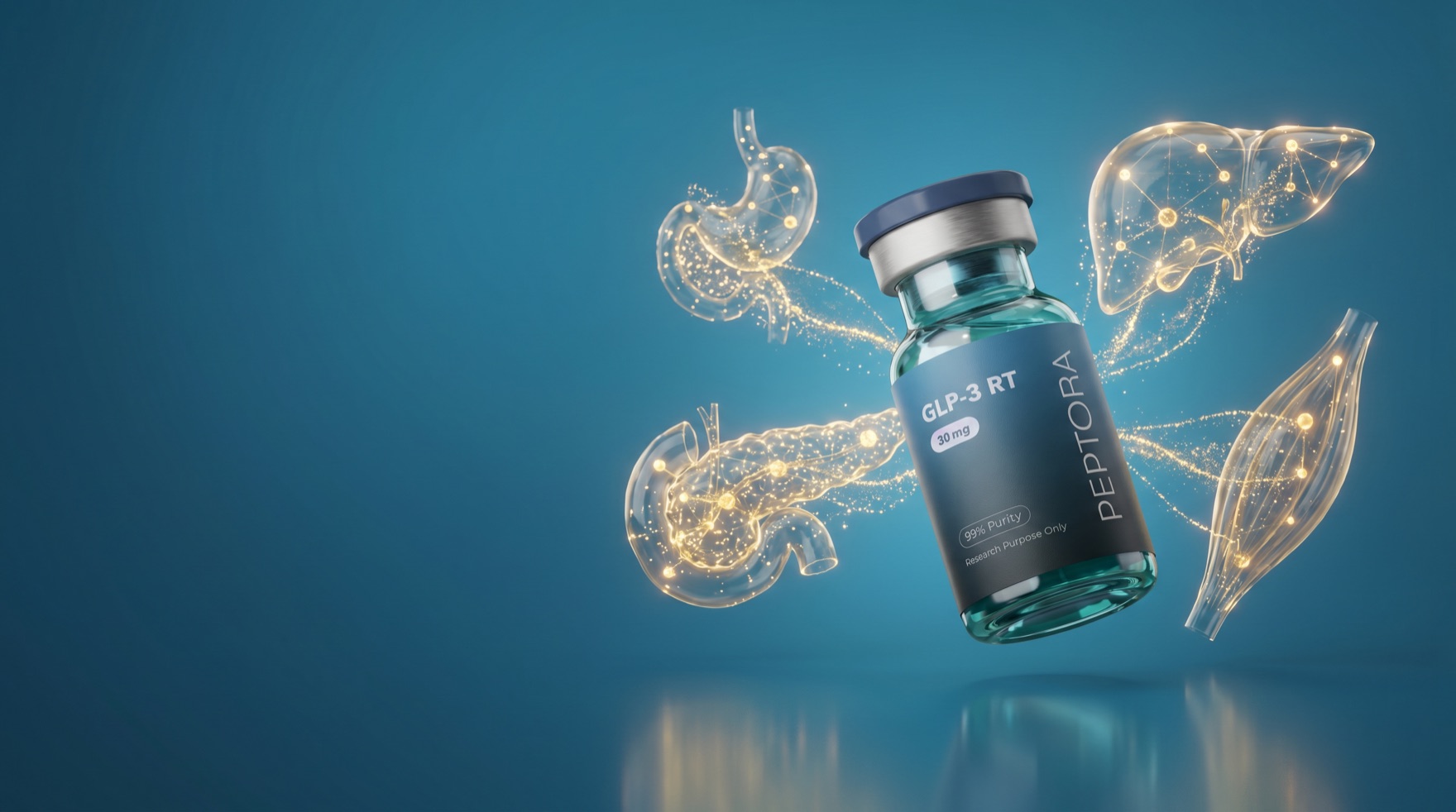
| Agonist | A molecule that plugs into a receptor and switches it on. A triple-receptor agonist like GLP-3 RT is studied for switching on three receptors at once. |
| Antagonist | A molecule that plugs into a receptor and blocks or dials it down without switching it on — the opposite of an agonist. |
| GLP-1 receptor | A receptor studied in metabolism research; it's linked to releasing insulin and to feeling full. ("GLP-1" is short for glucagon-like peptide-1.) |
| GIP receptor | The other major incretin receptor (see "incretin" below), studied in how the body handles blood sugar and fat. ("GIP" is a mouthful — glucose-dependent insulinotropic polypeptide.) |
| Glucagon receptor | A receptor tied in research to how many calories the body burns and how the liver handles sugar and fat. |
| Incretin | A group of gut hormones (mainly GLP-1 and GIP) that the gut releases after you eat. They're studied for their role in insulin, the body's blood-sugar signal. |
| Secretagogue | A substance that tells the body to release something else. For example, growth-hormone secretagogues are studied for nudging the body to release growth hormone. |
| GHRH | Growth-hormone-releasing hormone — the natural peptide that tells a gland in the brain to release growth hormone. It's the template behind remixes like Tesamorelin and Sermorelin. |
| Half-life | How long it takes for half of a peptide to be used up or broken down — a quick way to describe how long it sticks around. |
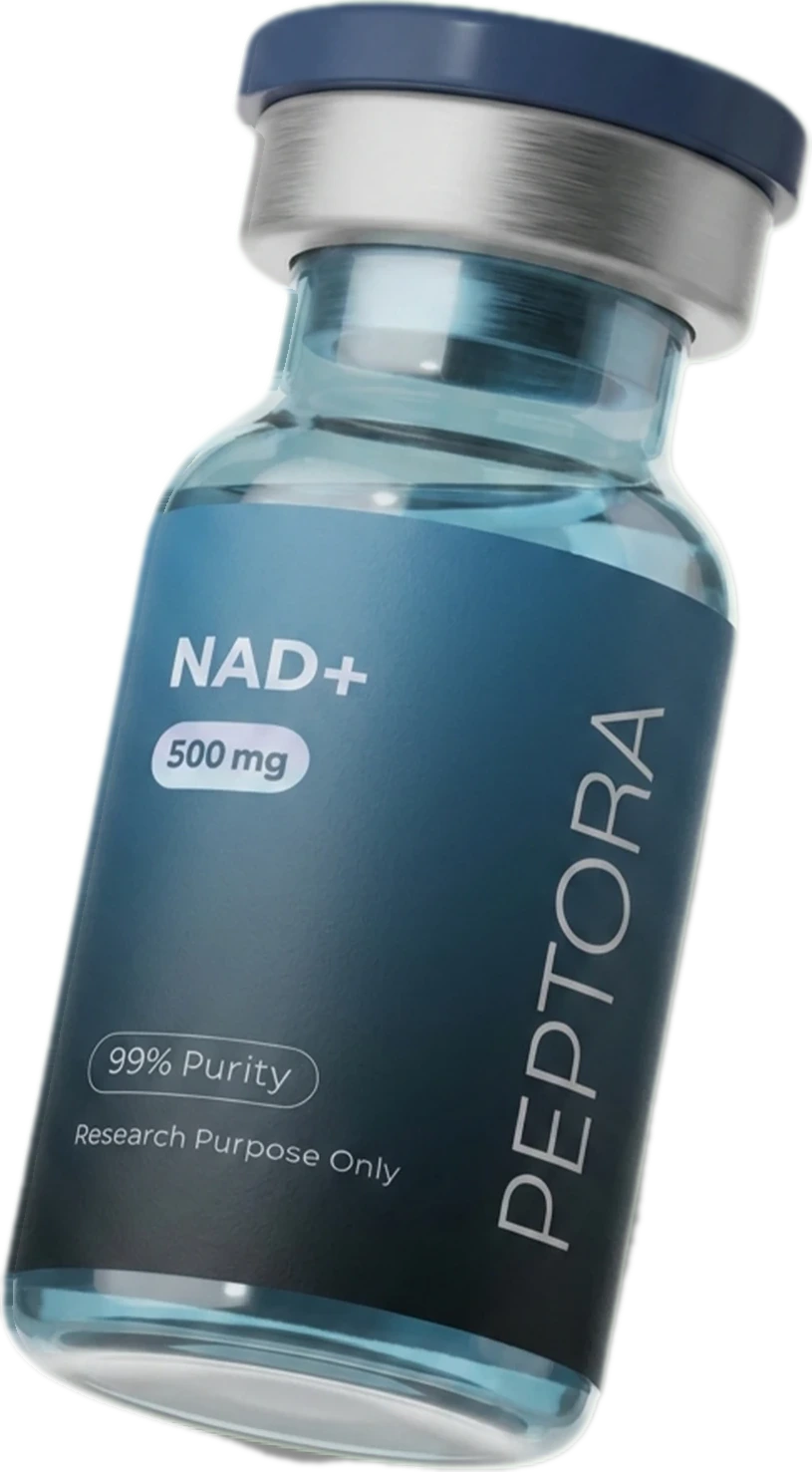
| Sirtuin | A family of enzymes (biological helpers) involved in how cells use energy, studied in aging research. They depend on NAD+ to work. |
| Bioavailability | How much of a substance actually reaches its target in a usable form. Peptides usually don't survive being swallowed, which shapes how they're studied. |
Peptide families you'll see referenced
Research peptides are often sorted into families based on what they act on or how they're built. These labels are shorthand you'll see across the compound guides:
| Term | Definition |
|---|---|
| Incretin mimetic | A peptide that copies incretin gut hormones by switching on the GLP-1 receptor (and sometimes the GIP and glucagon receptors too), like GLP-3 RT. "Mimetic" just means mimic. |
| Copper peptide | A peptide joined to a bit of copper, like GHK-Cu, studied in skin and tissue research. |
| Mitochondrial peptide | A peptide that comes from or acts on the mitochondria — the tiny power plants inside cells — such as MOTS-c or SS-31, studied in energy and metabolism research. |
| Growth-hormone secretagogue | A peptide studied for nudging the body to release growth hormone, such as Sermorelin and CJC-1295 / Ipamorelin. |
| Peptide blend | A mix of two or more peptides supplied together in one vial for research convenience. |
Quality, testing & handling terms
Finally, the words about the vial itself — how a research peptide is supplied, prepared, and checked. These are the words you'll see on a certificate of analysis and in the handling guides:
How a peptide's quality is verified
HPLC
The standard lab test for measuring how pure a peptide is — it splits the sample apart to see what's in it.
Mass spectrometry
Confirms a peptide is the right molecule by weighing it very precisely.
Certificate of analysis
The per-batch report card listing a peptide's measured purity and identity.
Purity
How much of a sample is the peptide you wanted — Peptora checks to 99%+.
| Term | Definition |
|---|---|
| Lyophilization | The science word for freeze-drying: pulling the water out of a peptide liquid to leave a stable dry powder for storage and shipping. |
| Lyophilized powder | The freeze-dried powder form that research peptides usually come in. |
| Reconstitution | The science word for mixing a freeze-dried peptide back into liquid before laboratory research use. |
| Bacteriostatic water | Water with a small amount of preservative added to stop germs. It's the usual liquid for mixing peptides in the lab. |
| HPLC | The main lab test for measuring a peptide's purity. It splits the sample into its parts so the lab can see how much is the target. (The letters stand for high-performance liquid chromatography.) |
| Mass spectrometry (LC-MS) | A lab test that confirms a peptide is the right molecule by weighing it very precisely. |
| Certificate of analysis (COA) | The per-batch report card listing a peptide's measured purity and confirmed identity. Every Peptora order ships with one. |
| Purity | How much of a sample is the peptide you wanted, as a percentage. Peptora checks its peptides to 99%+ purity. |
| Research use only (RUO) | A label meaning the material is supplied strictly for laboratory research and is not meant for people or animals. |
Further reading
For readers who want the real science behind these words, the big-picture reviews below — found on PubMed — cover how peptides are developed as medicines and how the incretin system works. They describe peptide science broadly and are here for background only.
- 1Muttenthaler M, King GF, Adams DJ, Alewood PF. Trends in peptide drug discovery. Nat Rev Drug Discov. 2021;20(4):309-325. doi:10.1038/s41573-020-00135-8 (PMID: 33536635).
- 2Lau JL, Dunn MK. Therapeutic peptides: historical perspectives, current development trends, and future directions. Bioorg Med Chem. 2018;26(10):2700-2707. doi:10.1016/j.bmc.2017.06.052 (PMID: 28720325).
- 3Drucker DJ. Mechanisms of action and therapeutic application of glucagon-like peptide-1. Cell Metab. 2018;27(4):740-756. doi:10.1016/j.cmet.2018.03.001 (PMID: 29617641).
- 4Campbell JE, Drucker DJ. Pharmacology, physiology, and mechanisms of incretin hormone action. Cell Metab. 2013;17(6):819-837. doi:10.1016/j.cmet.2013.04.008 (PMID: 23684623).
Put these terms to work
See all these words come together around one molecule in our flagship compound guide — for laboratory research use only.
Read the GLP-3 RT guideKey takeaways
- A peptide is a short chain of amino acids (the building blocks of proteins) joined together; chains longer than about 50 are called proteins.
- A receptor is the docking spot a peptide plugs into; an agonist switches it on, while an antagonist blocks it without switching it on.
- Incretins (GLP-1, GIP) and secretagogues are named for what they get the body to release — the words behind many metabolism and growth-hormone research peptides.
- Lyophilization (freeze-drying) and reconstitution (mixing back into liquid) describe how research peptides are shipped and prepared; HPLC and the weighing test (mass spectrometry) check their purity and identity.
- A certificate of analysis (COA) reports a batch's measured purity and identity, and "research use only" means the material is for laboratory research, not for people or animals.
- Every Peptora peptide is checked to 99%+ purity with a batch-specific certificate of analysis.
Frequently asked questions
This article is intended solely as an educational summary of publicly available scientific literature. Products offered by Peptora are supplied exclusively for laboratory research purposes and are not approved for human or veterinary use. The information presented should not be interpreted as medical advice, treatment recommendations, or clinical guidance.