
What is a certificate of analysis (COA)?
Here's the simple version: a certificate of analysis (COA) is a report card for one exact batch of a compound, written by a testing lab. It answers two plain questions about a research peptide — a short chain of the same building blocks that make up proteins: is this the right molecule (identity), and how much of the powder is that molecule (purity)? A COA turns a plain vial of white powder into something you can trace and trust.
The most important word here is batch-specific. Every production run — one "batch" or "lot" — is tested on its own, and its COA lists the numbers for that run alone. A good certificate has a batch or lot number that matches the label on the vial in your hand, so you can always tie the powder back to its own test results. A certificate with no batch number, or the same one reused for every order, tells you almost nothing.
The quick version
One report per batch
Each batch gets its own report card, tied to the batch number on the vial — not a generic form reused for everything.
The purity test
A test called HPLC splits the sample apart and reports how much of it is the molecule you wanted, as a percentage.
The identity test
A test that weighs the molecule confirms it's the right one by checking its weight against the weight it should be.
Research use only
A COA only describes the quality of the material. It says nothing about what the compound does, or any use in people or animals.
Every compound ships with its COA
Browse Peptora's research compounds — each one checked to 99%+ purity and shipped with its own batch-specific certificate of analysis, for laboratory research use only.
Shop HPLC-tested compoundsHow the purity test (HPLC) works
HPLC is the main test for measuring how pure a peptide is, and it's where the big purity number on most COAs comes from. (The letters stand for a mouthful — high-performance liquid chromatography — but the idea is simple: it separates things.) The powder is dissolved in liquid and pushed under high pressure through a long tube packed with fine material. Different molecules move through the tube at different speeds, so they come out one at a time instead of all at once.
As each part leaves the tube, it passes a sensor that records it. The result is a simple chart: a line with a bump (called a "peak") for each different molecule the sensor found. The molecule you want makes the biggest bump; anything else shows up as smaller bumps.
- The big bump is the molecule you want. How much of the whole chart it takes up — its share of the total — becomes the purity number (for example, 99.2%).
- The small bumps are impurities: bits of leftover material, or slightly wrong versions of the molecule, that got separated out.
- The setup matters. The lab picks the tube, the liquid, and the sensor settings so the impurities show up as their own bumps instead of hiding under the big one.
- A second test helps. Once in a while, two molecules leave the tube at the same moment and blur together. To be sure a bump is truly pure, labs often add a second, different test — such as weighing the molecule (more on that below).
How the lab proves it's the right molecule
The purity test tells you how pure a sample is, but not whether the big bump is the right molecule. That's the job of a second test that basically weighs the molecule — its formal name is mass spectrometry. It measures the molecule's weight very precisely.
Every peptide has one exact weight, set by its recipe of building blocks. So the lab compares the weight it measured to the weight the molecule should have. When the two match, the molecule is confirmed. Labs often run both tests back to back on one machine — this pairing is called LC-MS — so they check purity and identity in a single step.
- Confirming identity — the weight the lab measured matches the weight the right molecule should have.
- Spotting impurities — the weight of a small bump can show *what* the impurity is (say, a version missing one building block), not just that something is there.
- Two angles are better than one — the weighing test and the purity test answer different questions, so together they give a fuller picture than either one alone.
What "99%+ purity" actually means
When a COA says "99%+ purity," it means the purity test found that at least 99 out of every 100 parts of the powder are the molecule you wanted, and less than 1 part is anything else. It describes what the powder is made of — how clean it is — and nothing more.
Two things keep this number honest. First, the result depends on the test: a purity number only means as much as the test behind it, which is why a good COA lists exactly how the test was run. Second, "pure" is not the same as "how much is peptide." Some of the powder's weight is water and salt left over from making it. A batch can be 99%+ *pure* (almost nothing wrong is mixed in) and still have a separate number showing how much of the total weight is actually peptide. The best COAs list both.
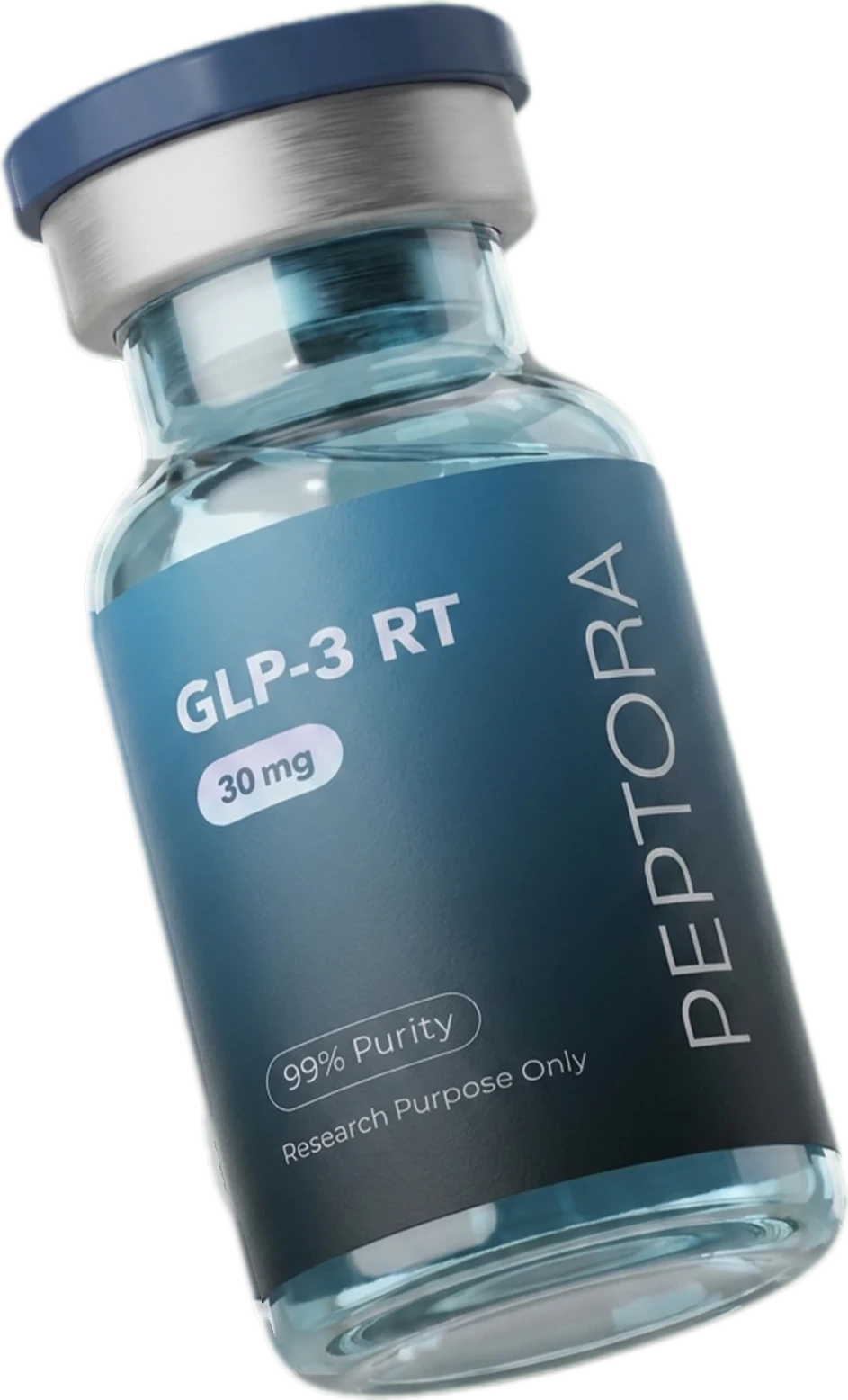
This is why the paperwork is standard here, not an extra: every compound — from GLP-3 RT to BPC-157 and TB-500 — is tested the same way and ships with its own batch-specific certificate.
How to read a certificate of analysis
Most COAs are laid out the same way. Once you know what each line means, a certificate takes only a moment to read — and the lines that are *missing* often tell you as much as the ones that are there.
| Line on the COA | What it tells you | Why it matters |
|---|---|---|
| Product / peptide name | Which compound was tested | Confirms the certificate matches what you ordered |
| Batch / lot number | A unique code for that one production run | Ties the exact vial in your hand to its own test results |
| Purity (%) | How much of the sample is the molecule you wanted | The main quality number — e.g. 99%+ |
| Identity | The molecule's measured weight vs. the weight it should be | Confirms it's the right molecule |
| Net peptide content | How much of the powder is peptide, not water or salt | Separates the total powder weight from the actual peptide |
| Appearance | e.g. white freeze-dried powder | A quick visual quality check |
| Test date / tester | When the tests were run, and by whom | Shows the paperwork is current and can be traced |
There are official groups that set the rules for this. For example, the United States Pharmacopeia (USP) publishes standard testing methods, and the International Council for Harmonisation (ICH) writes guidelines — like Q6 on specifications and Q7 on quality practices — for how identity, purity, and impurity limits should be set and written down. A research supplier's COA follows the same simple logic: say how you tested it, report the result, and tie it to one specific batch.
Scientific references
The studies below, found on PubMed, describe the lab methods behind a peptide certificate of analysis — measuring purity, confirming the molecule's identity by weight, checking for impurities, and setting quality standards. They're listed here for background:
- 1Lian Z, et al. Characterization of Synthetic Peptide Therapeutics Using Liquid Chromatography-Mass Spectrometry: Challenges, Solutions, Pitfalls, and Future Perspectives. J Am Soc Mass Spectrom. 2021;32(8):1852-1860. doi:10.1021/jasms.0c00479 (PMID: 34110145).
- 2Karongo R, et al. A selective comprehensive reversed-phase × reversed-phase 2D-liquid chromatography approach with multiple complementary detectors as an advanced generic method for the quality control of synthetic and therapeutic peptides. J Chromatogr A. 2020;1627:461430. doi:10.1016/j.chroma.2020.461430 (PMID: 32823119).
- 3Stoll DR, et al. A strategy for assessing peak purity of pharmaceutical peptides in reversed-phase chromatography methods using two-dimensional liquid chromatography coupled to mass spectrometry. J Chromatogr A. 2023;1693:463873. doi:10.1016/j.chroma.2023.463873 (PMID: 36871316).
- 4Prabhala BK, et al. Characterization of Synthetic Peptides by Mass Spectrometry. Methods Mol Biol. 2015;1348:77-82. doi:10.1007/978-1-4939-2999-3_9 (PMID: 26424265).
- 5McCarthy D, et al. Reference Standards to Support Quality of Synthetic Peptide Therapeutics. Pharm Res. 2023;40(6):1317-1328. doi:10.1007/s11095-023-03493-1 (PMID: 36949371).
- 6Hetrick EM, et al. Mass balance analysis for therapeutic peptides: case studies, applications, and perspectives. J Pharm Biomed Anal. 2024;252:116501. doi:10.1016/j.jpba.2024.116501 (PMID: 39442464).
Compare COAs across the catalog
Every Peptora research compound is checked to 99%+ purity and ships with its own batch-specific certificate of analysis — for laboratory research use only.
Browse research compoundsKey takeaways
- A certificate of analysis (COA) is a lab report card for one exact batch. It shows what the molecule is (identity) and how pure it is (purity).
- Purity is measured by a test called HPLC. It splits the sample apart, then reports how much of it is the molecule you wanted, as a percentage.
- Identity is confirmed by weighing the molecule and checking that weight against the weight it should be. Labs often run both tests together on one machine (LC-MS).
- "99%+ purity" means at least 99 of every 100 parts of the powder are the target compound. It's about how clean the material is — not what it does, or any use in people or animals.
- A COA you can trust is tied to one batch (matching the number on the vial), is dated, and names the test used. A generic, number-less, or undated certificate is a red flag.
- Every Peptora research compound is checked to 99%+ purity and ships with its own batch-specific COA, for laboratory research use only.
Frequently asked questions
This article is intended solely as an educational summary of publicly available scientific literature. Products offered by Peptora are supplied exclusively for laboratory research purposes and are not approved for human or veterinary use. The information presented should not be interpreted as medical advice, treatment recommendations, or clinical guidance.