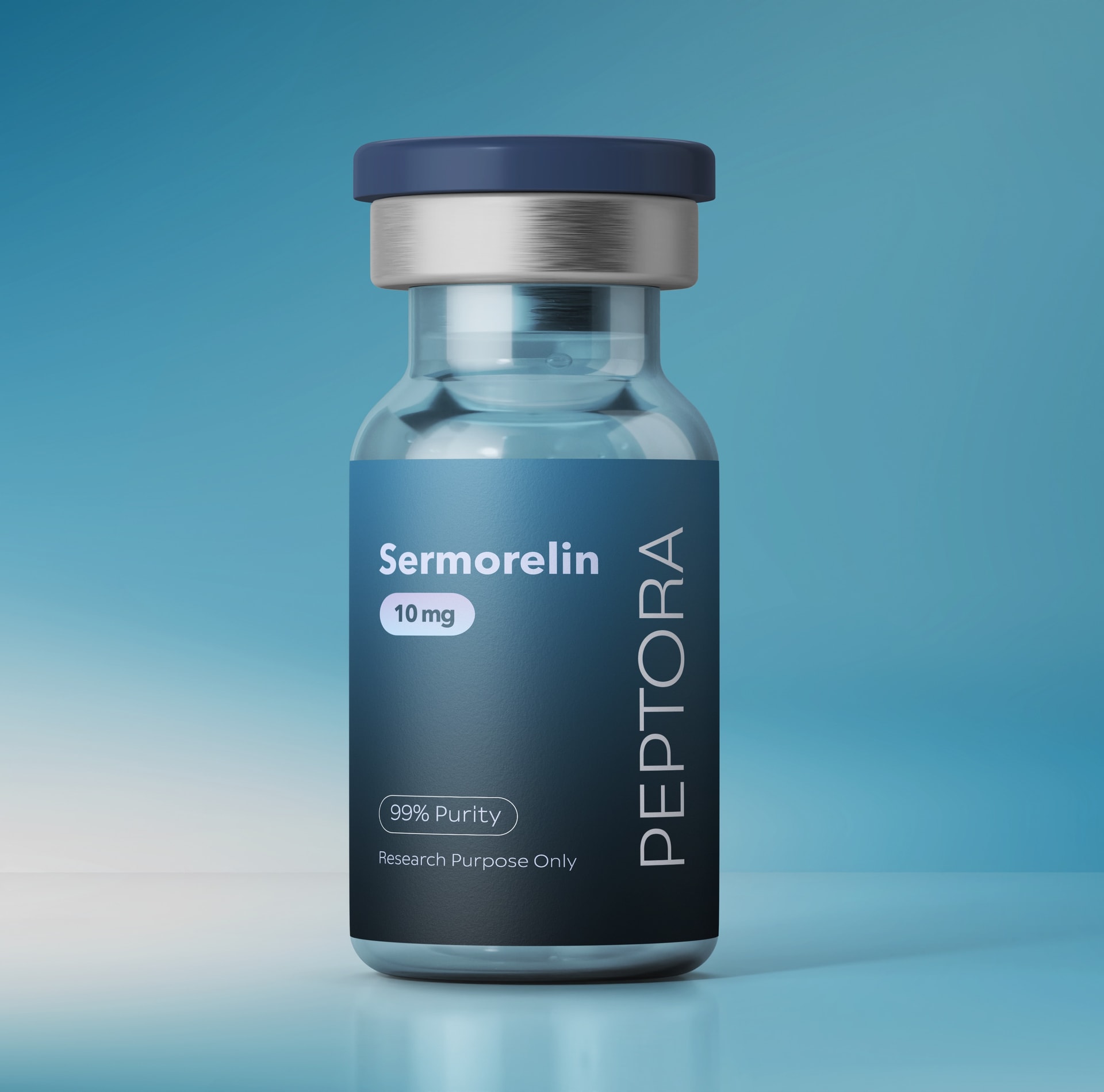

What is Sermorelin?
Sermorelin is a lab-made copy of GHRH(1–29) — the first 29 building blocks of GHRH (growth-hormone-releasing hormone), the brain's natural "go" signal that tells a small gland below it, the pituitary, to release growth hormone. Full GHRH is a chain of 44 building blocks, but almost all of its "switch-on" power sits in the front. That front piece, GHRH(1–29), is the shortest part that still does the full job — and Sermorelin is exactly that piece, made in a lab (with a small cap on one end, written GHRH(1–29)-NH2).
Because it works one step before growth hormone itself — nudging the gland rather than adding hormone directly — Sermorelin belongs to a family researchers call GHRH analogs ("analog" just means a close copy), which all fit the same docking spot, the GHRH receptor. It shares that spot with the longer-lasting full-length copy Tesamorelin and with CJC-1295. Long ago, Sermorelin was also sold as a prescription medicine (called Geref) used to check how well the growth-hormone system was working. But the version Peptora supplies is a research chemical for the laboratory only — it is not that medicine, and it is not for use in people or animals.
The quick version
The first, active piece of GHRH
Sermorelin is a lab-made copy of the first 29 building blocks of GHRH — the smallest piece that still works fully.
Fits the GHRH docking spot
Studied for how it fits the GHRH docking spot on the gland's cells to prompt its own growth-hormone release.
Growth hormone & IGF-1
Tied in research to growth hormone released in natural bursts and a follow-on marker called IGF-1.
99%+ pure
Double-checked by lab testing (HPLC + LC-MS) and shipped with a certificate for every batch — research use only.
Work with research-grade Sermorelin
The active GHRH(1–29) piece, 99%+ pure, with a certificate of analysis in every order — for laboratory research use only.
View SermorelinWhat it's made of, and why the short piece works
Full GHRH is a chain of 44 building blocks, but decades of lab work showed that almost all of its "switch-on" power sits in the front of the chain. Careful studies mapped just how much of the chain you actually need to flip the switch:
- The first 29 blocks are the working core — studies found that this front piece is the shortest part that still switches things on as fully as the whole 44-block GHRH.
- A small cap on one end (–NH2) — Sermorelin has a tiny chemical cap on one end, a feature tied in research to how well the piece fits its docking spot.
- It doesn't last long — on its own, this short piece is cleared from the body quickly. That's why later copies added parts to help them last; Sermorelin is the plain, unchanged piece.
That puts Sermorelin at the root of the GHRH-copy family: it's the small, unchanged GHRH(1–29) piece that the longer-lasting copies were later built from. The longer-lasting full-length copy Tesamorelin and the changed short-piece copy CJC-1295 both build on the same working core.
How it works, in plain terms
What scientists study comes down to one docking spot and the chain of events it kicks off:
- The docking spot (GHRH receptor) — Sermorelin fits the same docking spot on the gland's growth-hormone-making cells that natural GHRH uses.
- The gland's own growth hormone — in research, landing on that spot is tied to the gland releasing its own growth hormone, rather than growth hormone being added from outside.
- Natural bursts — the gland doesn't release growth hormone in a steady stream but in bursts, and studies have looked at how a steady GHRH signal works together with the body's own "stop" signal to shape those bursts.
- A follow-on signal (IGF-1) — once growth hormone is out, the liver makes a second messenger called IGF-1, a common marker scientists measure.
A theme that comes up again and again: GHRH copies work early in the chain — they ask the gland to release its own growth hormone, while the body's normal on/off controls (including its "stop" signal) keep working. That's a big part of why Sermorelin interests researchers as a tool for studying the growth-hormone system.
How it compares to similar peptides
Sermorelin is easiest to understand next to the other peptides scientists use to study growth hormone. There are two main groups: GHRH copies, which fit the GHRH docking spot, and a second type (growth-hormone secretagogues, or GHRPs), which fit a completely different docking spot:
| Compound | Group | Notes |
|---|---|---|
| Sermorelin | GHRH copy | The plain, unchanged GHRH(1–29) piece — the shortest piece that still works fully. |
| Tesamorelin | GHRH copy | A longer-lasting copy of the full 44-block chain, with one small part added to help it last. |
| CJC-1295 | GHRH copy | A changed version of the short piece; some forms add a part that helps it last much longer. |
| Ipamorelin | Different type (GHRP) | Fits a separate docking spot (the ghrelin spot) — a different route, often studied alongside GHRH copies. |
The key difference is which docking spot they fit: GHRH copies (Tesamorelin, Sermorelin, CJC-1295) fit the GHRH spot, while Ipamorelin fits a separate one (the ghrelin spot). Because the two types nudge the gland by different routes, scientists often study them together — which is why Peptora offers both standalone Sermorelin and ready-made GHRH-copy + secretagogue pairs such as the CJC-1295 + Ipamorelin and Tesamorelin + Ipamorelin blends, each with its own certificate of analysis.
What scientists actually study it for
In body-science studies and older medical research, GHRH(1–29) / Sermorelin has come up in a few connected areas:
- Growth-hormone release — how fitting the docking spot changes the gland's own growth-hormone output, and its natural burst pattern, in lab models and body-science studies.
- IGF-1 signal — the follow-on IGF-1 marker scientists measure to tell the system switched on.
- Checking the system — GHRH(1–29) has been used as a way to test how much growth hormone the gland can release. That's the job it did as the old medicine Geref.
- Aging & the GH system — older medical research looked at giving a GHRH(1–29) copy over a long period and tracking hormone and metabolism markers in older adults.
Two things to keep in mind. First, a lot of this is older medical research from back when Sermorelin was developed as the prescription medicine Geref — not the research-grade material Peptora supplies. Second, these are simply descriptions of published findings — they are not promises that anything works, and nothing here describes or endorses use outside controlled research.
Purity and testing (why the certificate matters)
In research, your results are only as trustworthy as the material you start with. Every batch of Sermorelin from Peptora is checked to 99%+ purity by HPLC, confirmed by a second test (LC-MS) that proves it's the right molecule, and run through a full quality-control panel before it ships. Every order comes with a certificate of analysis (COA) for that exact batch.
That paperwork is standard here, not an add-on. To learn what the numbers on a certificate actually mean, see the guide on purity and certificates of analysis and the testing standards overview.
How it's handled in the lab
Sermorelin ships as a freeze-dried powder. Before it's used in research, it's mixed with bacteriostatic water — a special sterile water, sold separately. A little care keeps the peptide intact so the results stay reliable:
- 1Let the sealed vial warm up to room temperature before opening it.
- 2Add the water slowly down the side of the vial, then swirl gently — don't shake.
- 3Wait until the powder is fully dissolved before drawing anything out.
- 4Keep the mixed solution in the fridge, away from light.
Step-by-step details are in the reconstitution guide and the storage guide. Doing these the same way every time is one of the easiest ways to keep research consistent.
Scientific references
The sources below are here for background, from PubMed. They cover body-science, chemistry, and older medical research on GHRH(1–29) / Sermorelin — not the laboratory research product Peptora supplies. It's a summary of published findings, not medical advice.
- 1Grossman A, Savage MO, Besser GM. Growth hormone releasing hormone. Clin Endocrinol Metab. 1986;15(3):607-627. doi:10.1016/s0300-595x(86)80012-3 (PMID: 2429796).
- 2Cervini LA, Donaldson CJ, Koerber SC, et al. Human growth hormone-releasing hormone hGHRH(1-29)-NH2: systematic structure-activity relationship studies. J Med Chem. 1998;41(5):717-727. doi:10.1021/jm970618s (PMID: 9513600).
- 3Wilton P, Chardet Y, Danielson B, et al. Pharmacokinetics of growth hormone-releasing hormone(1-29)-NH2 and stimulation of growth hormone secretion in healthy subjects after intravenous or intranasal administration. Acta Paediatr Suppl. 1993;388:10-15. doi:10.1111/j.1651-2227.1993.tb12827.x (PMID: 8329825).
- 4Achermann JC, Hindmarsh PC, Robinson IC, et al. The relative roles of continuous growth hormone-releasing hormone (GHRH(1-29)NH2) and intermittent somatostatin(1-14) in growth hormone (GH) pulse generation: studies in normal and post cranial irradiated individuals. Clin Endocrinol (Oxf). 1999;51(5):575-585. doi:10.1046/j.1365-2265.1999.00839.x (PMID: 10594518).
- 5Neyzi O, Yordam N, Ocal G, et al. Growth response to growth hormone-releasing hormone(1-29)-NH2 compared with growth hormone. Acta Paediatr Suppl. 1993;388:16-21. doi:10.1111/j.1651-2227.1993.tb12828.x (PMID: 8329826).
- 6Khorram O, Laughlin GA, Yen SS. Endocrine and metabolic effects of long-term administration of [Nle27]growth hormone-releasing hormone-(1-29)-NH2 in age-advanced men and women. J Clin Endocrinol Metab. 1997;82(5):1472-1479. doi:10.1210/jcem.82.5.3943 (PMID: 9141536).
- 7Ross RJ, Rodda C, Tsagarakis S, et al. Treatment of growth-hormone deficiency with growth-hormone-releasing hormone. Lancet. 1987;1(8523):5-8. doi:10.1016/s0140-6736(87)90699-4 (PMID: 2879138).
Explore research-grade Sermorelin
99%+ pure, a certificate of analysis with every batch, fast U.S. shipping — for laboratory research use only.
View SermorelinKey takeaways
- Sermorelin is a lab-made copy of the first, active part of GHRH — its first 29 building blocks — the shortest piece that still works as fully as the whole 44-block signal.
- Scientists study how it fits the GHRH docking spot on the pituitary gland, where landing on that spot is tied to the gland releasing its own growth hormone in natural bursts, plus a follow-on signal called IGF-1.
- Sermorelin is the root of the GHRH-copy family alongside tesamorelin (a longer-lasting full-length copy) and CJC-1295 (a changed short-piece copy). Ipamorelin works a different way (a separate docking spot) and is often studied together with it.
- GHRH(1–29) has a long history in body-science and medical research — including tests of how well the growth-hormone system works — and was once the prescription medicine Geref. Peptora's version is a research compound only, not that medicine.
- In research it shows up in lab models of growth-hormone release, IGF-1, natural bursts, and the aging growth-hormone system — for laboratory research only.
- Peptora's Sermorelin is a freeze-dried powder, 99%+ pure (checked by HPLC and LC-MS) with a certificate of analysis, mixed with bacteriostatic water before it's used in the lab.
Frequently asked questions
This article is intended solely as an educational summary of publicly available scientific literature. Products offered by Peptora are supplied exclusively for laboratory research purposes and are not approved for human or veterinary use. The information presented should not be interpreted as medical advice, treatment recommendations, or clinical guidance.