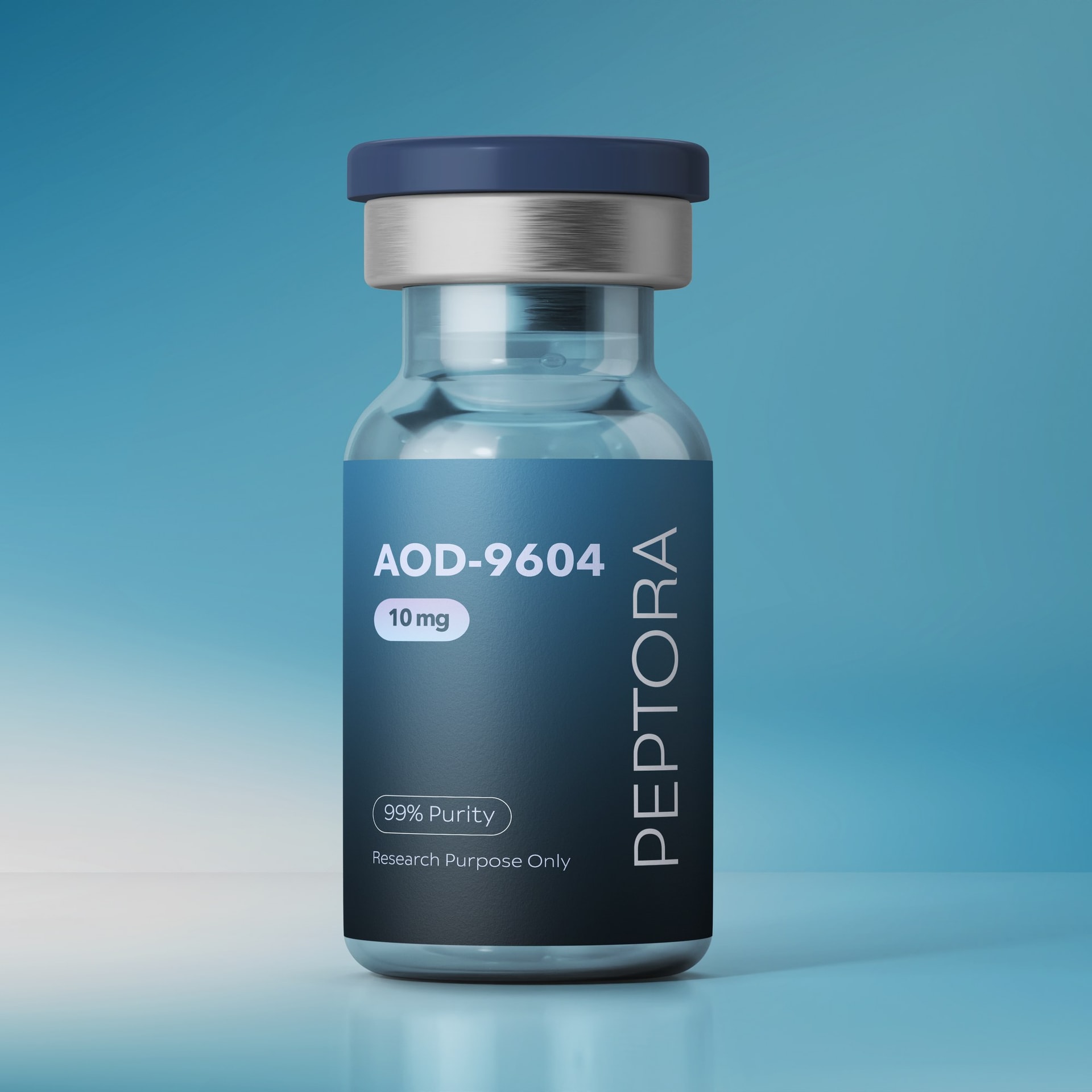


What is AOD-9604?
AOD-9604 is a peptide — a tiny protein — built to copy just the tail end of human growth hormone (hGH). The easiest way to picture it: growth hormone is like a big multi-tool with lots of jobs. AOD-9604 is only one small piece of it — the part linked to handling fat — snapped off on its own. Because of that, you'll also see it written as hGH fragment 176-191, which is just a technical way of saying "amino acids 176 through 191 of growth hormone."
One important note up front: AOD-9604 was originally developed as a possible obesity treatment, but the version Peptora sells is a research chemical for the laboratory only. It is not a medicine, and it is not for use in people or animals.
The quick version
A fragment, not the whole thing
It copies only the tail end of growth hormone — the piece tied to handling fat, not the rest.
Why it stands out
In animal studies it nudged fat metabolism without the raised blood sugar that comes with full growth hormone.
Lab use only
Studied in fat-metabolism and, more recently, cartilage experiments — never for people or animals.
Published lab results
Each lot's HPLC purity is listed on its certificate of analysis.
Explore AOD-9604
Independently lab tested, with each lot's certificate of analysis published online, fast U.S. shipping — for laboratory research use only.
View AOD-9604How it works, in plain terms
Full growth hormone does a lot of things at once — some tied to fat, some tied to blood sugar, some tied to cell growth. Researchers noticed that the very end of the hormone seemed to carry the fat job on its own. AOD-9604 is that end piece, made in a lab. Here's the plain-English version of what studies have described:
- Lipolysis — a word that just means "breaking fat down." In animal studies, AOD-9604 was tied to more fat being broken down and burned for energy.
- No blood-sugar spike — unlike full growth hormone, the fragment did not raise blood sugar or blunt insulin in those studies, which is a big part of why scientists found it interesting.
- Not through the growth-hormone receptor — a receptor is a docking spot on a cell. Lab work suggested AOD-9604 does not dock onto the usual growth-hormone receptor, so it doesn't drive cell growth the way the full hormone can.
How it differs from full growth hormone
The simplest way to place AOD-9604 is to line it up next to the full hormone it was copied from. The whole point of using a fragment is to keep one job and leave the others behind:
| What it does in studies | Full hGH | AOD-9604 |
|---|---|---|
| Tied to fat breakdown | Yes | Yes |
| Raises blood sugar | Often | Not observed |
| Docks on the growth-hormone receptor | Yes | No |
| Drives cell growth | Yes | Not observed |
| Size | The whole hormone | Just the tail end (16 amino acids) |
Peptora also carries other compounds studied in the growth-hormone and metabolism space, including Tesamorelin, Sermorelin, and IGF-1 LR3 — each with its own certificate of analysis.
What scientists actually study it for
In the lab, AOD-9604 usually comes up in a few connected areas:
- Fat metabolism — how the fragment changes the way cells break down and burn fat, mostly in cell and animal studies.
- Body weight in animal models — early studies in obese mice and rats measured changes in weight gain and body fat.
- Analytical science — because it once reached human trials, labs also study how to detect it, which is why it shows up in sports-testing method papers.
Purity and testing (why the certificate matters)
In research, your results are only as trustworthy as the material you start with. Peptora's AOD-9604 lots are tested for purity by HPLC (a technique that separates out any impurities) at an independent lab, with a second test (mass spectrometry) to confirm it's the right molecule. Each lot's results are published online as a certificate of analysis (COA).
That paperwork is standard here, not an add-on. To learn what the numbers on a certificate actually mean, see the guide on what a certificate of analysis is.
How it's handled in the lab
AOD-9604 ships as a lyophilized (freeze-dried) powder. Before it's used in research, it's reconstituted — mixed with bacteriostatic water, a special sterile water sold separately. A little care keeps the peptide intact so results stay reliable:
- 1Let the sealed vial warm up to room temperature before opening it.
- 2Add the water slowly down the side of the vial, then swirl gently — don't shake.
- 3Wait until the powder is fully dissolved before drawing anything out.
- 4Keep the mixed solution in the fridge, away from light.
Step-by-step details are in the reconstitution guide. Doing these the same way every time is one of the easiest ways to keep research consistent.
Scientific references
AOD-9604 (also called human growth hormone fragment 176-191) was first characterized by researchers at Monash University in Australia and later developed by Metabolic Pharmaceuticals. The studies below are here for background, from PubMed. They describe research on the compound itself — not the laboratory research product Peptora supplies.
- 1Ng FM, et al. Metabolic studies of a synthetic lipolytic domain (AOD9604) of human growth hormone. Horm Res. 2000;53(6):274-278. doi:10.1159/000053183.
- 2Heffernan MA, et al. Increase of fat oxidation and weight loss in obese mice caused by chronic treatment with human growth hormone or a modified C-terminal fragment. Int J Obes Relat Metab Disord. 2001;25(10):1442-1449. doi:10.1038/sj.ijo.0801740.
- 3Heffernan M, et al. The effects of human GH and its lipolytic fragment (AOD9604) on lipid metabolism following chronic treatment in obese mice and beta(3)-AR knock-out mice. Endocrinology. 2001;142(12):5182-5189. doi:10.1210/endo.142.12.8522.
- 4Orlovius AK, et al. AOD-9604 does not influence the WADA hGH isoform immunoassay. Drug Test Anal. 2013;5(11-12):850-852. doi:10.1002/dta.1557.
- 5Thevis M, Schänzer W. Analytical approaches for the detection of emerging therapeutics and non-approved drugs in human doping controls. J Pharm Biomed Anal. 2014;101:66-83. doi:10.1016/j.jpba.2014.05.020.
Explore AOD-9604
Independently lab tested, with each lot's certificate of analysis published online, fast U.S. shipping — for laboratory research use only.
View AOD-9604Key takeaways
- AOD-9604 is a small peptide that copies only the tail end (fragment 176-191) of human growth hormone — the part tied to handling fat.
- In animal studies it was linked to more fat being broken down and burned, but without the raised blood sugar seen with full growth hormone.
- Lab work suggests it does not dock on the growth-hormone receptor, so it doesn't drive cell growth the way the full hormone can.
- It shows up in research on fat metabolism, body weight in animal models, and — more recently — cartilage repair. It's for laboratory research only, not a medicine, and not for people or animals.
- Lots are tested by an independent lab (HPLC, LC-MS), and each lot's results are published online as a certificate of analysis.
Frequently asked questions
This article is intended solely as an educational summary of publicly available scientific literature. Products offered by Peptora are supplied exclusively for laboratory research purposes and are not approved for human or veterinary use. The information presented should not be interpreted as medical advice, treatment recommendations, or clinical guidance.