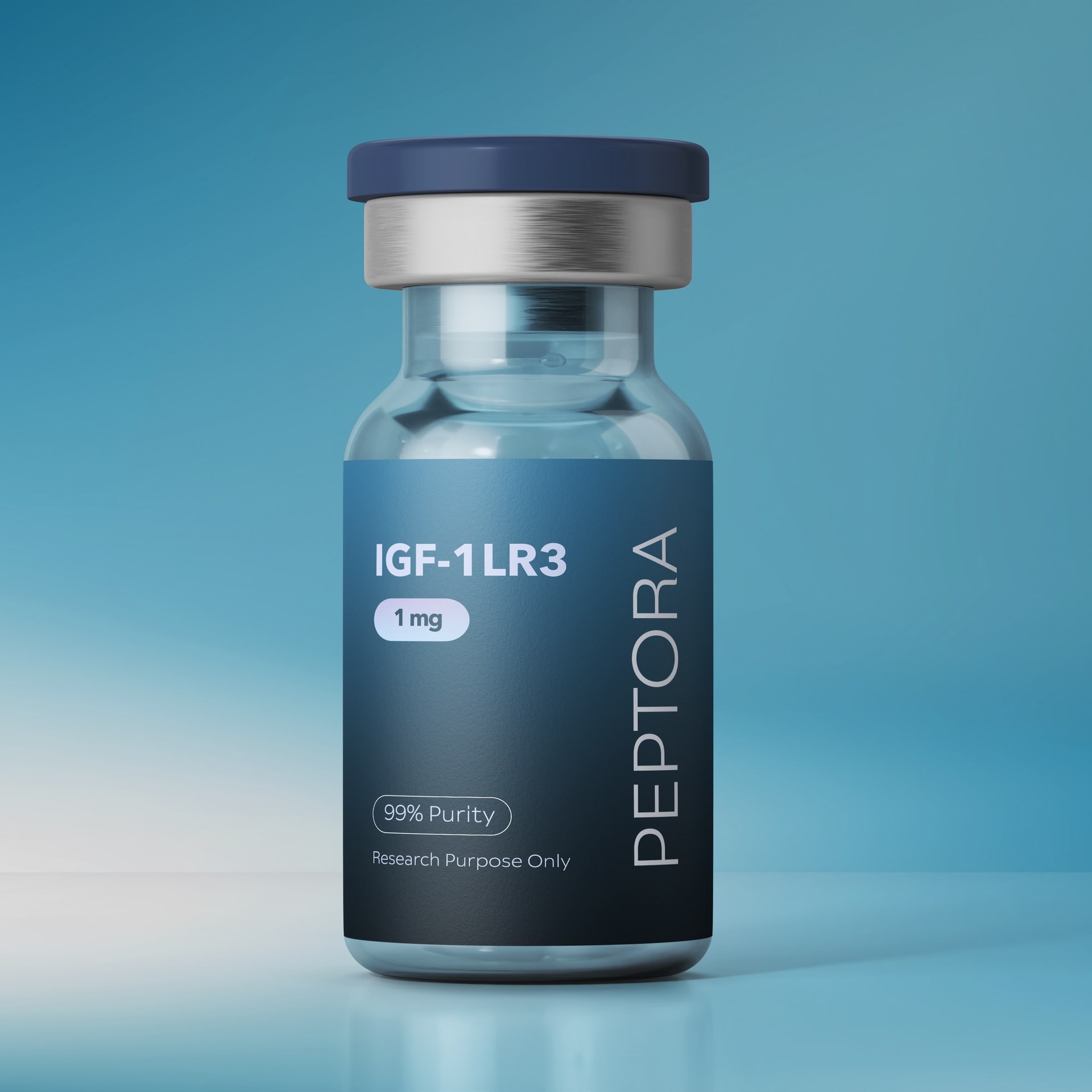


What is IGF-1 LR3 (Long R3 IGF-1)?
IGF-1 LR3, also written Long R3 IGF-1, is a lab-tweaked copy of IGF-1 (short for insulin-like growth factor 1). IGF-1 is a natural "grow" signal the body makes — it carries out many of the growth jobs that growth hormone kicks off. The copy is different from natural IGF-1 in two small ways: one building block (at spot 3) is swapped for another one called arginine, and 13 extra building blocks are added to one end (that's the "Long" part). Together, these changes make it much harder for the sticky proteins that normally grab IGF-1 (called IGF-binding proteins, or IGFBPs) to hold onto it.
In the body, most IGF-1 is stuck to those sticky proteins, so only a small, free part is actually working at any moment. Because IGF-1 LR3 slips past them, it stays free and active longer in lab models — which is also why it's a common ingredient added to cells grown in a dish for research. In this guide, it's talked about only as a research material. It is meant only for laboratory use and is not a medicine — not for people or animals.
The quick version
A lab-tweaked IGF-1
Natural IGF-1 with one building block swapped and 13 extra ones added to one end (Long R3).
Slips past its handlers
It dodges the sticky proteins (IGFBPs) that hold IGF-1 back, so more stays free in research models.
Research use only
Studied in growth, cell-multiplying, and muscle models — never for people or animals.
Published lab results
Each lot's HPLC purity is listed on its certificate of analysis.
Explore IGF-1 LR3
Independently lab tested, with each lot's certificate of analysis published online, fast U.S. shipping — for laboratory research use only.
View IGF-1 LR3How it works, in plain terms
IGF-1 LR3 is studied along the same signal path as natural IGF-1 — the big difference is that the sticky proteins can't grab it as easily. Here's how research describes that path:
- The IGF-1 docking spot (IGF-1R) — IGF-1 and its copies plug into this docking spot on the cell, which kicks off the growth signal.
- The inside-the-cell signal chain (PI3K/Akt/mTOR) — once the docking spot is switched on, it sets off a chain of signals that research ties to building proteins and growing cells.
- The sticky handler proteins (IGFBPs) — natural IGF-1 gets grabbed and held back by these; the Long R3 changes make it harder to grab, so more of the copy stays free in lab models.
Slipping past those handler proteins is the main thing that sets IGF-1 LR3 apart from natural IGF-1 in research. It's also why scientists reach for it when a model needs a steadier or stronger IGF-1 signal.
How it compares to natural IGF-1 and its variations
The clearest way to place IGF-1 LR3 is next to natural IGF-1 and the natural variations of IGF-1 that scientists mention most:
| Form | What's different | Grabbed by handler proteins? | How research uses it |
|---|---|---|---|
| IGF-1 LR3 (Long R3) | Swapped + 13 extra building blocks | Barely | Longer-lasting copy / cells-in-a-dish ingredient |
| Natural IGF-1 | The body's own version | A lot | The reference "grow" signal |
| IGF-1Ea / IGF-1Ec (MGF) | Natural variations | Varies | Local muscle-repair signals |
Peptora carries IGF-1 LR3, each with its own certificate of analysis. Researchers looking at the wider growth-hormone system may also want the guides on Sermorelin, CJC-1295 + Ipamorelin, and Tesamorelin.
What scientists actually study it for
In the lab, IGF-1 and its copies usually come up in a few connected areas:
- How cells multiply — IGF-1 and IGF-1 LR3 have been used to study how cells in a dish make copies of themselves, including how different amounts change the result.
- Muscle biology — research has looked at IGF-1 signals in how muscle builds protein, grows bigger, and wastes away.
- Muscle-repair models — natural variations of IGF-1 and "muscle stem cells" have been studied in tissue-repair models.
- Growth-signal paths — the IGF-1 docking spot and the signal chain it sets off (PI3K/Akt) are studied as possible ways it works.
Purity and testing (why the certificate matters)
In research, your results are only as trustworthy as the material you start with. Peptora's IGF-1 LR3 lots are tested for purity by HPLC at an independent lab, with LC-MS as a second test to confirm it's the right molecule. Each lot's results are published online as a certificate of analysis (COA), so you can match the material to its paperwork by lot number.
That paperwork is standard here, not an add-on. To learn what the numbers on a certificate actually mean, see the guide on the certificate of analysis.
How it's handled in the lab
IGF-1 LR3 ships as a freeze-dried powder. Before it's used in research, it's mixed with bacteriostatic water — a special sterile water, sold separately. It's a larger, more delicate molecule than most peptides, so a gentle touch matters:
- 1Let the sealed vial warm up to room temperature before opening it.
- 2Add the water slowly down the side of the vial, then swirl gently — don't shake or spin it hard.
- 3Wait until the powder is fully dissolved before drawing anything out.
- 4Keep the mixed solution in the fridge, away from light.
Step-by-step details are in the reconstitution guide. Doing these the same way every time is one of the easiest ways to keep research consistent.
Scientific references
IGF-1 and the Long R3 copy have been studied for decades — in cells, in animals, and in human body research. The studies listed below are here for background, from PubMed. They describe research on IGF-1 and its copies — not the laboratory research product Peptora supplies.
- 1Yoshida T, Delafontaine P. Mechanisms of IGF-1-Mediated Regulation of Skeletal Muscle Hypertrophy and Atrophy. Cells. 2020;9(9):1970. doi:10.3390/cells9091970.
- 2Philippou A, Barton ER. Optimizing IGF-I for skeletal muscle therapeutics. Growth Horm IGF Res. 2014;24(5):157-163. doi:10.1016/j.ghir.2014.06.003.
- 3Hill M, Goldspink G. Expression and splicing of the insulin-like growth factor gene in rodent muscle is associated with muscle satellite (stem) cell activation following local tissue damage. J Physiol. 2003;549(Pt 2):409-418. doi:10.1113/jphysiol.2002.035832.
- 4Velloso CP, Harridge SDR. Insulin-like growth factor-I E peptides: implications for aging skeletal muscle. Scand J Med Sci Sports. 2010;20(1):20-27. doi:10.1111/j.1600-0838.2009.00997.x.
- 5Khamsi F, Roberge S. Differential effects of insulin-like growth factor-I and gonadotropins on the proliferative activity of two subgroups of granulosa cells (using the LR3-IGF-I analogue). Fertil Steril. 2001;75(5):997-1003. doi:10.1016/s0015-0282%2801%2901695-8.
- 6Khamsi F, Armstrong DT. Interactions between follicle-stimulating hormone and growth factors in regulation of DNA synthesis in bovine granulosa cells (comparing long arg3-IGF-I). Biol Reprod. 1997;57(3):684-688. doi:10.1095/biolreprod57.3.684.
Explore IGF-1 LR3
Independently lab tested, with each lot's certificate of analysis published online, fast U.S. shipping — for laboratory research use only.
View IGF-1 LR3Key takeaways
- IGF-1 LR3 (Long R3 IGF-1) is a lab-tweaked copy of IGF-1, with one building block swapped and 13 extra ones added to one end.
- Those changes let it slip past the sticky proteins that normally grab IGF-1, so it stays free and active longer.
- It signals through the IGF-1 docking spot and the PI3K/Akt/mTOR chain, studied in how-cells-multiply, growth, and muscle models.
- Most of the work on the LR3 copy specifically is early lab research, including its common use as an ingredient for cells grown in a dish.
- Peptora's IGF-1 LR3 is independently lab tested, with each lot's certificate of analysis published online, supplied for research use only.
Frequently asked questions
This article is intended solely as an educational summary of publicly available scientific literature. Products offered by Peptora are supplied exclusively for laboratory research purposes and are not approved for human or veterinary use. The information presented should not be interpreted as medical advice, treatment recommendations, or clinical guidance.