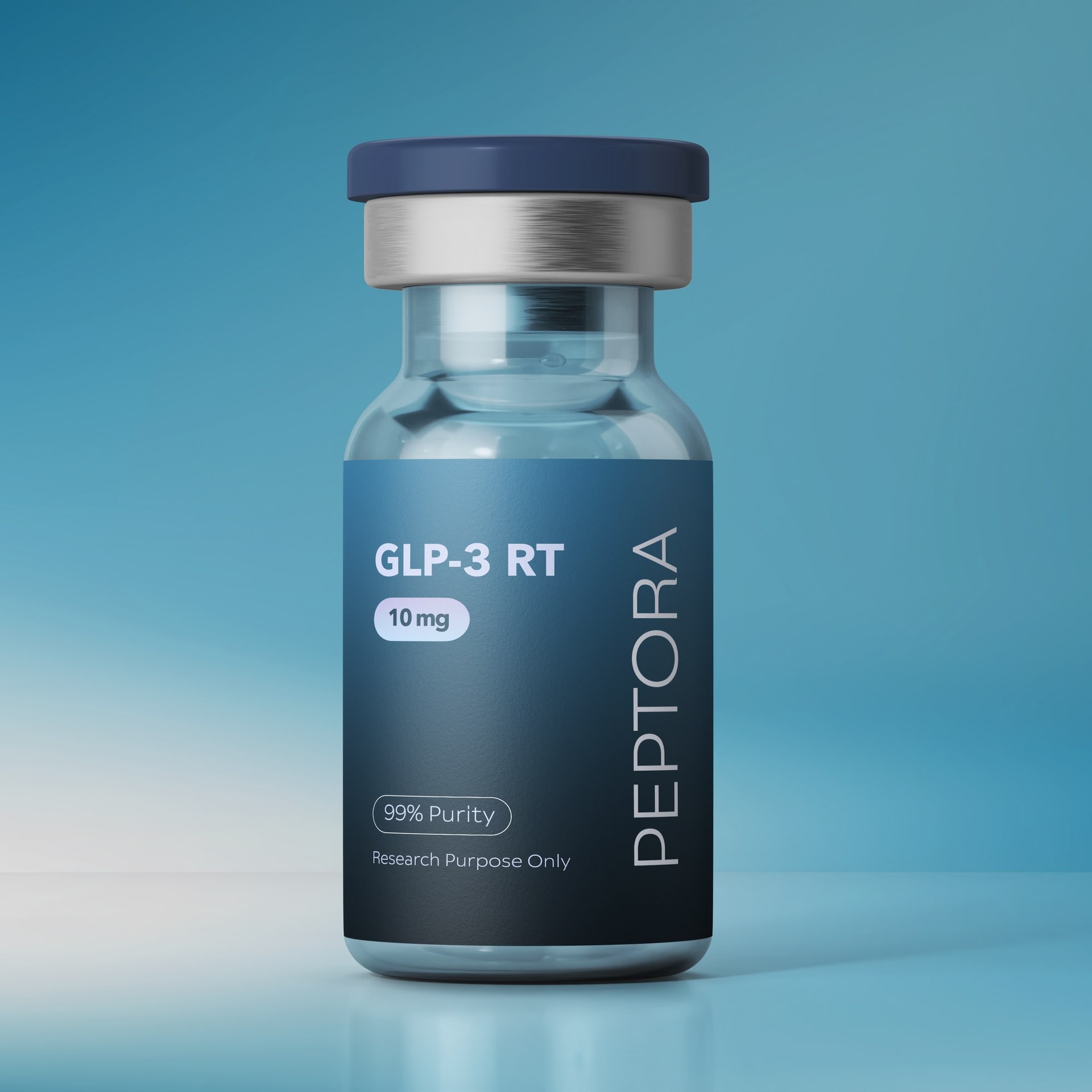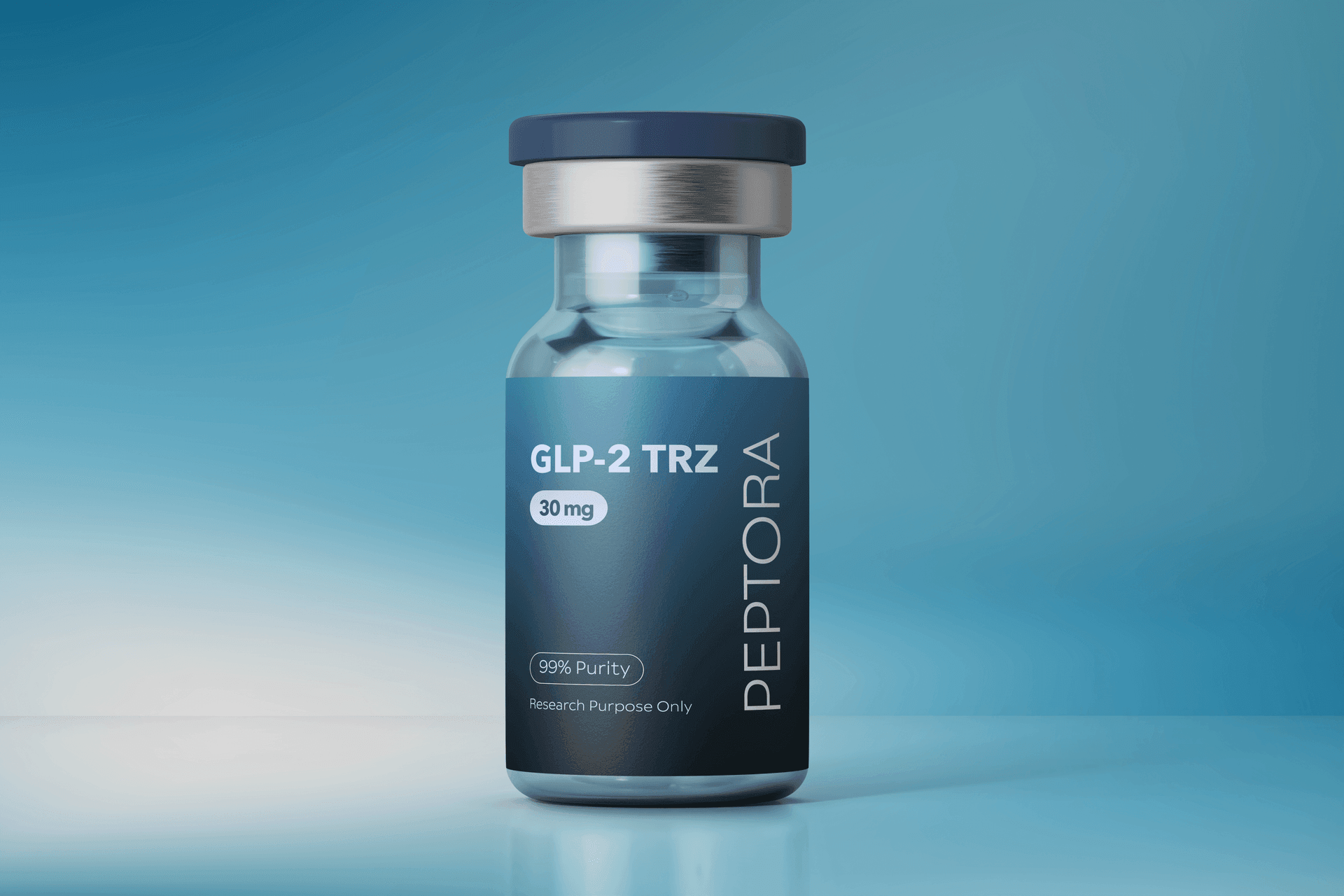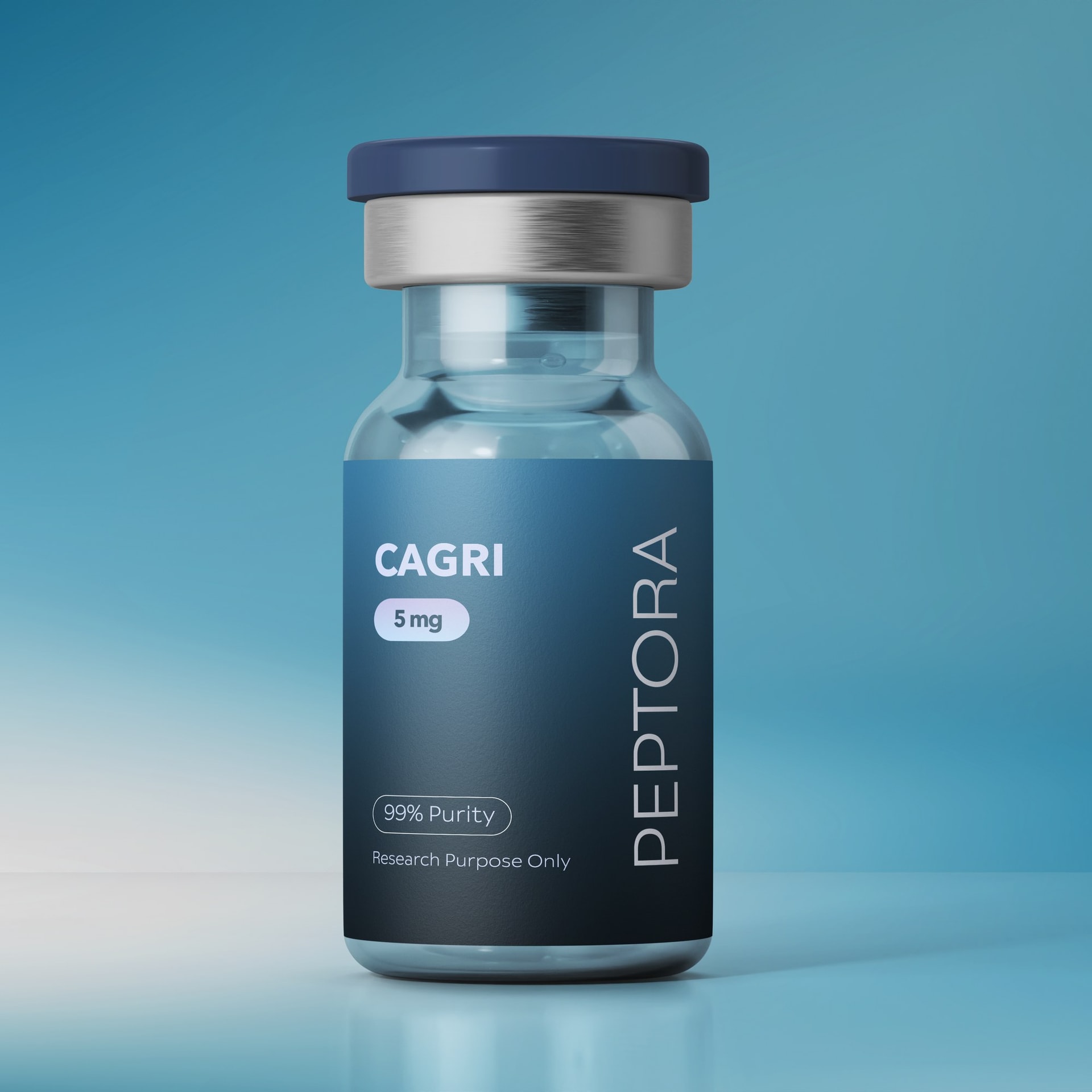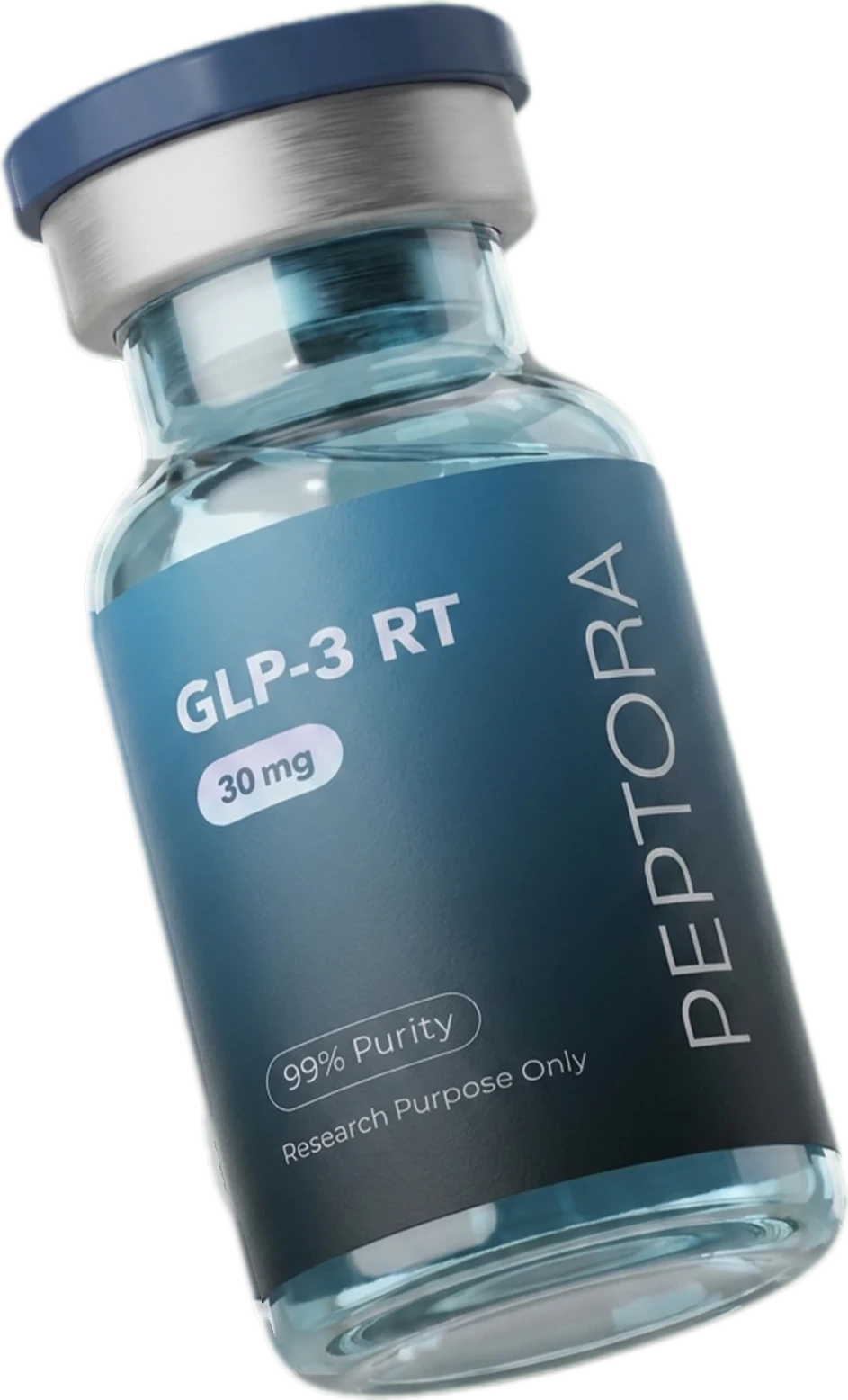
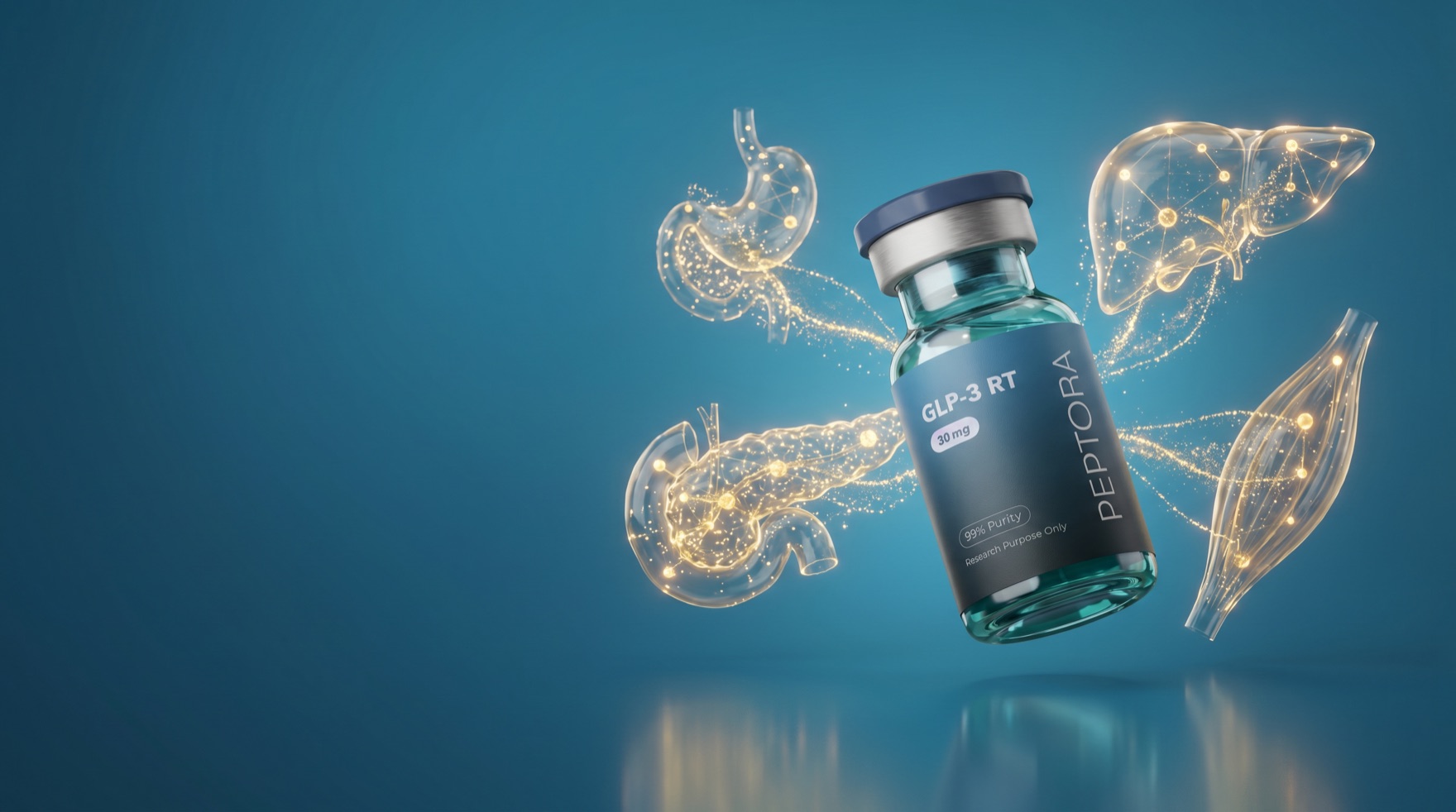
What is GLP-3 RT?
GLP-3 RT is a triple-receptor research compound. The easiest way to picture it: the body has a few "switches" that help control blood sugar, hunger, and how much energy it burns. Most compounds in this family flip just one of those switches. A few newer ones flip two. GLP-3 RT flips three at once — and that's the whole reason scientists find it so interesting to study. Because of that, you'll see it called a triple-receptor agonist, which is just a technical way of saying "one molecule, three switches."
One important note up front: the underlying compound (development code LY3437943) is being tested in human clinical trials as a possible future medicine. But the version Peptora sells is a research chemical for the laboratory only. It is not that medicine, and it is not for use in people or animals.
The quick version
Three switches, one molecule
It turns on the GLP-1, GIP, and glucagon signals all at the same time.
Why it stands out
Older compounds flip one or two switches. This one adds a third — the glucagon receptor, tied in research to energy expenditure — which is what makes it different.
Lab use only
Studied in metabolism, appetite, and body-weight experiments — never for people or animals.
99%+ pure
Double-checked by lab testing (HPLC + LC-MS) and shipped with a certificate for every batch.
How it works, in plain terms
The three "switches" GLP-3 RT flips are all part of how the body handles food and energy. Here's what each one does, in everyday language:
- GLP-1 — helps the body release insulin, slows down how fast the stomach empties, and is tied to feeling full.
- GIP — another "a meal is coming" signal, linked to insulin and to how the body handles fat.
- Glucagon — connected to how many calories the body burns and how the liver deals with sugar and fat.
Older compounds use just one or two of these signals. GLP-3 RT uses all three — and that third one (glucagon) is the one tied in research to energy expenditure. That extra angle is the main reason scientists study it as its own kind of tool, separate from the one- and two-switch compounds.
How it compares to similar compounds
The simplest way to place GLP-3 RT next to the others is by counting how many switches each one flips. These are the compounds scientists bring up most often:
| Compound | GLP-1 | GIP | Glucagon | How many switches |
|---|---|---|---|---|
| GLP-3 RT | ✓ | ✓ | ✓ | Three (triple) |
| TRZ (GLP-2 TRZ) | ✓ | ✓ | — | Two (dual) |
| SEMA | ✓ | — | — | One (single) |
| Cagrilintide (CAGRI) | — | — | — | A different family (amylin) |
Peptora carries research-grade versions of several of these, including GLP-3 RT, TRZ (GLP-2 TRZ), and Cagrilintide (CAGRI) — each one with its own certificate of analysis.
What scientists actually study it for
In the lab, GLP-3 RT usually comes up in a few connected areas:
- Metabolism — how flipping all three switches at once changes the way cells handle sugar and fat (in lab models).
- Appetite — the "feeling full" signals that these switches are tied to.
- Body weight — weight and body-composition measurements in early (animal and cell) studies.
- Energy expenditure — the glucagon switch, which is the piece that sets triple compounds apart from the one- and two-switch ones.
Purity and testing (why the certificate matters)
In research, your results are only as trustworthy as the material you start with. Every batch of GLP-3 RT from Peptora is checked to 99%+ purity by HPLC, confirmed by a second test (LC-MS) that proves it's the right molecule, and run through a full quality-control panel before it ships. Every order comes with a certificate of analysis (COA) for that exact batch.
That paperwork is standard here, not an add-on. To learn what the numbers on a certificate actually mean, see the guide on purity and certificates of analysis and the testing standards overview.
How it's handled in the lab
GLP-3 RT ships as a freeze-dried powder. Before it's used in research, it's mixed with bacteriostatic water — a special sterile water, sold separately. A little care keeps the peptide intact so the results stay reliable:
- 1Let the sealed vial warm up to room temperature before opening it.
- 2Add the water slowly down the side of the vial, then swirl gently — don't shake.
- 3Wait until the powder is fully dissolved before drawing anything out.
- 4Keep the mixed solution in the fridge, away from light.
Step-by-step details are in the reconstitution guide and the storage guide. Doing these the same way every time is one of the easiest ways to keep research consistent.
Scientific references
The underlying compound (development code LY3437943) has been tested in human clinical trials — early (phase 2) results are published, and a larger phase 3 program (called TRIUMPH) is underway. The studies listed below are here for background, from PubMed and ClinicalTrials.gov. They describe research on the compound itself — not the laboratory research product Peptora supplies.
- 1Jastreboff AM, et al. N Engl J Med. 2023;389(6):514-526. doi:10.1056/NEJMoa2301972 (ClinicalTrials.gov: NCT04881760).
- 2Rosenstock J, et al. Lancet. 2023;402(10401):529-544. doi:10.1016/S0140-6736(23)01053-X (NCT04867785).
- 3Sanyal AJ, et al. Nat Med. 2024;30(7):2037-2048. doi:10.1038/s41591-024-03018-2 (NCT04881760).
- 4Tewari J, et al. Expert Rev Clin Pharmacol. 2025;18(1-2):51-66. doi:10.1080/17512433.2025.2450254.
- 5Abdul-Rahman T, et al. Eur J Pharmacol. 2024;985:177095. doi:10.1016/j.ejphar.2024.177095.
- 6Katsi V, et al. Biomolecules. 2025;15(6):796. doi:10.3390/biom15060796.
- 7Phase 3 TRIUMPH clinical programme — e.g. NCT05882045, NCT06354660, NCT06260722.
Explore research-grade GLP-3 RT
99%+ pure, a certificate of analysis with every batch, fast U.S. shipping — for laboratory research use only.
View GLP-3 RTKey takeaways
- GLP-3 RT is one molecule that flips three of the body's metabolism "switches" (GLP-1, GIP, and glucagon) at the same time.
- Most similar compounds flip only one or two switches. The third one, glucagon, is tied to how much energy the body burns — and that's the main reason scientists study it.
- It shows up in lab research on metabolism, appetite, and body weight. It's for laboratory research only — not a medicine, and not for people or animals.
- Every batch is 99%+ pure (checked by HPLC and LC-MS) and comes with a certificate of analysis.
- It ships as a freeze-dried powder and is mixed with bacteriostatic water before it's used in the lab.
Frequently asked questions
This article is intended solely as an educational summary of publicly available scientific literature. Products offered by Peptora are supplied exclusively for laboratory research purposes and are not approved for human or veterinary use. The information presented should not be interpreted as medical advice, treatment recommendations, or clinical guidance.