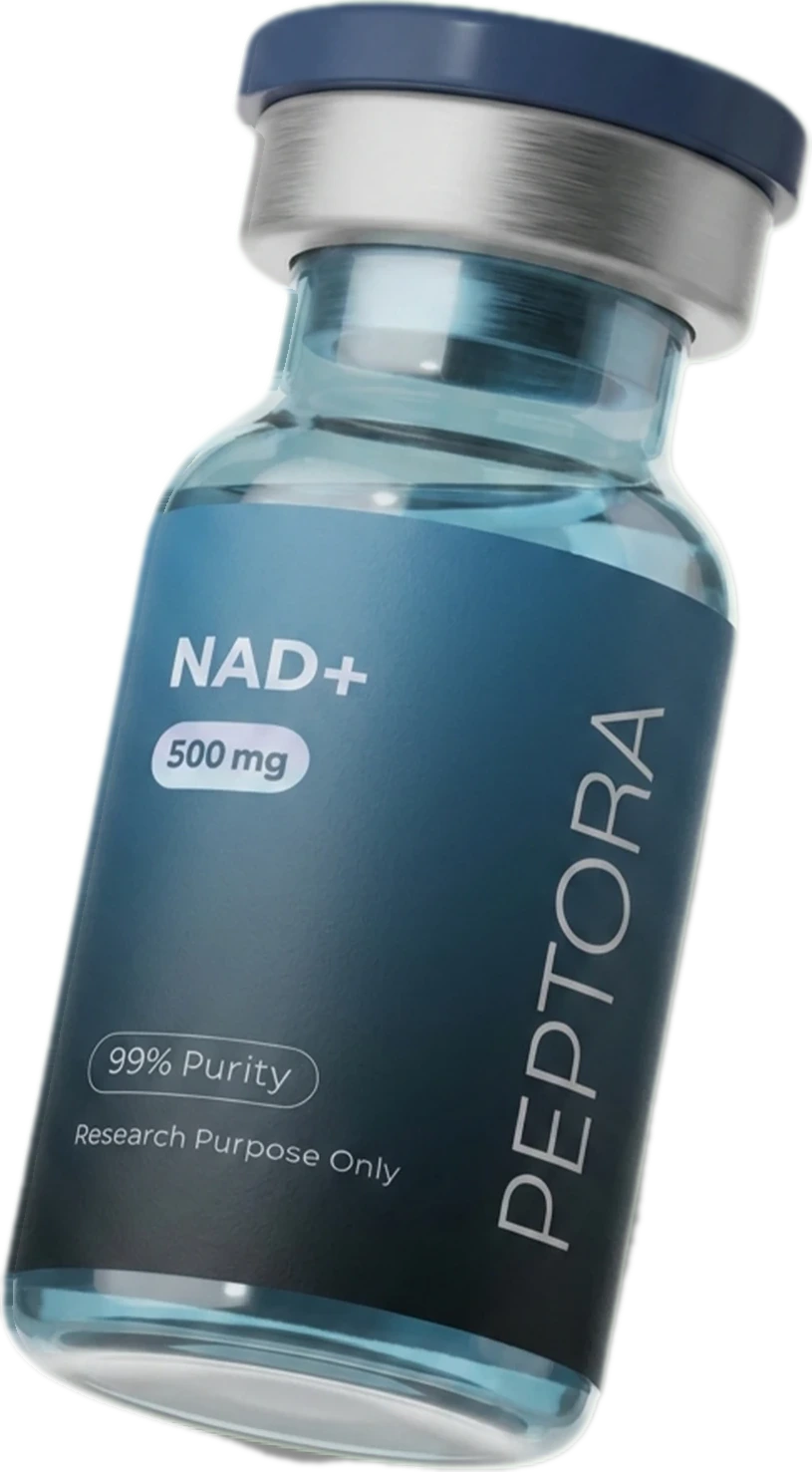
What is NAD+?
NAD+ (short for nicotinamide adenine dinucleotide — that's why everyone just says "NAD+") is a tiny helper molecule found in every living cell. It's one of the most important molecules in all of biology. Its main job is simple: it carries electrons from one place to another, like a little shuttle. Hundreds of the cell's proteins can't do their jobs without it. That's why scientists study it right where three big topics meet — how cells make energy, how cells send signals, and how the body ages.
The molecule comes in two forms that flip back and forth. When it's "empty" and ready to pick up electrons, it's called NAD+. Once it grabs them, it becomes NADH — the "loaded" form. The mix of the two is one of the quickest clues to how a cell is doing energy-wise. When scientists just say "NAD+," they often mean the whole family and everything that depends on it. It is studied only in the lab and is not a medicine — not for people or animals.
The quick version
A helper in every cell
NAD+ is a tiny helper molecule that every living cell needs to make energy.
It carries electrons
Think of it as a shuttle that moves electrons around so the cell's power plants can make fuel.
Tied to aging & repair
It's also used up by proteins linked to aging and to fixing damaged DNA.
99%+ pure
Double-checked by lab testing (HPLC + LC-MS) and shipped with a certificate for every batch — research use only.
How NAD+ works, in plain terms
NAD+'s best-known job is carrying electrons. Here's the loop: a protein pulls electrons off one molecule and hands them to NAD+, which turns it into NADH (the loaded form). Somewhere else, NADH drops those electrons off and turns back into NAD+, empty and ready to go again. Round and round it goes. This simple back-and-forth is how a cell moves energy from the food it breaks down to the parts that turn that energy into fuel.
- Breaking down sugar — NAD+ picks up electrons as the cell breaks apart sugar (glucose) for energy. Scientists call this step glycolysis.
- The cell's energy cycle — inside the power plants (mitochondria), several steps load electrons onto NAD+. Its formal name is the citric acid, or TCA, cycle.
- Burning fat — when the cell breaks down fat for energy, that hands electrons to NAD+ too.
- The NAD+/NADH balance — checking how much is "empty" versus "loaded" is a common way scientists read a cell's energy state.
NAD+ and the cell's power plants
The electrons NAD+ picks up don't sit still for long. Inside the cell's power plants — called mitochondria — the loaded NADH drops them off at an assembly line of proteins that builds ATP. ATP is the cell's main fuel, the thing it spends to get work done. Picture NAD+ as the loading dock and NADH as the delivery truck carrying the raw material for making that fuel.
Making ATP needs a steady supply of empty NAD+ ready to grab more electrons. So how much NAD+ a cell has — and how fast it recycles it — comes up again and again in research on cell energy. If a cell can't make fresh NAD+ fast enough, it can't pull out as much energy. That's why scientists so often study NAD+ side by side with the cell's power plants.
Proteins that use up NAD+: sirtuins, PARPs, and CD38
Carrying electrons isn't NAD+'s only role. Some proteins actually use it up — they cut NAD+ apart to get their own jobs done. That means their work depends on how much NAD+ is around. Three groups of these proteins get the most attention from scientists:
- Sirtuins (a set of seven, named SIRT1 through SIRT7) — proteins that need NAD+ to work. Scientists study them a lot in aging research because they're tied to how genes get switched on and off and how cells handle stress. Since they can't run without NAD+, they're a big reason NAD+ is linked to the science of aging.
- PARPs — proteins that use up NAD+ to fix damaged DNA. When a cell spots DNA damage, PARPs get busy and burn through a lot of NAD+.
- CD38 — a protein that breaks down NAD+ and is studied in immunology research. It's one of the biggest users of a cell's NAD+, and research says cells make more of it as they age.
Sirtuins, PARPs, and CD38 all pull from the same limited supply of NAD+, so scientists often study them together. In a way, the amount of NAD+ on hand ties three things to each other: how cells make energy, how they fix DNA, and how they age.
NAD+ and aging research
One of the most talked-about findings about NAD+ is simple: cells seem to hold less and less of it as we get older, in lots of different tissues and lab models. Because sirtuins and other repair and energy proteins all need NAD+, that drop with age has made it a key topic in aging research, cell-energy research, and research on how the body handles food and fuel.
This is the setting where NAD+ and its building blocks are usually studied — not as an "anti-aging" promise to anyone, but as a molecule whose supply scientists track alongside the biology of aging, in the lab. The usual question is how the size of a cell's NAD+ supply connects to the proteins and steps above. This is all early research, done in cells and animals, not proven results in people.
NAD+ vs. its building blocks: NMN and NR
Cells don't only get NAD+ ready-made — they can also build it and recycle it from smaller building-block molecules, using a kind of recycling route scientists call the salvage pathway. Two building blocks show up most in research: NMN and NR (their long chemistry names are nicotinamide mononucleotide and nicotinamide riboside). Both are studied as raw materials the cell turns into NAD+, and both get compared to NAD+ itself.
| Molecule | What it is | What it does for NAD+ |
|---|---|---|
| NAD+ | The finished helper molecule | The working form — carries electrons and gets used up by sirtuins, PARPs, and CD38. |
| NMN (nicotinamide mononucleotide) | A direct building block | The cell turns it into NAD+ in just one step. A big focus of aging research. |
| NR (nicotinamide riboside) | A building block related to vitamin B3 | Becomes NMN first, then NAD+. Studied as an earlier raw material. |
| Nicotinamide (NAM) | A form of vitamin B3 | Gets recycled back into NAD+. It's also a leftover piece from the proteins that use NAD+ up. |
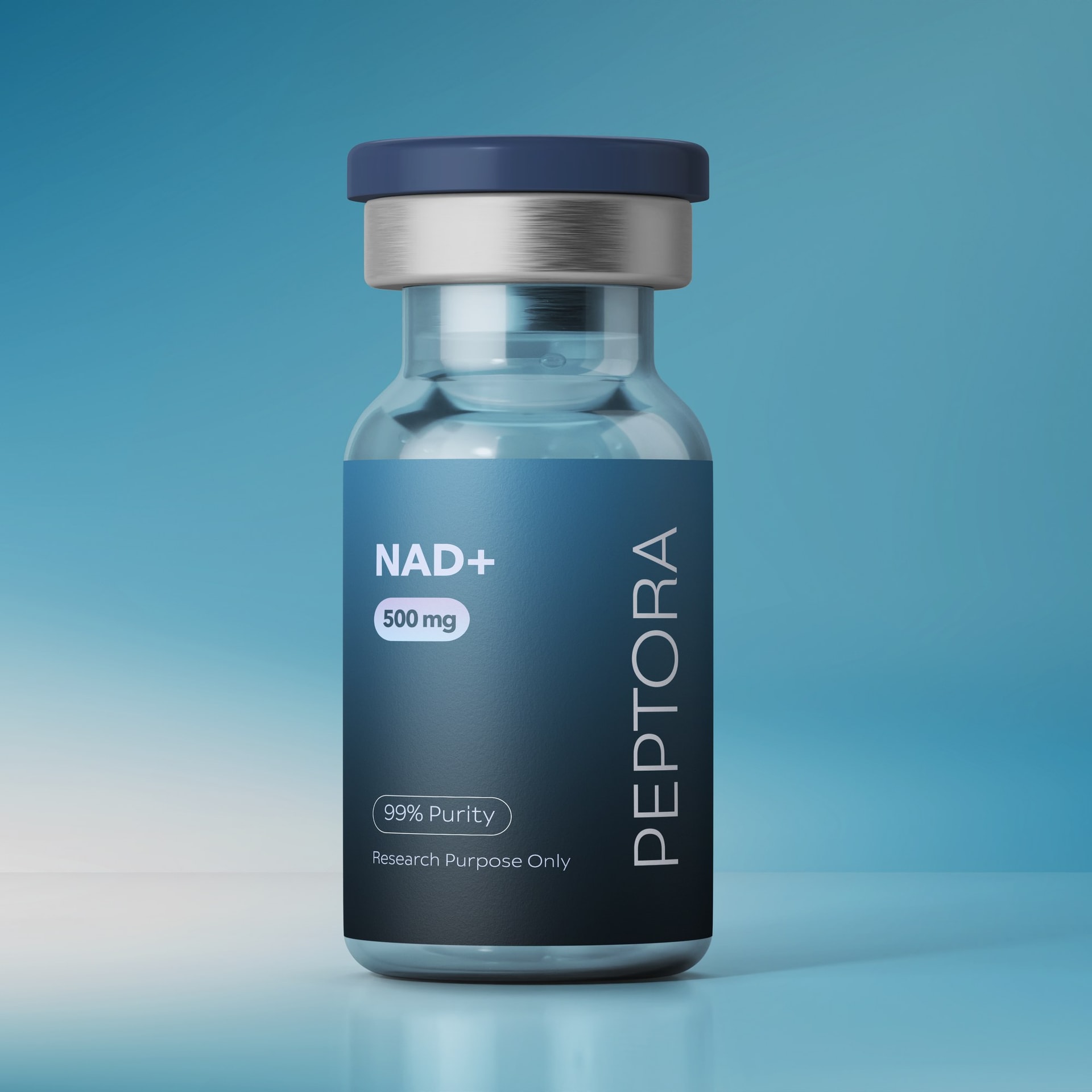
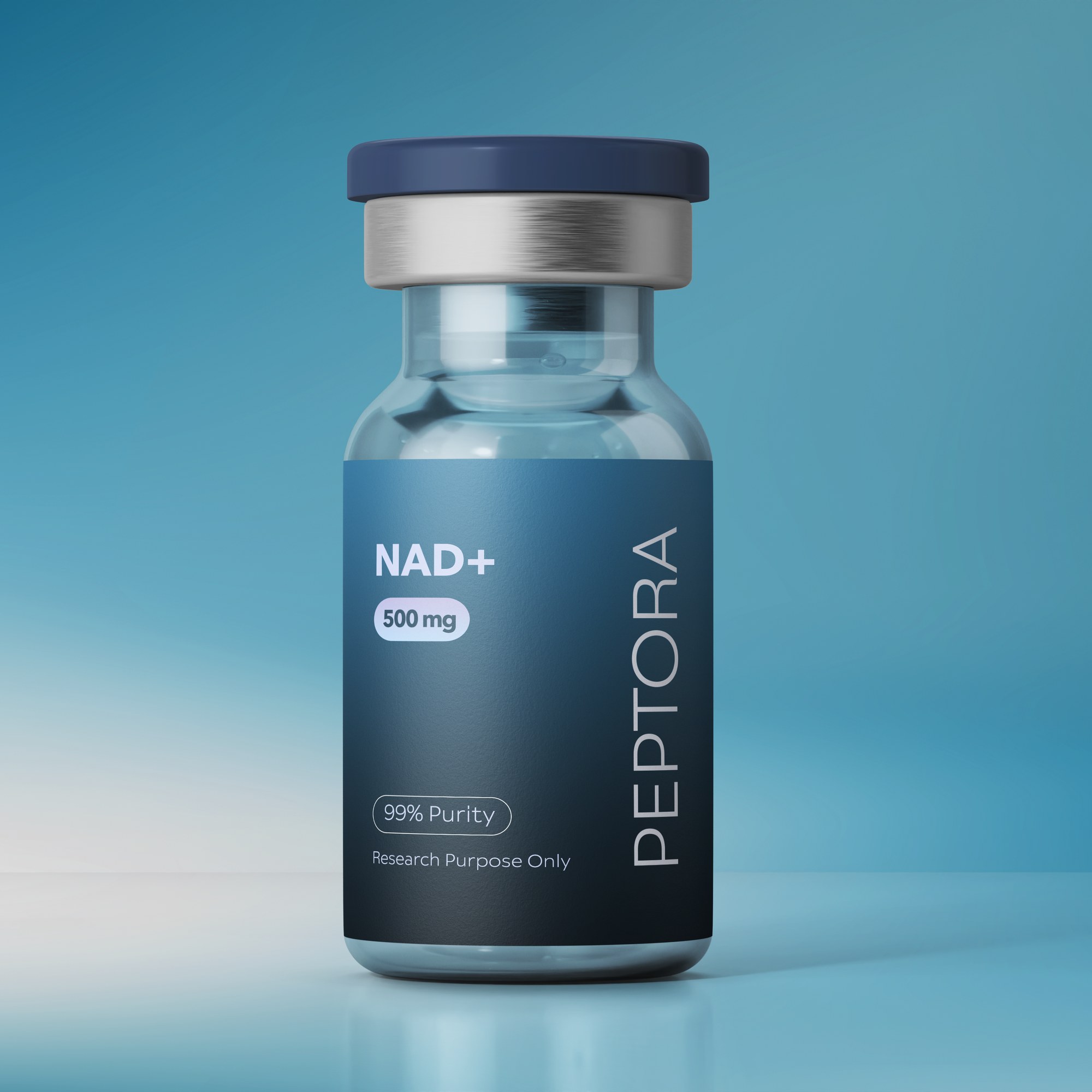
The difference scientists care about is really just where each one sits in the line: NAD+ is the finished, working molecule, while comparing NMN vs NAD+ (or NR vs NAD+) is a question of feeding the raw materials in early versus studying the finished product itself. Peptora supplies research-grade NAD+ as a freeze-dried powder, and every batch comes with its own certificate of analysis.
What scientists actually study it for
In the lab, NAD+ usually comes up in a few connected areas:
- Cell energy — how the amount of NAD+, and the empty-versus-loaded balance, connects to the power plants and to making ATP.
- Aging — the drop in NAD+ with age and how it relates to sirtuin activity.
- DNA repair — how PARP proteins use up NAD+ when they fix damage.
- Handling food and fuel — how cells deal with sugar and fat in models where the NAD+ supply is changed.
- Electron carrying — NAD+ as a main electron shuttle across the big energy steps.
Purity and testing (why the certificate matters)
In research, your results are only as trustworthy as the material you start with. Every batch of NAD+ from Peptora is checked to 99%+ purity by HPLC, confirmed by a second test (LC-MS) that proves it's the right molecule, and run through a full quality-control panel before it ships. Every order comes with a certificate of analysis (COA) for that exact batch, so you can match the material to its paperwork.
That paperwork is standard here, not an add-on. To learn what the numbers on a certificate actually mean, see the guide on purity and certificates of analysis and the testing standards overview.
How it's handled in the lab
NAD+ ships as a freeze-dried powder. Before it's used in research, it's mixed with bacteriostatic water — a special sterile water, sold separately. NAD+ doesn't like moisture, heat, or light, so a little care keeps it intact and keeps the results reliable:
- 1Let the sealed vial warm up to room temperature before opening it, so water doesn't form on it.
- 2Add the water slowly down the side of the vial, then swirl gently — don't shake.
- 3Wait until the powder is fully dissolved before drawing anything out.
- 4Keep the mixed solution in the fridge, away from light, and try not to freeze and thaw it over and over.
Step-by-step details are in the reconstitution guide and the storage guide. Doing these the same way every time is one of the easiest ways to keep research consistent. Peptora offers NAD+ in 500 mg and 1000 mg research vials, all for laboratory research use only.
Scientific references
NAD+ has been studied for decades in the lab, and its building blocks NMN and NR have been tested in a growing number of human trials. The studies listed below are here for background, from PubMed and ClinicalTrials.gov. They describe research on NAD+ itself — not the laboratory research product Peptora supplies.
- 1Verdin E. NAD+ in aging, metabolism, and neurodegeneration. Science. 2015;350(6265):1208-1213. doi:10.1126/science.aac4854.
- 2Covarrubias AJ, et al. NAD+ metabolism and its roles in cellular processes during ageing. Nat Rev Mol Cell Biol. 2021;22(2):119-141. doi:10.1038/s41580-020-00313-x.
- 3Yoshino M, et al. Nicotinamide mononucleotide increases muscle insulin sensitivity in prediabetic women. Science. 2021;372(6547):1224-1229. doi:10.1126/science.abe9985 (ClinicalTrials.gov: NCT03151239).
- 4Dollerup OL, et al. A randomized placebo-controlled clinical trial of nicotinamide riboside in obese men: safety, insulin-sensitivity, and lipid-mobilizing effects. Am J Clin Nutr. 2018;108(2):343-353. doi:10.1093/ajcn/nqy132 (ClinicalTrials.gov: NCT02303483).
- 5Yi L, et al. The efficacy and safety of β-nicotinamide mononucleotide (NMN) supplementation in healthy middle-aged adults: a randomized, multicenter, double-blind, placebo-controlled, parallel-group, dose-dependent clinical trial. GeroScience. 2022;45(1):29-43. doi:10.1007/s11357-022-00705-1 (ClinicalTrials.gov: NCT04823260).
- 6Guarente L, Sinclair DA, Kroemer G. Human trials exploring anti-aging medicines. Cell Metab. 2024;36(2):354-376. doi:10.1016/j.cmet.2023.12.007.
Explore research-grade NAD+
99%+ pure, a certificate of analysis with every batch, fast U.S. shipping — for laboratory research use only.
View NAD+Key takeaways
- NAD+ is a tiny helper molecule in every living cell. Its main job is carrying electrons — like a shuttle — so the cell can make energy.
- Some proteins use it up: sirtuins, PARPs, and CD38. That ties three things together — making energy, fixing DNA, and aging.
- Studies say cells hold less NAD+ as we age, which is why scientists study it in aging, cell-energy, and metabolism research.
- Its building blocks, NMN and NR, get turned into NAD+. Comparing them to NAD+ is really about feeding in raw materials versus studying the finished molecule.
- Peptora's NAD+ is 99%+ pure (checked by HPLC and LC-MS), comes with a certificate for each batch, and ships as a freeze-dried powder for laboratory research use only.
Frequently asked questions
This article is intended solely as an educational summary of publicly available scientific literature. Products offered by Peptora are supplied exclusively for laboratory research purposes and are not approved for human or veterinary use. The information presented should not be interpreted as medical advice, treatment recommendations, or clinical guidance.