What is GHK-Cu (copper peptide)?
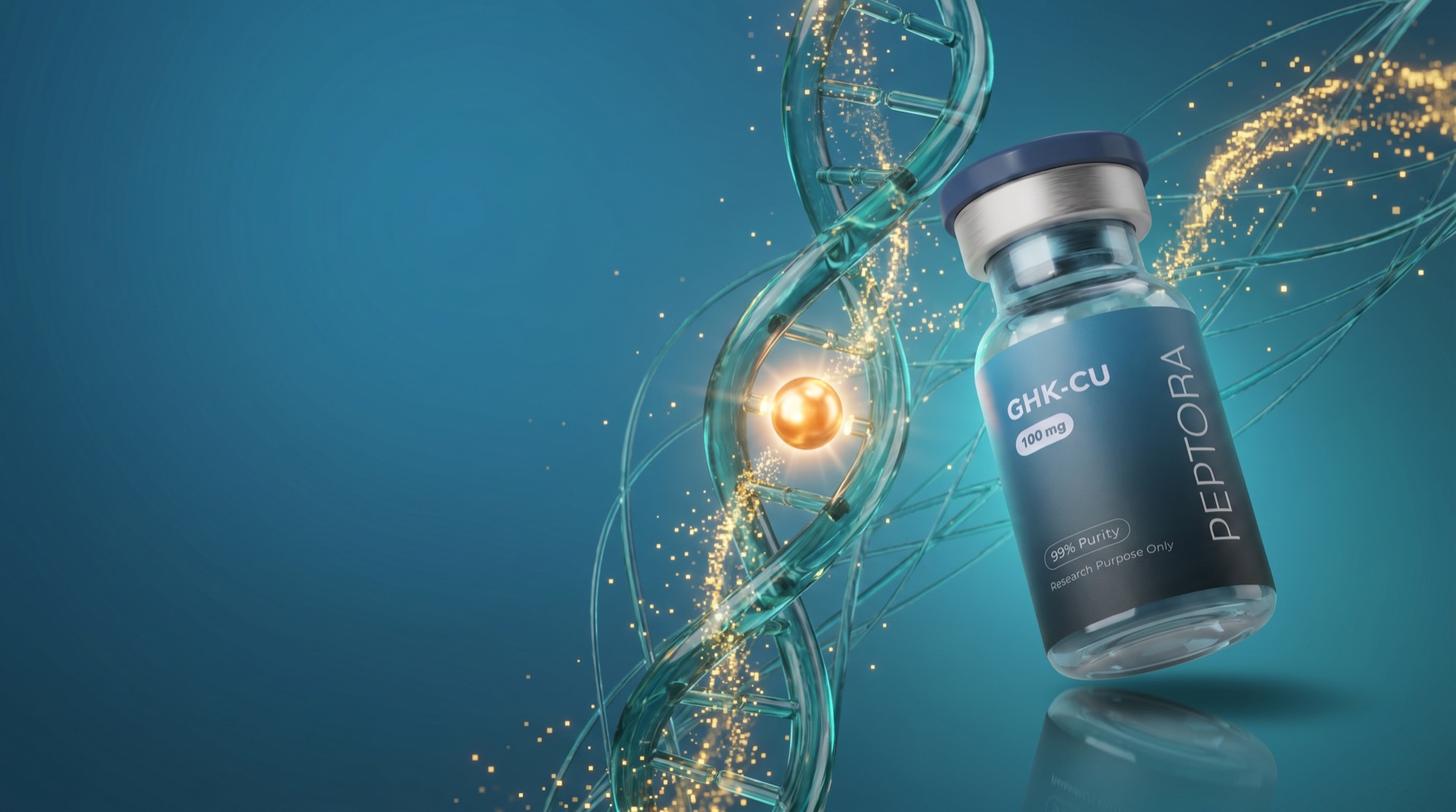
GHK-Cu is a tiny peptide that carries a bit of copper. The peptide part is made of just three amino-acid building blocks — glycine, histidine, and lysine — strung together (short name: GHK). That little chain grabs onto a single atom of copper and holds it tight. Because it always carries that copper at its center, most people just call it "the copper peptide." The body makes GHK-Cu naturally, and scientists have studied it in skin and repair research for decades.
What makes GHK-Cu interesting to study is that pairing itself: the GHK chain naturally grabs copper and holds on tightly, and it's this copper-carrying combo that most research looks at. In this guide, GHK-Cu is talked about only as something scientists study in the lab. It is not a skin-care product, a supplement, or a medicine, and it is supplied for laboratory research use only — not for people or animals.
The quick version
A copper-carrying peptide
GHK-Cu is a three-piece peptide (GHK) that grabs and holds a bit of copper.
Skin & collagen
A common focus of research into skin's support structure and how the body makes collagen.
Antioxidant angle
Studied in the lab for antioxidant activity and for how tissues rebuild and repair.
99%+ pure
Double-checked by lab testing (HPLC + LC-MS) and shipped with a certificate for every batch — research use only.
The chemistry, in plain terms
GHK-Cu is built from just three amino acids, but that small size is exactly what makes it interesting. The middle building block — histidine — acts like a little hook that grabs a copper atom and holds it, forming a steady GHK–copper pair. Here are the key things the research points to:
- Its three pieces — glycine, histidine, and lysine (Gly-His-Lys), a tiny peptide the body makes on its own.
- It loves copper — the GHK chain grabs copper tightly, and this copper-carrying form is what most research studies.
- A blue tint — GHK-Cu dissolved in water turns a clear blue, a giveaway that the copper is along for the ride.
- Very small — with only three building blocks, it's one of the smallest peptides in skin and repair research.
GHK-Cu and age: a peptide the body makes
One reason GHK-Cu comes up so often in research is that the body makes it on its own — it's naturally found in the blood. Studies say there's most of it when we're young adults, and less and less as we age. A lot of the interest in this peptide comes from that drop over time, and from the tissue-repair steps it's linked to.
GHK-Cu properties at a glance
Here's a quick summary of the basic facts researchers reach for most when working with GHK-Cu:
| Property | Detail |
|---|---|
| What it is | A tiny peptide that carries a bit of copper |
| Its three pieces | Glycine, histidine, and lysine (Gly-His-Lys) |
| The metal it holds | A copper atom |
| Found naturally in | The blood; studies say it drops as we age |
| Color in water | A clear blue tint from the copper |
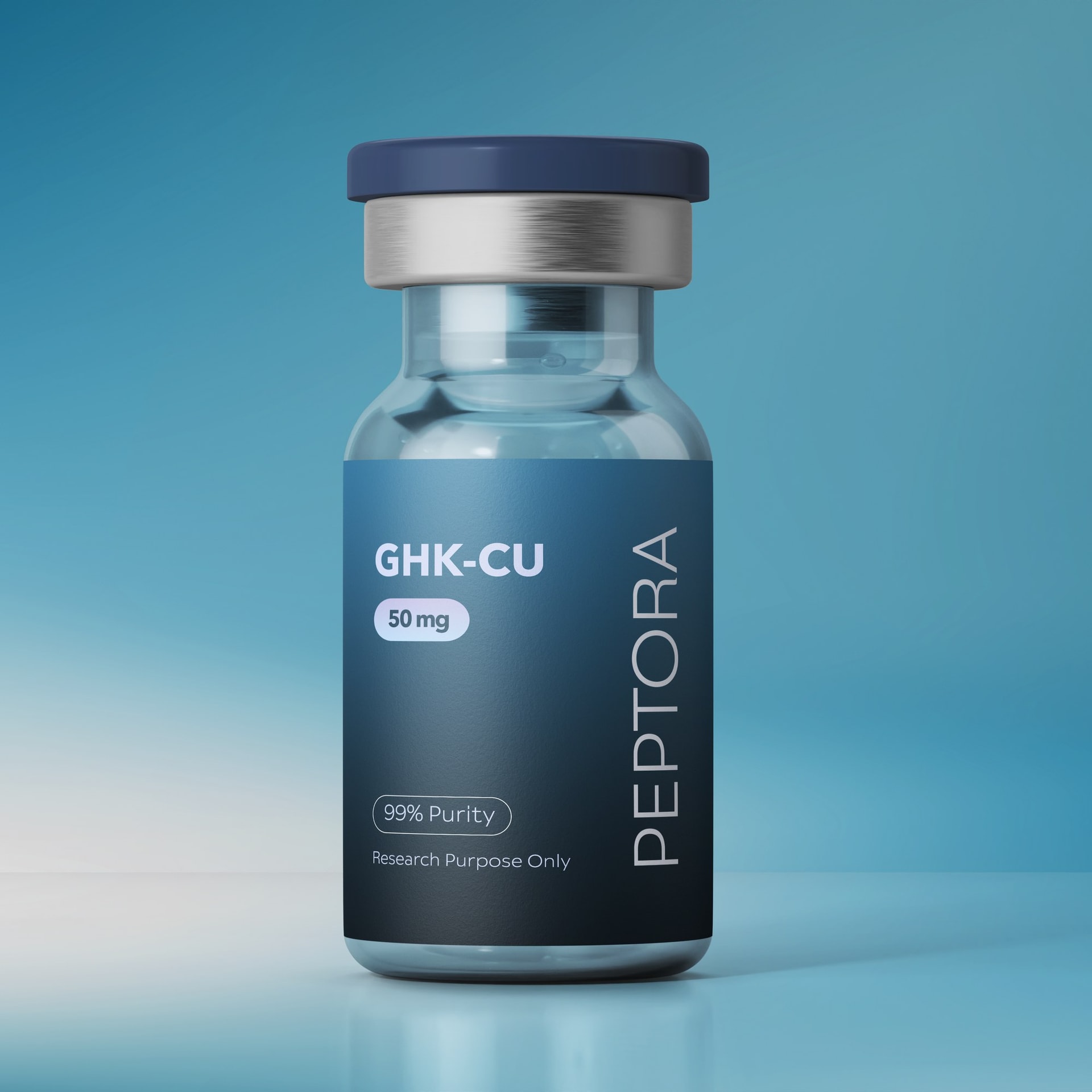
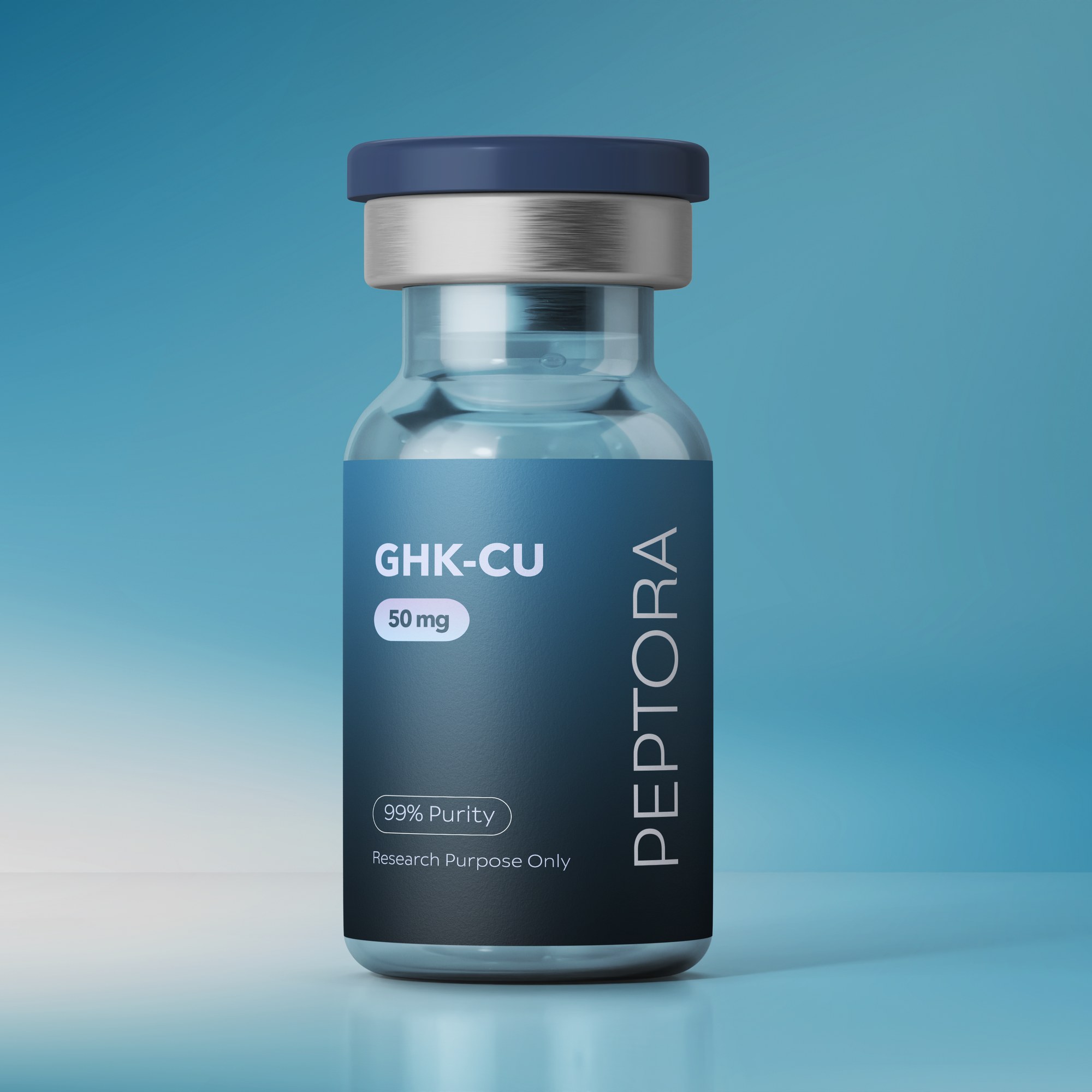
| Form (from Peptora) | Freeze-dried powder, 50 mg vial |
| Meant for | Laboratory research use only |
What scientists actually study it for
In the lab, GHK-Cu shows up across several connected areas of skin and repair research. Here are the ones scientists look at most:
| Research area | What scientists look at |
|---|---|
| Skin & its support structure | How the body makes collagen and elastin, and rebuilds skin |
| Wound healing | Repair and regrowth signals in lab models |
| Hair follicles | How follicles work and the signals tied to them |
| Antioxidant / calming irritation | How it deals with cell-damaging stress and inflammation |
| Tissue-rebuilding enzymes | How it affects enzymes (MMPs) and growth signals that reshape tissue |
Skin repair and collagen research
The biggest pile of GHK-Cu research is about the extracellular matrix — think of it as the protein scaffolding that gives skin its structure and support. In lab models, GHK-Cu is studied for how it's tied to making collagen and elastin (the proteins that keep skin firm and springy) and to the enzymes (called MMPs) and growth signals that decide how that scaffolding gets built up and broken down. That's why the peptide shows up so often in skin-science research.
One thing to be clear about: these are descriptions of signals that scientists have mapped in lab research, not claims that GHK-Cu will do anything to anyone's skin. GHK-Cu is not meant to be put on skin or used in or on people or animals in any way.
Hair-follicle and antioxidant research
Beyond skin, GHK-Cu is studied in hair-follicle research, where scientists look at how follicles work and the signals tied to the peptide. It's also studied for antioxidant and anti-inflammatory activity — how it handles cell-damaging stress and irritation — which comes from the electron-swapping ability of the copper it carries. Together, these topics keep GHK-Cu a regular reference point in repair and skin-science research.
GHK-Cu is one of several peptides Peptora carries for this kind of research. It's also part of GLOW, a related Peptora research blend. Like everything in the catalog, both are supplied strictly for laboratory research use.
Purity and testing (why the certificate matters)
In research, your results are only as trustworthy as the material you start with. Every batch of GHK-Cu from Peptora is checked to 99%+ purity by HPLC, confirmed by a second test (LC-MS) that proves it's the right molecule, and run through a full quality-control panel before it ships. Every order comes with a certificate of analysis (COA) for that exact batch, so you can match the material to its paperwork.
That paperwork is standard here, not an add-on. To learn what the numbers on a certificate actually mean, see the guide on purity and certificates of analysis and the testing standards overview.
How it's handled in the lab
GHK-Cu ships as a freeze-dried powder. Before it's used in research, it's mixed with bacteriostatic water — a special sterile water, sold separately. Because it carries copper, it doesn't like light, so handling it the same way each time keeps it intact and the results reliable:
- 1Let the sealed vial warm up to room temperature before opening it.
- 2Add the water slowly down the side of the vial, then swirl gently — don't shake.
- 3Wait until the powder fully dissolves — a light blue tint is normal, that's just the copper.
- 4Keep the mixed solution in the fridge, away from light.
Step-by-step details are in the reconstitution guide and the storage guide. Doing these the same way every time is one of the easiest ways to keep research consistent.
Scientific references
The studies listed below are here for background, from PubMed. They describe early lab and skin-science research on GHK-Cu — a compound with no major approved-drug program — not the laboratory research product Peptora supplies.
- 1Pickart L, Vasquez-Soltero JM, Margolina A. GHK Peptide as a Natural Modulator of Multiple Cellular Pathways in Skin Regeneration. Biomed Res Int. 2015;2015:648108. doi:10.1155/2015/648108 (PMID: 26236730).
- 2Pickart L. The human tri-peptide GHK and tissue remodeling. J Biomater Sci Polym Ed. 2008;19(8):969-988. doi:10.1163/156856208784909435 (PMID: 18644225).
- 3Pickart L, Vasquez-Soltero JM, Margolina A. GHK and DNA: Resetting the Human Genome to Health. Biomed Res Int. 2014;2014:151479. doi:10.1155/2014/151479 (PMID: 25302294).
- 4Maquart FX, Bellon G, Chaqour B, et al. In vivo stimulation of connective tissue accumulation by the tripeptide-copper complex glycyl-L-histidyl-L-lysine-Cu2+ in rat experimental wounds. J Clin Invest. 1993;92(5):2368-2376. doi:10.1172/JCI116842 (PMID: 8227353).
- 5Siméon A, Wegrowski Y, Bontemps Y, Maquart FX. Expression of glycosaminoglycans and small proteoglycans in wounds: modulation by the tripeptide-copper complex glycyl-L-histidyl-L-lysine-Cu2+. J Invest Dermatol. 2000;115(6):962-968. doi:10.1046/j.1523-1747.2000.00166.x (PMID: 11121126).
- 6Park JR, Lee H, Kim SI, Yang SR. The tri-peptide GHK-Cu complex ameliorates lipopolysaccharide-induced acute lung injury in mice. Oncotarget. 2016;7(36):58405-58417. doi:10.18632/oncotarget.11168 (PMID: 27517151).
Explore research-grade GHK-Cu
99%+ pure, a certificate of analysis with every batch, fast U.S. shipping — for laboratory research use only.
View GHK-CuKey takeaways
- GHK-Cu is a tiny three-piece peptide (GHK) that grabs and holds a bit of copper — that's why it's called "the copper peptide."
- The body makes it naturally, and studies say we have less of it as we age.
- Scientists study it a lot in skin and repair research — looking at skin structure, collagen and elastin, wound healing, hair follicles, and antioxidant activity.
- All of this describes signals mapped in research — these are research findings, not proven results — and GHK-Cu is for laboratory research use only.
- Peptora's GHK-Cu ships as a freeze-dried 50 mg powder, 99%+ pure, with a certificate for each batch, and is mixed with bacteriostatic water before research use.
Frequently asked questions
This article is intended solely as an educational summary of publicly available scientific literature. Products offered by Peptora are supplied exclusively for laboratory research purposes and are not approved for human or veterinary use. The information presented should not be interpreted as medical advice, treatment recommendations, or clinical guidance.