
The short answer
Picture a family of five locks scattered around the body. They are all built from the same basic design, so they look alike — but they are installed in very different places. One sits in the skin, where it controls pigment. Two sit mostly in the brain, where they are involved in appetite and arousal signaling. The others are elsewhere again. Scientists call this family the melanocortin receptors, and a receptor is simply a docking spot on a cell where a signal has to land before anything happens.
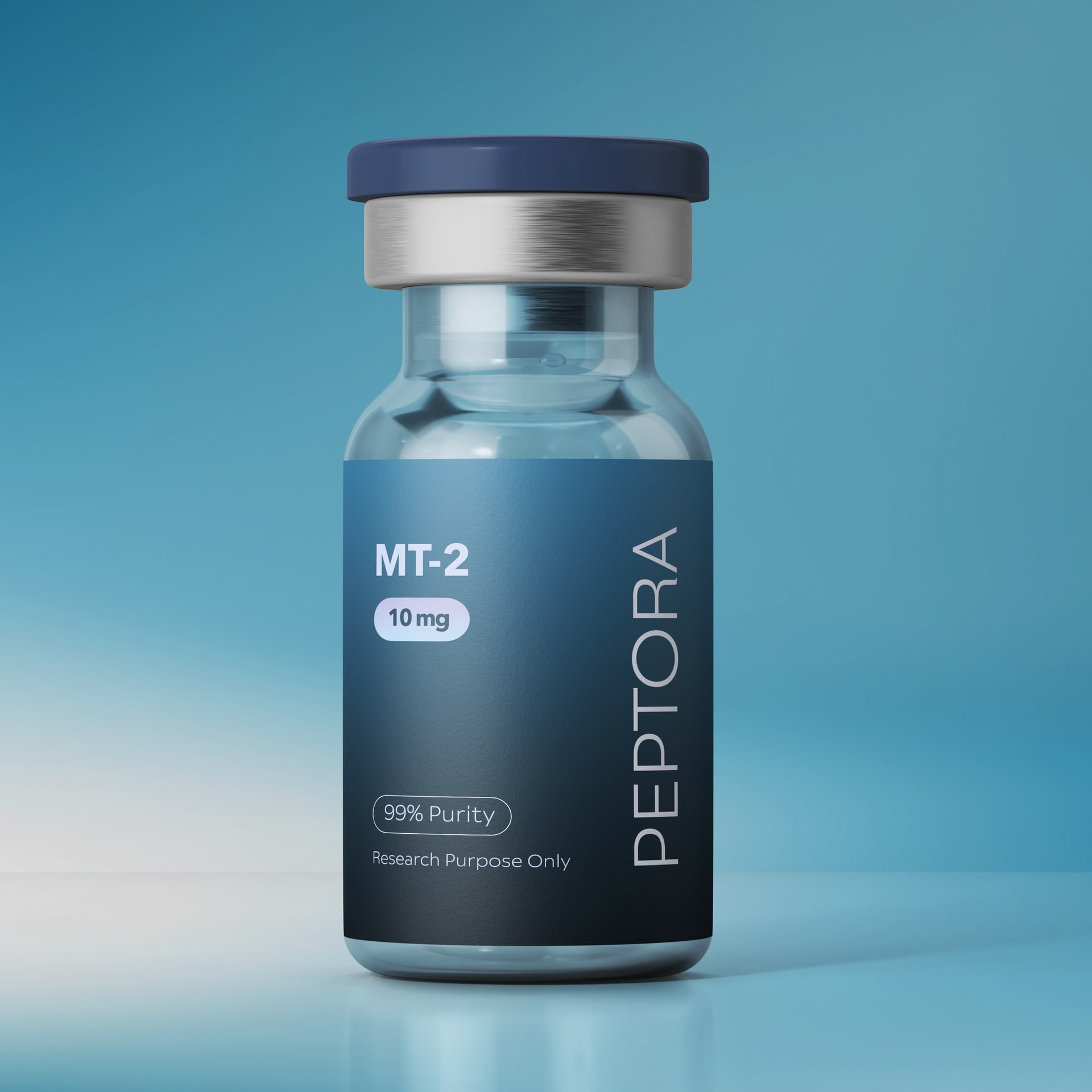
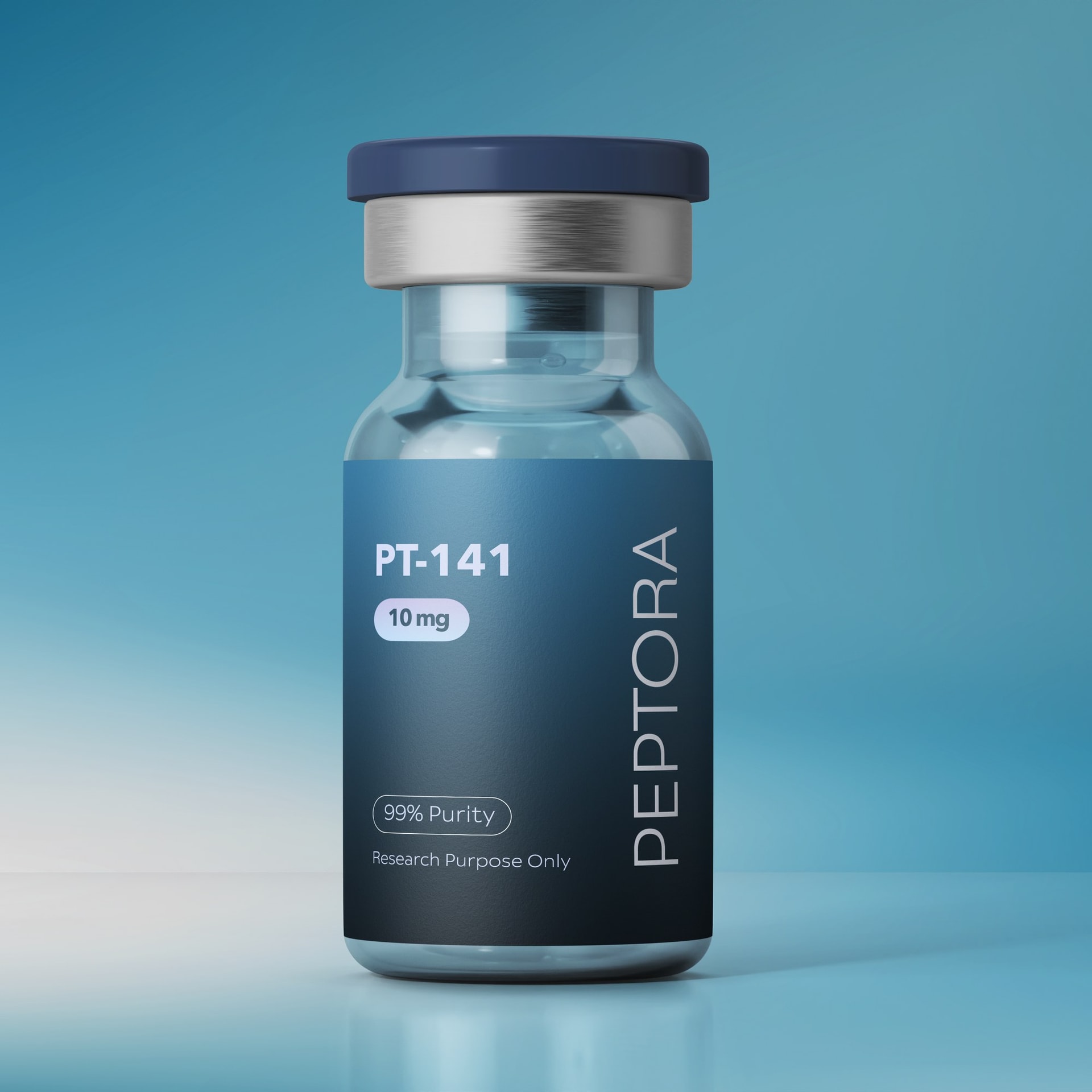
MT-2 is a broad key. Published work describes it as a non-selective melanocortin agonist — an agonist being a key that switches a lock on — meaning it fits nearly all of those locks, skin one included. PT-141 started from the same chemistry but was reshaped so it leans much more toward the brain locks and much less toward the skin one.
Explore research-grade PT-141
99%+ pure, a certificate of analysis with every batch — for laboratory research use only.
View PT-141The quick version
MT-2 — the master key
A cyclic peptide (its chain loops back on itself) that published work describes as fitting nearly every melanocortin lock.
PT-141 — the tuned key
Reshaped to favor the brain receptors, especially MC4R, rather than the skin one.
Same origin story
Both trace back to melanocortin peptide work at the University of Arizona in the 1990s.
Lab use only
Peptora supplies both as research chemicals — never for people or animals.
MT-2: the broad one
MT-2 — full name Melanotan II — came out of work on a natural body signal called α-MSH (alpha-melanocyte-stimulating hormone). The natural version breaks down almost immediately, which makes it nearly useless as a research tool. So chemists rebuilt it: they shortened the chain and then closed it into a ring, tying one end back to the middle. That ring is what makes it hold its shape and survive far longer.
A small pilot study published in *Life Sciences* in 1996 by researchers at the University of Arizona — Dorr, Hruby, Hadley and colleagues — described MT-II's effects in a handful of volunteers, and reported increased skin pigmentation along with side effects including nausea, yawning and stretching. A later paper from the same group, published in 2000, reported on melanocortin agonists and erectile response.
That breadth is exactly the point of MT-2 as a research tool — and exactly its limitation. If a key opens every lock, it is very hard to work out which lock produced which effect. That ambiguity is one reason researchers went looking for something narrower.
PT-141: the narrower one
PT-141 — also called Bremelanotide — grew out of the same melanocortin research line. The chemistry was adjusted at one end of the molecule, and the result behaves noticeably differently: published reviews describe it as a synthetic analogue of α-MSH with high affinity for the melanocortin type 4 receptor (MC4R), the one thought to be involved in sexual response pathways in the brain.
That narrowing is why PT-141 has a formal clinical record and MT-2 does not. It was taken through development by Palatin Technologies, later licensed to AMAG Pharmaceuticals, and two identical phase 3 trials known as RECONNECT were published in *Obstetrics & Gynecology* in 2019. It received U.S. approval that year for a specific indication in premenopausal women.
Published trial data also documented something worth knowing about the whole class: an ambulatory blood-pressure study reported small, short-lived rises in blood pressure after dosing, accompanied by a modest drop in heart rate. That is a real, measured property of MC4R-directed compounds and part of why this family is studied carefully.
Side by side
| MT-2 (Melanotan II) | PT-141 (Bremelanotide) | |
|---|---|---|
| Selectivity | Non-selective — fits most melanocortin receptors | Weighted toward MC4R and MC3R |
| Includes the skin receptor (MC1R)? | Yes — pigment effects are documented | Much less so |
| Main published research angle | Pigment biology, appetite, arousal | Brain arousal pathways (MC4R) |
| Origin | University of Arizona melanocortin work, 1990s | Same research line; developed by Palatin Technologies |
| Clinical record | Small early studies only | Two phase 3 trials (RECONNECT), U.S. approval 2019 |
| Documented class effect | Nausea, yawning, flushing | Nausea, flushing, transient blood-pressure rise |
The practical takeaway for a lab: they are not substitutes. If the research question is about the melanocortin system as a whole — including pigment — that is MT-2 territory. If the question is specifically about MC4R signaling, a broad agonist muddies the answer, and the narrower compound is the cleaner tool. Peptora carries research-grade MT-2 and PT-141, each with its own certificate of analysis.
What they do have in common
- The same receptor family. Both act on melanocortin receptors, so their literatures overlap heavily.
- The same ancestor. Both descend from work on α-MSH, the body's own melanocortin signal.
- A shared side-effect signature. Nausea and flushing appear repeatedly in published reports for both.
- Both are cyclic peptides. Their chains loop back on themselves, which is what gives them their stability.
- Both ship lyophilized. Freeze-dried powder, reconstituted with bacteriostatic water before research use.
Where else this family turns up in the literature
Melanocortin research is broader than the two headline topics. A 2022 paper in *Neuropeptides* reported that MT-II injected directly into a specific brain region in mice reduced both food consumption and the motivation to work for food, without producing an aversive state or changing metabolic rate. And a 2024 cell-culture study explored bremelanotide's effects on glioblastoma cell lines through MC3R and MC4R — early laboratory work, a long way from any clinical conclusion.
Purity and handling
Published dermatology reviews of unregulated melanotan products flagged product impurity as a specific concern. That is precisely the problem a certificate solves. Every batch Peptora supplies is checked to 99%+ purity by HPLC — a machine that separates a sample into its parts so you can see exactly how much of it is the peptide you ordered — and confirmed by LC-MS, a second test proving the molecule is the right one.
Both arrive lyophilized (freeze-dried) and are reconstituted — mixed with bacteriostatic water — before research use. Warm the sealed vial to room temperature first, add the water slowly down the side, swirl rather than shake, and keep the mixed solution cold and out of light. Full steps are in the reconstitution guide, and what a certificate of analysis means explains the paperwork.
Scientific references
The sources below are listed for background, from PubMed and ClinicalTrials.gov. They describe research on the molecules themselves — not the laboratory research products Peptora supplies.
- 1Dorr RT, Lines R, Levine N, et al. Evaluation of melanotan-II, a superpotent cyclic melanotropic peptide in a pilot phase-I clinical study. Life Sci. 1996;58(20):1777-1784. doi:10.1016/0024-3205(96)00160-9 (PMID: 8637402).
- 2Wessells H, Levine N, Hadley ME, Dorr R, Hruby V. Melanocortin receptor agonists, penile erection, and sexual motivation: human studies with Melanotan II. Int J Impot Res. 2000;12 Suppl 4:S74-S79. doi:10.1038/sj.ijir.3900582 (PMID: 11035391).
- 3Dhillon S, Keam SJ. Bremelanotide: First Approval. Drugs. 2019;79(14):1599-1606. doi:10.1007/s40265-019-01187-w (PMID: 31429064).
- 4Kingsberg SA, Clayton AH, Portman D, et al. Bremelanotide for the Treatment of Hypoactive Sexual Desire Disorder: Two Randomized Phase 3 Trials. Obstet Gynecol. 2019;134(5):899-908. doi:10.1097/AOG.0000000000003500 (ClinicalTrials.gov: NCT02333071, NCT02338960).
- 5White WB, Myers MG, Jordan R, Lucas J. Usefulness of ambulatory blood pressure monitoring to assess the melanocortin receptor agonist bremelanotide. J Hypertens. 2017;35(4):761-768. doi:10.1097/HJH.0000000000001221 (PMID: 27977473).
- 6Langan EA, Nie Z, Rhodes LE. Melanotropic peptides: more than just 'Barbie drugs' and 'sun-tan jabs'? Br J Dermatol. 2010;163(3):451-455. doi:10.1111/j.1365-2133.2010.09891.x (PMID: 20545686).
- 7Ong S, Bowling J. Melanotan-associated melanoma in situ. Australas J Dermatol. 2012;53(4):301-302. doi:10.1111/j.1440-0960.2012.00915.x (PMID: 22724573).
- 8Eliason NL, Martin L, Low MJ, Sharpe AL. Melanocortin receptor agonist melanotan-II microinjected in the nucleus accumbens decreases appetitive and consumptive responding for food. Neuropeptides. 2022;96:102289. doi:10.1016/j.npep.2022.102289 (PMID: 36155088).
- 9Suzuki S, Kitanaka C, Okada M. Melanocortin Receptor Agonist Bremelanotide Induces Cell Death and Growth Inhibition in Glioblastoma Cells. Anticancer Res. 2024;44(9):3875-3883. doi:10.21873/anticanres.17214 (PMID: 39197897).
Explore research-grade MT-2
99%+ pure, a certificate of analysis with every batch, fast U.S. shipping — for laboratory research use only.
View MT-2Key takeaways
- The melanocortin system is a family of five related receptors — docking spots — installed in different places, including one in skin that controls pigment and others in the brain.
- MT-2 (Melanotan II) is described in published work as non-selective: it fits nearly all of those receptors, which is both its usefulness and its limitation as a research tool.
- PT-141 (Bremelanotide) came from the same research line but was reshaped to favor the brain receptors, especially MC4R.
- That narrowing is why PT-141 has a formal clinical record — two phase 3 RECONNECT trials and a 2019 U.S. approval — while MT-2 does not.
- Published trial data documented small, short-lived blood-pressure rises after bremelanotide dosing; dermatology literature has raised separate concerns about unregulated melanotan products, including impurity and case reports of atypical moles and melanoma in situ.
- Peptora supplies both as laboratory research chemicals at 99%+ purity with a batch-specific certificate of analysis — never as medicines, tanning products, or for use in people or animals.
Frequently asked questions
This article is intended solely as an educational summary of publicly available scientific literature. Products offered by Peptora are supplied exclusively for laboratory research purposes and are not approved for human or veterinary use. The information presented should not be interpreted as medical advice, treatment recommendations, or clinical guidance.