


What is Melanotan II (MT-2)?
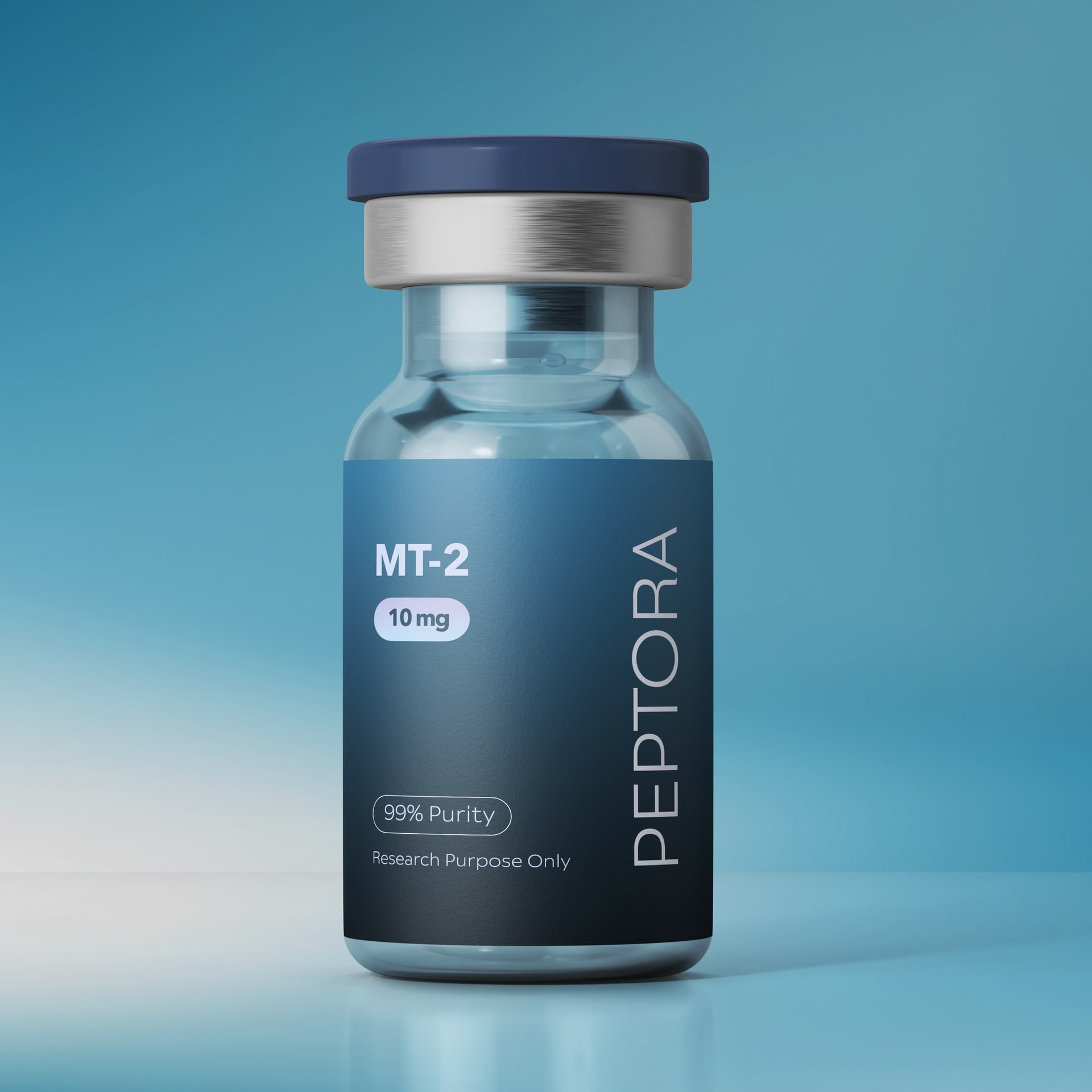
Melanotan II — which Peptora labels MT-2 — is a lab-made copy of a natural body signal called alpha-melanocyte-stimulating hormone, or α-MSH for short. (A peptide like this is just a short chain of amino acids, the same building blocks that make up proteins.) The lab version is built in a ring shape so it's sturdier and lasts longer than the natural one. The easiest way to picture how it works: the body has a set of 'locks' called melanocortin receptors, and α-MSH is the 'key' that fits them. MT-2 is a copy of that key — and it fits several of those locks at once instead of just one.
Those locks help control things like skin color, appetite, energy use, and some nerve signals — so scientists use MT-2 as a research tool to study how the whole system works. That's the reason it comes up so often in the lab. One thing to be clear about up front: MT-2 is only for laboratory research. It is not a medicine, not a cosmetic, and not a tanning product, and it is not for use in people or animals.
The quick version
A copy of α-MSH
A lab-made, ring-shaped copy of a natural body signal (α-MSH), built to be sturdier than the real thing.
Fits several locks
Switches on several of the body's melanocortin 'locks' at once — the two studied most are called MC1R and MC4R.
A lab research tool
Used to study skin color, appetite, and nerve signals in early lab tests — never for people or animals.
Published lab results
Each lot's HPLC purity is listed on its certificate of analysis.
Explore Melanotan II
Independently lab tested, with each lot's certificate of analysis published online, and fast U.S. shipping — for laboratory research use only.
View Melanotan II (MT-2)The body system MT-2 acts on
The melanocortin system is a family of five 'locks' in the body, labeled MC1R through MC5R. Natural body signals — including α-MSH — are the 'keys' that fit them. MT-2 acts on several of these locks at once, which is why it shows up in research across a few different areas of the body:
- MC1R — the lock scientists tie to skin-color biology (the cells that make skin pigment).
- MC3R and MC4R — locks studied for their part in hunger, feeling full, and how the body uses energy, mostly in appetite-control parts of the brain.
- The wider system — looked at in early lab models of nerve repair, nerve protection, and brain-related behavior.
According to PubMed, early studies have looked at MT-2 in a few of these areas: as something that lowered how much food mice ate when placed in a specific brain region, as something tied to better blood-sugar handling in a rat study, and as a copy of α-MSH that seemed to help nerves in a rat nerve-injury model. These are findings from animal and cell studies — not conclusions about people.
What scientists actually study it for
In the lab, MT-2 is mostly used as a tool to study how the melanocortin locks work. It usually comes up in a few connected areas:
- How the locks work — which locks it fits, how tightly, and how its shape changes that. Scientists also use MT-2 as a starting point to design newer copies that fit just one lock.
- Appetite and energy — hunger and 'feeling full' signals (through the MC3R and MC4R locks) in rodent studies.
- Skin-color biology — the MC1R lock in studies of pigment-making cells.
- Brain and nerve studies — nerve repair, nerve protection, and behavior in early lab research.
How MT-2 relates to similar compounds
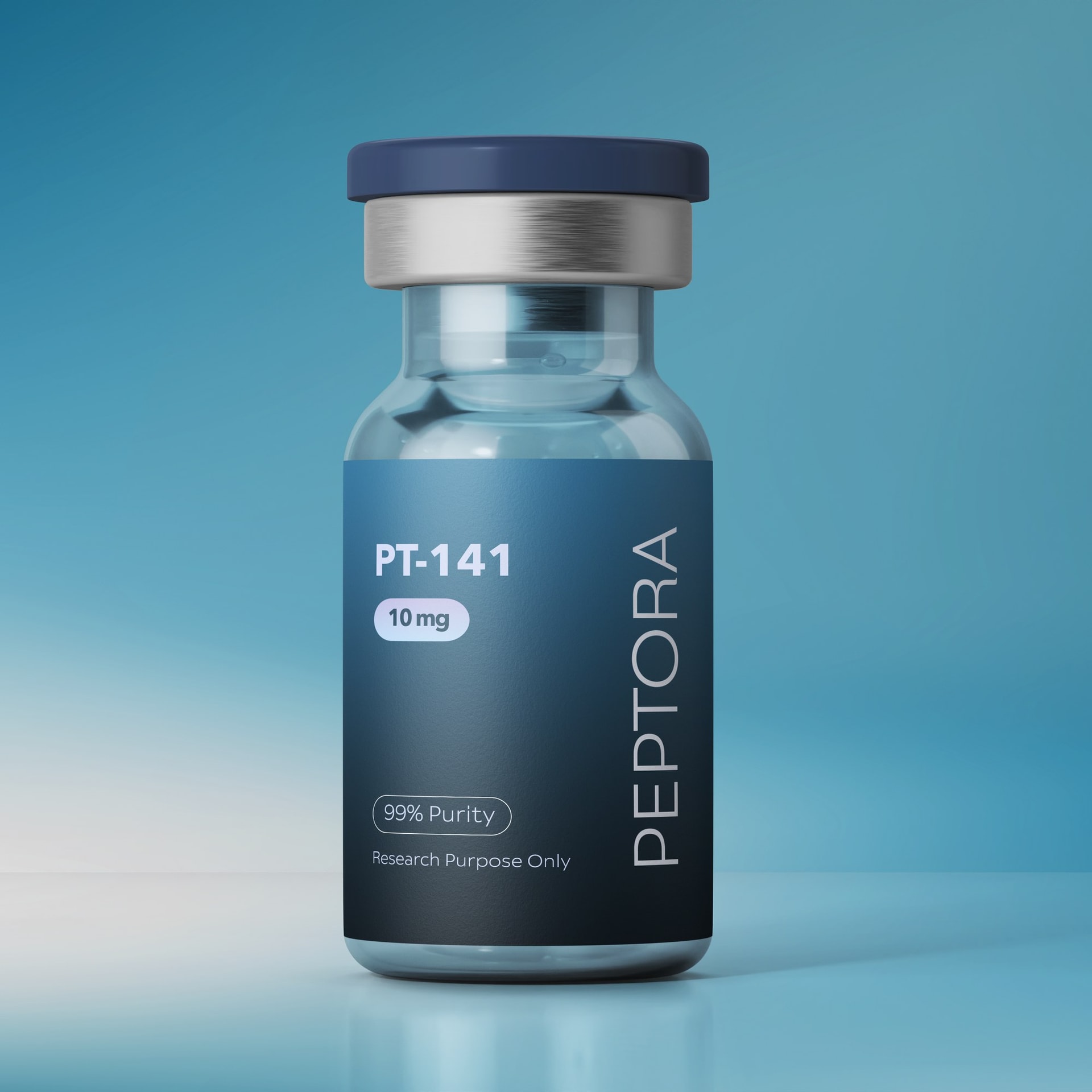
MT-2 fits many of the melanocortin locks, while some related compounds are pickier and mainly fit one. The best-known example is bremelanotide (PT-141), which scientists study more for a single lock (MC4R) in the brain. Here's how researchers line these tools up:
| Compound | What it is | Which locks | What scientists study it for |
|---|---|---|---|
| Melanotan II (MT-2) | Copy of α-MSH | Many locks (MC1R–MC5R) | Skin color, appetite, nerve signals |
| Bremelanotide (PT-141) | Copy of α-MSH | Mainly one lock (MC4R) | Brain-signal behavior models |
| α-MSH (native) | The body's own signal | Many locks | The natural 'key' for comparison |
Peptora carries versions of several of these, including Melanotan II (MT-2) and PT-141 (Bremelanotide) — each with its own certificate of analysis. For a simple starting point, see the research peptide overview.
Purity and testing (why the certificate matters)
In research, your results are only as trustworthy as the material you start with. Peptora's Melanotan II lots are tested for purity by HPLC at an independent lab, with LC-MS as a second test to confirm it's the right molecule. Each lot's results are published online as a certificate of analysis (COA).
Because a ring-shaped peptide only works right if its exact shape is correct, knowing you have the real thing — and that it's pure — really matters for clear results. To learn what the numbers on a certificate mean, see the guide on certificates of analysis.
How it's handled in the lab
Melanotan II ships as a freeze-dried powder (a dry powder with the water removed). Before it's used in research, it's mixed with bacteriostatic water — a special sterile water, sold separately. A little care keeps the peptide intact so the results stay reliable:
- 1Let the sealed vial warm up to room temperature before opening it.
- 2Add the water slowly down the side of the vial, then swirl gently — don't shake.
- 3Wait until the powder is fully dissolved before drawing anything out.
- 4Keep the mixed solution in the fridge, away from light.
Step-by-step details are in the reconstitution guide. Doing these the same way every time is one of the easiest ways to keep research consistent.
Scientific references
Melanotan II has mostly been studied in early animal and cell research, as a tool for learning how the melanocortin locks work. The studies listed below are here for background, from PubMed. They describe research on the compound itself — not the laboratory research product Peptora supplies.
- 1Eliason NL, et al. Melanocortin receptor agonist melanotan-II microinjected in the nucleus accumbens decreases appetitive and consumptive responding for food. Neuropeptides. 2022;96:102289. doi:10.1016/j.npep.2022.102289.
- 2Tomassi S, et al. CLIPSing Melanotan-II to Discover Multiple Functionally Selective hMCR Agonists. J Med Chem. 2022;65(5):4007-4017. doi:10.1021/acs.jmedchem.1c01848.
- 3McMillan TR, et al. Melanotan II, a melanocortin agonist, partially rescues the impaired thermogenic capacity of PACAP-deficient mice. Exp Physiol. 2021;106(2):427-437. doi:10.1113/EP088838.
- 4Ter Laak MP, et al. The potent melanocortin receptor agonist melanotan-II promotes peripheral nerve regeneration and has neuroprotective properties in the rat. Eur J Pharmacol. 2003;462(1-3):179-183. doi:10.1016/s0014-2999(02)02945-x.
- 5Banno R, et al. The melanocortin agonist melanotan II increases insulin sensitivity in OLETF rats. Peptides. 2004;25(8):1279-1286. doi:10.1016/j.peptides.2004.05.007.
- 6Minakova E, et al. Melanotan-II reverses autistic features in a maternal immune activation mouse model of autism. PLoS One. 2019;14(1):e0210389. doi:10.1371/journal.pone.0210389.
Explore Melanotan II (MT-2)
Independently lab tested, with each lot's certificate of analysis published online, and fast U.S. shipping — for laboratory research use only.
View Melanotan II (MT-2)Key takeaways
- Melanotan II (Peptora's MT-2) is a lab-made copy of a natural body signal called α-MSH.
- It fits several of the body's melanocortin 'locks' at once — the two studied most are MC1R and MC4R.
- Scientists use it as a research tool in studies of skin color, appetite and energy, and nerve protection.
- The research here is shared for background only. MT-2 is not an approved drug, cosmetic, or tanning product, and it's for laboratory research only — not for people or animals.
- Lots are tested by an independent lab (HPLC, LC-MS), and each lot's results are published online as a certificate of analysis.
Frequently asked questions
This article is intended solely as an educational summary of publicly available scientific literature. Products offered by Peptora are supplied exclusively for laboratory research purposes and are not approved for human or veterinary use. The information presented should not be interpreted as medical advice, treatment recommendations, or clinical guidance.