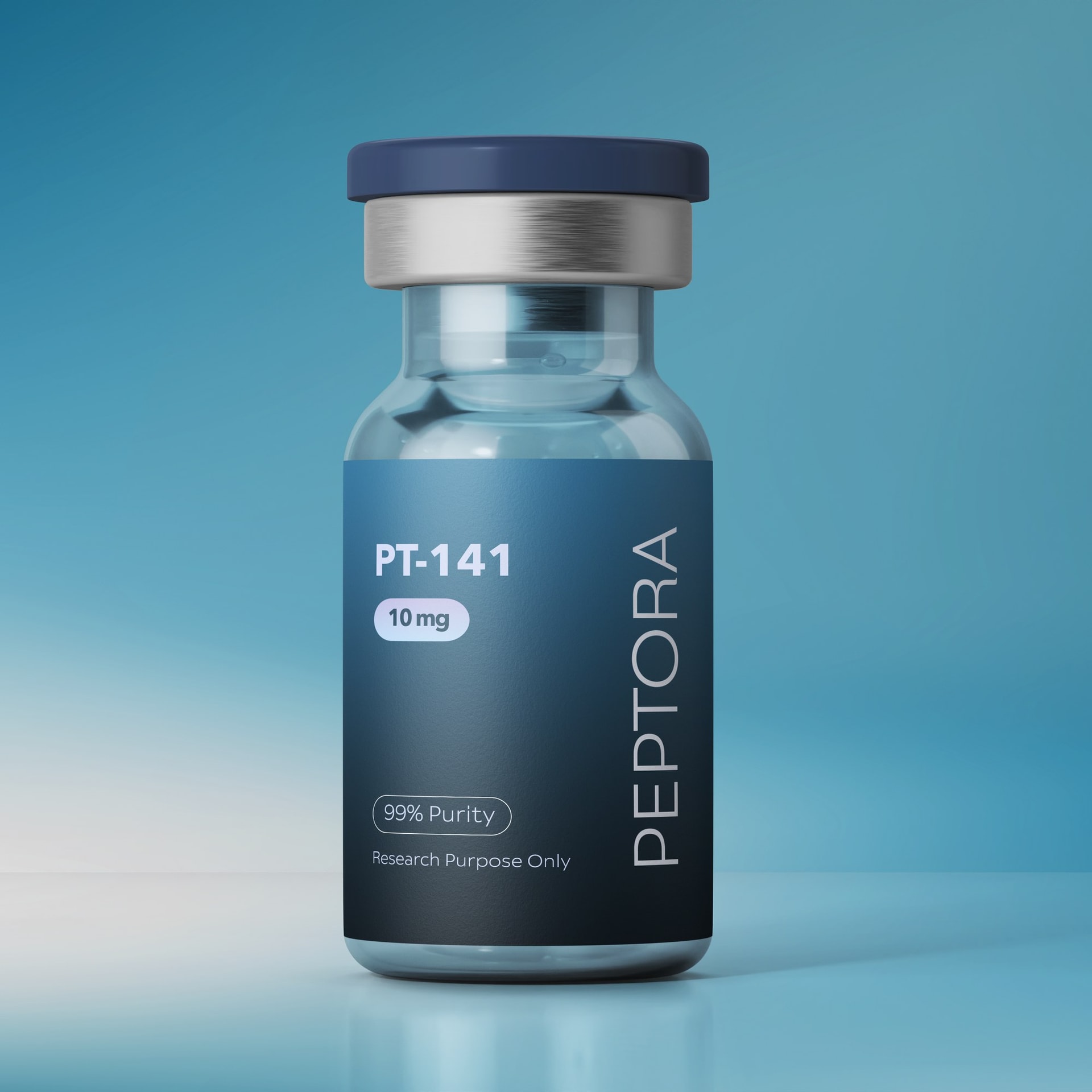
What is PT-141 (Bremelanotide)?
PT-141 is the research name for bremelanotide, a lab-made copy of a natural body signal called α-MSH (short for alpha-melanocyte-stimulating hormone). It's a small, ring-shaped protein. PT-141 belongs to a group called melanocortin-receptor agonists — a mouthful that simply means compounds that switch on the melanocortin receptors. Those receptors are docking points on cells (there are five, named MC1R through MC5R), and together they make up the body's melanocortin system, which carries several kinds of signals. PT-141 is especially drawn to one of them, the MC4R, which sits in the brain.
So why do scientists study it? PT-141 gives researchers a reliable way to switch on the melanocortin system and watch what happens, which makes it a handy tool for studying these brain signals. It grew out of research on an earlier melanocortin compound and was developed as a drug by Palatin Technologies, which later handed off the rights to AMAG Pharmaceuticals. Throughout this guide, PT-141 is treated strictly as a laboratory research compound — the material Peptora supplies is not a medicine, and nothing here describes use, dosing, or giving it to people or animals.
The quick version
A copy of α-MSH
A small, ring-shaped lab-made protein modeled on a natural body signal called α-MSH.
Switches on melanocortin receptors
Studied for turning on the melanocortin receptors (docking points on cells), especially the MC4R.
A tool for the melanocortin system
Used in research to explore the brain's melanocortin signals and how α-MSH look-alikes behave.
99%+ pure
Double-checked by lab testing (HPLC and LC-MS), with a certificate for every batch — research use only.
Work with research-grade PT-141
A melanocortin-system research tool, 99%+ pure, with a certificate of analysis in every order — for laboratory research use only.
View PT-141How PT-141 works, in plain terms
The part scientists study centers on the melanocortin receptors — a family of five docking points on cells (MC1R through MC5R) that respond to natural signals like α-MSH:
- A copy of α-MSH — bremelanotide is a lab-made look-alike of α-MSH, the body's own signal that naturally switches on several melanocortin receptors.
- MC4R activity — studies describe bremelanotide as switching on the melanocortin receptors, and it's especially drawn to the MC4R, a docking point involved in brain and nervous-system signals.
- The brain's melanocortin system — because it engages these brain signals, PT-141 is studied as a tool for that system, rather than for the body's outer or blood-vessel pathways.
The wider melanocortin system comes up in review articles as an area of interest across several parts of the body. Because these signals can switch on more than one kind of receptor, a recurring question is exactly which receptors a given compound turns on, and how strongly.
The melanocortin system in context
PT-141 makes the most sense next to the wider family of melanocortin signals and the receptors they switch on. These receptors do very different jobs, and different melanocortin look-alikes are told apart by which receptors they aim at:
| Receptor | Broadly linked in research to | Notes |
|---|---|---|
| MC1R | Skin and hair color | Switched on by several α-MSH look-alikes |
| MC3R | Brain and energy signals | One of the brain's melanocortin receptors |
| MC4R | Brain and nervous-system signals | The one bremelanotide is best known for turning on |
| MC5R | Gland biology | A melanocortin receptor found outside the brain |
Review articles on the melanocortin system note that these brain signals have been studied across several areas of the body, and that a few melanocortin compounds have gone through drug development. PT-141 is one research tool within that bigger picture.
Clinical-development history
Bremelanotide has a clear record of drug development, which gives useful scientific background — while staying separate from the research-grade material Peptora supplies:
- Palatin Technologies and AMAG — bremelanotide was developed by Palatin Technologies, which later handed off the North American rights to AMAG Pharmaceuticals.
- Late-stage trials — two matching, carefully controlled late-stage trials (the RECONNECT studies) tested bremelanotide, and their results have been published in peer-reviewed journals.
- Reported side effects — across the trials, the side effects reported most often were nausea, flushing (a warm, red feeling in the skin), and headache, plus small, short-lived changes in blood pressure — all from the published clinical findings.
Two things are worth keeping in mind. First, this record describes drug research done as part of developing a prescription medicine — not the research-grade material Peptora supplies. Second, these are published findings — they are not claims that it works, medical advice, or instructions for use, and nothing here describes or supports use outside controlled research.
What scientists actually study it for
Across the melanocortin research, PT-141 (bremelanotide) shows up in a few connected areas:
- How it acts on the receptors — how an α-MSH look-alike switches on the melanocortin receptors, especially MC4R.
- The brain's melanocortin system — the network of signals that bremelanotide is used to explore.
- Which receptors it prefers — how strongly it turns on each of the different melanocortin receptors.
- Its drug-development record — the published mid- and late-stage trial results that frame how it's been studied.
These are published findings — they are not claims that it works, and nothing here describes or supports use outside controlled research.
Purity and testing (why the certificate matters)
In research, your results are only as trustworthy as the material you start with. Every batch of PT-141 from Peptora is checked to 99%+ purity by HPLC, confirmed by a second test (LC-MS) that proves it's the right molecule, and run through a full set of quality checks before it ships. Every order comes with a certificate of analysis (COA) so the material matches its paperwork.
Researchers often choose Peptora because that paperwork is standard here, not an add-on. To learn what the numbers on a certificate actually mean, see the guide on purity and certificates of analysis and the testing standards overview.
How it's handled in the lab
PT-141 ships as a freeze-dried powder. Before it's used in research, it's mixed with bacteriostatic water — a special sterile water, sold separately. A little care keeps the compound intact so the results stay reliable:
- 1Let the sealed vial warm up to room temperature before opening it.
- 2Add the water slowly down the side of the vial, then swirl gently — don't shake.
- 3Wait until the powder is fully dissolved before drawing anything out.
- 4Keep the mixed solution in the fridge, away from light.
Step-by-step details are in the reconstitution guide and the storage guide. Doing these the same way every time is one of the easiest ways to keep research consistent.
Scientific references
The studies listed below are here for background, from PubMed. They cover lab and clinical research on bremelanotide and the melanocortin system — they describe research on the compound itself, not the laboratory research product Peptora supplies. This is a summary of published findings, not medical guidance.
- 1Kingsberg SA, Clayton AH, Portman D, et al. Bremelanotide for the Treatment of Hypoactive Sexual Desire Disorder: Two Randomized Phase 3 Trials. Obstet Gynecol. 2019;134(5):899-908. doi:10.1097/AOG.0000000000003500 (PMID: 31599840; NCT02333071, NCT02338960).
- 2Dhillon S, Keam SJ. Bremelanotide: First Approval. Drugs. 2019;79(14):1599-1606. doi:10.1007/s40265-019-01187-w (PMID: 31429064).
- 3Sweeney P, Gimenez LE, Hernandez CC, Cone RD. Targeting the central melanocortin system for the treatment of metabolic disorders. Nat Rev Endocrinol. 2023;19(9):507-519. doi:10.1038/s41574-023-00855-y (PMID: 37365323).
- 4Clayton AH, Kingsberg SA, Portman D, et al. Safety Profile of Bremelanotide Across the Clinical Development Program. J Womens Health (Larchmt). 2022;31(2):171-182. doi:10.1089/jwh.2021.0191 (PMID: 35147466).
- 5White WB, Myers MG, Jordan R, Lucas J. Usefulness of ambulatory blood pressure monitoring to assess the melanocortin receptor agonist bremelanotide. J Hypertens. 2017;35(4):761-768. doi:10.1097/HJH.0000000000001221 (PMID: 27977473).
- 6Mayer D, Lynch SE. Bremelanotide: New Drug Approved for Treating Hypoactive Sexual Desire Disorder. Ann Pharmacother. 2020;54(7):684-690. doi:10.1177/1060028019899152 (PMID: 31893927).
Explore research-grade PT-141
99%+ pure, a certificate of analysis with every batch, fast U.S. shipping — for laboratory research use only.
View PT-141Key takeaways
- PT-141 is the research name for bremelanotide, a lab-made copy of a natural body signal called α-MSH.
- It's studied for switching on the melanocortin receptors (docking points on cells), especially the MC4R in the brain, which is part of the melanocortin system.
- Bremelanotide was developed as a drug by Palatin Technologies, which later handed off the rights to AMAG Pharmaceuticals, with published mid- and late-stage (RECONNECT) trial results.
- The published trials reported common side effects (nausea, flushing, headache) and small, short-lived blood-pressure changes — background from the clinical findings, not guidance.
- PT-141 is a laboratory research compound only; the research behind it describes drug and lab studies, not the research-grade material Peptora supplies, and makes no claims that it works.
- Peptora's PT-141 is a freeze-dried powder, checked to 99%+ purity with a certificate of analysis, mixed with bacteriostatic water before research use.
Frequently asked questions
This article is intended solely as an educational summary of publicly available scientific literature. Products offered by Peptora are supplied exclusively for laboratory research purposes and are not approved for human or veterinary use. The information presented should not be interpreted as medical advice, treatment recommendations, or clinical guidance.