
The short answer
Picture a cell as a building, and the mitochondria as the little power plants inside it that make the building's energy. Both of these peptides get filed under "mitochondrial research," which makes people assume they are interchangeable. They are not — they do close to opposite jobs.
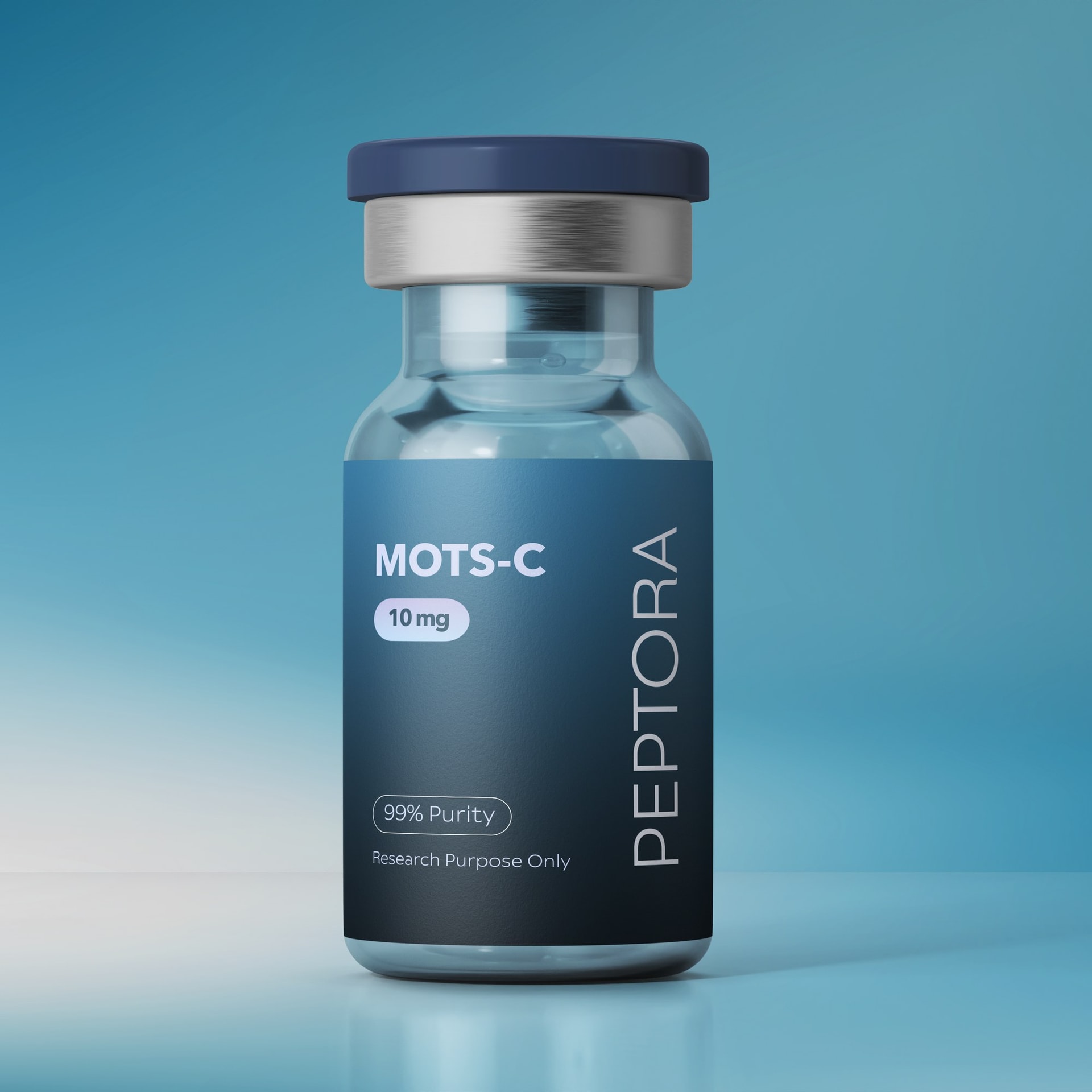
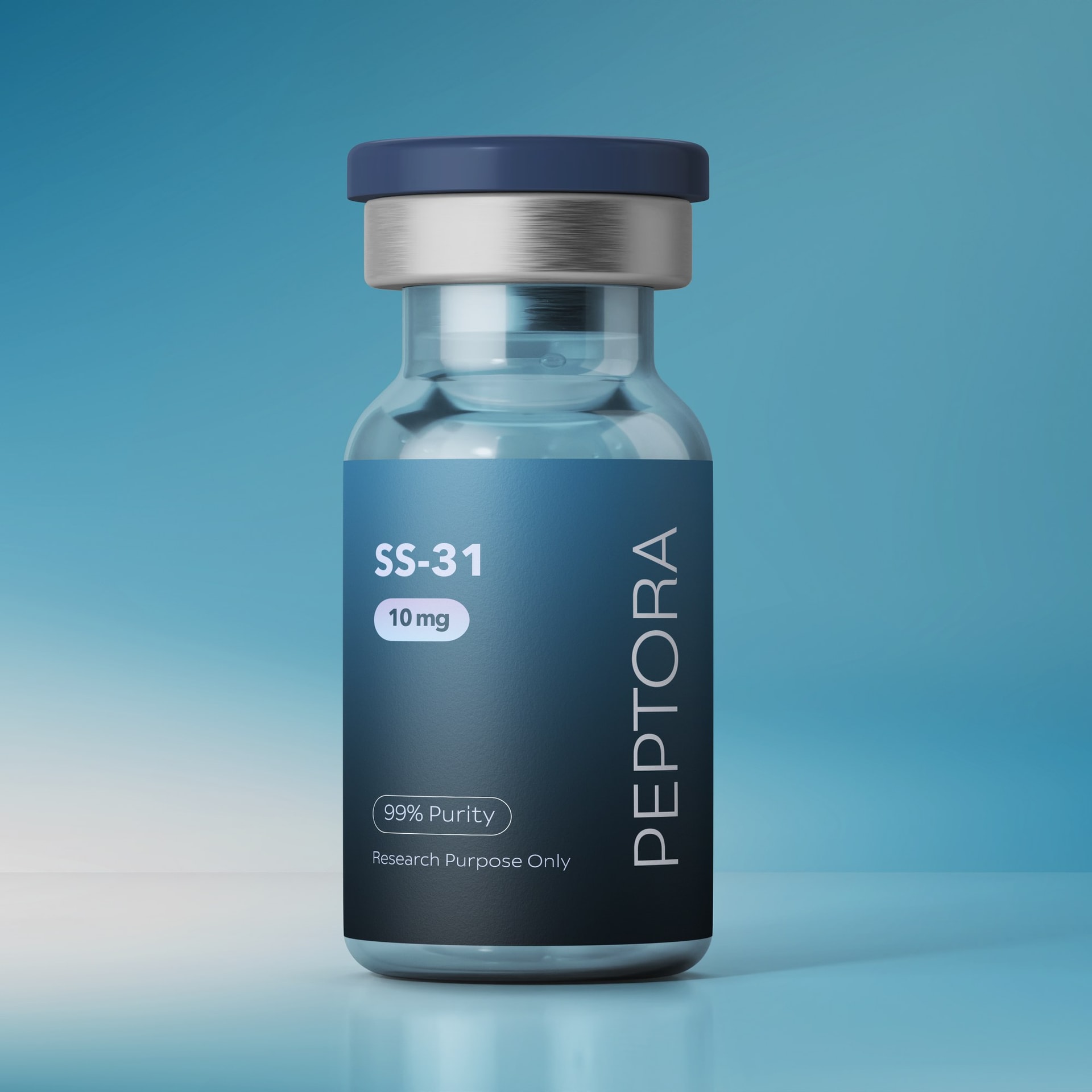
MOTS-c is a message the power plant sends out. It is a real signal your own mitochondria produce, and it travels out to talk to the rest of the cell — and even the rest of the body. SS-31 sends no message at all. It goes and sits in the inner wall of the power plant and is studied for whether it helps that wall keep its shape.
Explore research-grade MOTS-c
99%+ pure, a certificate of analysis with every batch — for laboratory research use only.
View MOTS-cThe quick version
MOTS-c — the messenger
A 16-piece peptide your mitochondria actually encode and release. Studied as a signal about energy and exercise.
SS-31 — the wall worker
A 4-piece synthetic peptide that binds a fat called cardiolipin in the mitochondrial inner wall.
Natural vs designed
MOTS-c was discovered in the human mitochondrial genome. SS-31 was invented in a lab.
Lab use only
Peptora supplies both as research chemicals — never for people or animals.
MOTS-c: a message from inside the power plant
Here is the part that surprises people. Mitochondria carry their own small set of genes, separate from the ones in the cell's nucleus. In 2015, researchers at the University of Southern California reported that a stretch of that mitochondrial DNA quietly codes for a 16-amino-acid peptide — a chain of 16 building blocks — which they named MOTS-c. In other words, the power plant writes its own memo.
That memo does not stay put. In the published work, MOTS-c moves into the cell's nucleus (the control room where the main genes live) under metabolic stress and is described as influencing which genes get switched on. It has also been measured circulating in blood. Because of that, researchers call it a mitochondrial-derived peptide — a signal that starts in the power plant and acts elsewhere.
What is it studied for? Mostly things connected to energy handling: how skeletal muscle deals with glucose, what happens to those signals in aging, and — the finding that got the most attention — its link to exercise. A 2021 report described MOTS-c levels rising in human muscle and blood after exercise, and examined intermittent MOTS-c treatment in mice of different ages. Those are laboratory and animal findings, not conclusions about people.
SS-31: a peptide that works on the wall
SS-31 — also called elamipretide — took the opposite route. It is not something the body makes. It is a four-amino-acid peptide designed in a lab at Weill Cornell Medicine and later developed by the company Stealth BioTherapeutics.
Its whole story is about one place. The inside of a mitochondrion is not a smooth bag; its inner membrane is folded over and over like an accordion, and those folds are where energy actually gets made. Holding those folds in shape is a distinctive fat called cardiolipin. SS-31 binds tightly to cardiolipin, which is how it ends up concentrated exactly there and almost nowhere else.
Later work using cross-linking mass spectrometry — a technique that chemically staples a molecule to whatever it is touching, so you can identify the neighbors — mapped which mitochondrial proteins sit near SS-31. Every one of them was already known to bind cardiolipin, which supported the idea that SS-31's address really is the inner membrane.
Side by side
| MOTS-c | SS-31 (elamipretide) | |
|---|---|---|
| Where it comes from | Encoded by human mitochondrial DNA | Designed in a laboratory |
| Size | 16 amino acids | 4 amino acids |
| What it does | Acts as a signal to other parts of the cell | Binds cardiolipin in the inner membrane |
| Main research angle | Metabolism, exercise, aging | Membrane structure and energy production |
| First reported | 2015 (USC) | Early 2010s (Weill Cornell) |
| Human trial record | Early-stage research | Studied in company-run clinical trials |
The practical upshot for a lab: these two are not substitutes for each other. If the research question is about a signal — something being sent, measured, and responded to — that is MOTS-c territory. If the question is about the physical state of the inner membrane, that is SS-31 territory. Peptora carries research-grade MOTS-c and SS-31, each with its own certificate of analysis.
What they do have in common
- The same neighborhood. Both are studied in relation to mitochondria, so they show up in overlapping literature on cell energy and aging.
- Both are peptides. Short chains of amino acids, which means both are handled the same careful way in the lab.
- Both are still being characterized. Neither has a settled, complete picture — which is exactly why they are research compounds.
- Both ship lyophilized. Freeze-dried powder, reconstituted with bacteriostatic water before research use.
Purity and handling
Both are checked to 99%+ purity by HPLC — a machine that separates a sample into its parts so you can see exactly how much of it is the peptide you ordered — and confirmed by LC-MS, a second test proving the molecule is the right one. Every order ships with a certificate of analysis (COA) for that exact batch.
Both arrive lyophilized (freeze-dried) and are reconstituted — mixed with bacteriostatic water — before research use. Warm the sealed vial to room temperature first, add the water slowly down the side, swirl gently rather than shaking, and keep the mixed solution cold and out of light. Full steps are in the reconstitution guide, and what a certificate of analysis means explains the paperwork.
Scientific references
The sources below are listed for background, from PubMed and ClinicalTrials.gov. They describe research on the molecules themselves — not the laboratory research products Peptora supplies.
- 1Lee C, Zeng J, Drew BG, et al. The mitochondrial-derived peptide MOTS-c promotes metabolic homeostasis and reduces obesity and insulin resistance. Cell Metab. 2015;21(3):443-454. doi:10.1016/j.cmet.2015.02.009 (PMID: 25738459).
- 2Reynolds JC, Lai RW, Woodhead JST, et al. MOTS-c is an exercise-induced mitochondrial-encoded regulator of age-dependent physical decline and muscle homeostasis. Nat Commun. 2021;12(1):470. doi:10.1038/s41467-020-20790-0 (PMID: 33473109).
- 3Lee C, Kim KH, Cohen P. MOTS-c: A novel mitochondrial-derived peptide regulating muscle and fat metabolism. Free Radic Biol Med. 2016;100:182-187. doi:10.1016/j.freeradbiomed.2016.05.015 (PMID: 27216708).
- 4Zheng Y, Wei Z, Wang T. MOTS-c: A promising mitochondrial-derived peptide for therapeutic exploitation. Front Endocrinol (Lausanne). 2023;14:1120533. doi:10.3389/fendo.2023.1120533 (PMID: 36761202).
- 5Birk AV, Liu S, Soong Y, et al. The mitochondrial-targeted compound SS-31 re-energizes ischemic mitochondria by interacting with cardiolipin. J Am Soc Nephrol. 2013;24(8):1250-1261. doi:10.1681/ASN.2012121216 (PMID: 23813215).
- 6Chavez JD, Tang X, Campbell MD, et al. Mitochondrial protein interaction landscape of SS-31. Proc Natl Acad Sci U S A. 2020;117(26):15363-15373. doi:10.1073/pnas.2002250117 (PMID: 32554501).
- 7Tung C, Varzideh F, Farroni E, et al. Elamipretide: A Review of Its Structure, Mechanism of Action, and Therapeutic Potential. Int J Mol Sci. 2025;26(3):944. doi:10.3390/ijms26030944 (PMID: 39940712).
- 8Karaa A, Bertini E, Carelli V, et al. Efficacy and Safety of Elamipretide in Individuals With Primary Mitochondrial Myopathy: The MMPOWER-3 Randomized Clinical Trial. Neurology. 2023;101(3):e238-e252. doi:10.1212/WNL.0000000000207402 (ClinicalTrials.gov: NCT03323749).
Explore research-grade SS-31
99%+ pure, a certificate of analysis with every batch, fast U.S. shipping — for laboratory research use only.
View SS-31Key takeaways
- Both peptides are studied around mitochondria — the cell's power plants — but they do close to opposite jobs.
- MOTS-c is a natural 16-amino-acid signal encoded by mitochondrial DNA itself; it travels out and is studied as a messenger about metabolism, exercise, and aging.
- SS-31 (elamipretide) is a four-amino-acid peptide designed in a lab; it binds cardiolipin, a fat in the mitochondrial inner membrane, and is studied for that membrane's structure.
- MOTS-c was discovered in the human genome; SS-31 was invented. That difference shapes what each one is used to ask.
- They are not substitutes for each other — a signaling question calls for one, a membrane-structure question calls for the other.
- Peptora supplies both as laboratory research chemicals at 99%+ purity with a batch-specific certificate of analysis — never for people or animals.
Frequently asked questions
This article is intended solely as an educational summary of publicly available scientific literature. Products offered by Peptora are supplied exclusively for laboratory research purposes and are not approved for human or veterinary use. The information presented should not be interpreted as medical advice, treatment recommendations, or clinical guidance.