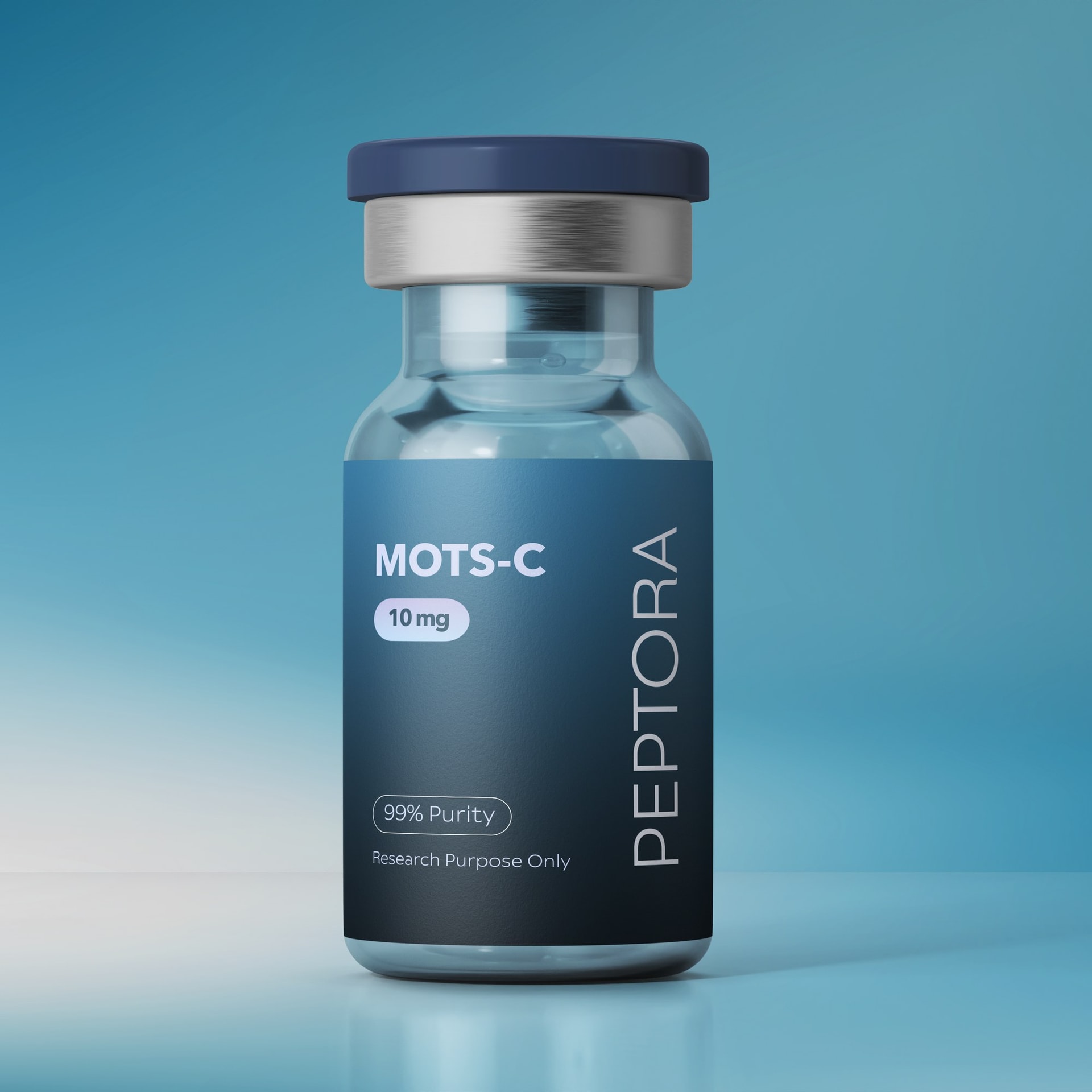

What is MOTS-c?
MOTS-c is a very small protein — a chain of just 16 amino acids (the building blocks of proteins). What makes it special is where its recipe is kept. Most of a cell's instructions live in the main DNA in the cell's nucleus, but MOTS-c is written in the separate, tiny set of genes inside the mitochondria — the little power plants that make energy for the cell. It's one of a small group known as mitochondrial-derived peptides (another is called humanin). When scientists found it in 2015, it was a clue that mitochondria don't just make energy — they can also send out their own messages to the rest of the cell.
So why do scientists study it? MOTS-c is interesting because of the direction its message travels. When a cell is under stress — for example, running low on energy — MOTS-c can move from the mitochondria back to the cell's control center (the nucleus) and help decide which genes get turned on. That backward, "power-plant-to-headquarters" signal is unusual, and it's a big reason researchers look at MOTS-c in studies of energy and metabolism. Throughout this guide, MOTS-c is treated strictly as a laboratory research compound — it is not a medicine, and nothing here describes use in people or animals.
The quick version
Made by the mitochondria
A tiny 16-building-block protein whose recipe lives in the mitochondria — the cell's power plants — not the main DNA.
Flips the energy sensor
Research links it to AMPK, a kind of "fuel gauge" inside cells that helps manage energy.
A backward signal
Studied for traveling from the mitochondria to the cell's control center under stress to help switch genes on or off.
99%+ pure
Double-checked by lab testing (HPLC and LC-MS), with a certificate for every batch — research use only.
Work with research-grade MOTS-c
A mitochondrial-made compound, 99%+ pure, with a certificate of analysis in every order — for laboratory research use only.
View MOTS-cHow MOTS-c works, in plain terms
The idea researchers describe most often is about how cells sense energy. In the first big study, MOTS-c was reported to work through the folate cycle — a normal chain of chemical steps cells use to build parts of DNA — and, through it, to switch on AMPK, the cell's main "fuel gauge" that keeps energy in balance:
- Muscle is the main focus — the first study pointed to skeletal muscle (the muscle you move with) as MOTS-c's main area, where it was tied to better blood-sugar handling.
- The folate cycle and AMPK — MOTS-c was reported to slow the folate cycle, which nudges the cell's "fuel gauge" (AMPK) to switch on — a theme that keeps coming up in later reviews.
- A stress signal to the control center — later research describes MOTS-c moving to the cell's control center under stress, where it's linked to genes that handle stress and mop up harmful molecules.
In that first study, adding MOTS-c was reported to keep mice from developing insulin resistance (when the body stops responding well to insulin) tied to age or a high-fat diet, and to hold off diet-driven weight gain in those mice. Findings like these got scientists thinking of MOTS-c as a possible link between the mitochondria's own genes and how the whole body manages energy.
MOTS-c, exercise & aging
A separate line of MOTS-c research connects it to exercise and to how bodies age. In a much-cited 2021 study, MOTS-c was described as something the body makes more of when it exercises:
- Exercise makes more of it — the study reported that, in people, exercise raises the body's own MOTS-c levels in muscle and in the blood.
- Fitness in mice — giving MOTS-c now and then was reported to improve physical performance in young, middle-aged, and old mice, even when started late in life.
- Levels drop with age — reviews note that the amount of MOTS-c in the blood has been reported to fall as animals get older, which is part of why scientists study its role in aging.
Beyond energy and aging, some early research has looked at MOTS-c in other settings — for example, blood-sugar control during pregnancy, and separate cell and animal studies exploring how it behaves in disease. These are still early findings from controlled research, not settled conclusions.
Where MOTS-c fits among similar compounds
MOTS-c makes the most sense next to the other tiny proteins written in the mitochondria's genes, and the wider group of compounds scientists study for energy and mitochondrial biology:
| Compound | Where it comes from | Studied for |
|---|---|---|
| MOTS-c | Made by the mitochondria's own genes | Blood sugar, cell energy sensing, exercise, aging |
| Humanin | Also made by the mitochondria's genes | Protecting cells and energy signaling |
| SS-31 (elamipretide) | A lab-made 4-building-block compound | The mitochondria's inner membrane |
| NAD+ precursors | Building blocks for a main-DNA energy pathway | Cell energy and sirtuin enzymes |
Scientists who study energy and aging often talk about these tools together. For a related topic, see the guide on NAD+ and its role in cell energy; Peptora also carries NAD+ as a research compound, each with its own batch-specific certificate of analysis.
What scientists actually study it for
In the lab, MOTS-c usually comes up in a few connected areas:
- Blood sugar and insulin — how MOTS-c is tied to the way muscle handles blood sugar, in cell and mouse studies.
- Energy sensing (AMPK) — the folate-cycle-to-AMPK idea that's proposed as how it works.
- Exercise — how the body makes more of it during exercise, and how it's linked to fitness in animal studies.
- Aging — how it behaves as an age-related stress signal from the mitochondria.
These are published findings, mostly early-stage — they are not proof that it works, and nothing here describes or supports use outside controlled research.
Purity and testing (why the certificate matters)
In research, your results are only as trustworthy as the material you start with. Every batch of MOTS-c from Peptora is checked to 99%+ purity by HPLC, confirmed by a second test (LC-MS) that proves it's the right molecule, and run through a full set of quality checks before it ships. Every order comes with a certificate of analysis (COA) so the material matches its paperwork.
Researchers often choose Peptora because that paperwork is standard here, not an add-on. To learn what the numbers on a certificate actually mean, see the guide on purity and certificates of analysis and the testing standards overview.
How it's handled in the lab
MOTS-c ships as a freeze-dried powder. Before it's used in research, it's mixed with bacteriostatic water — a special sterile water, sold separately. A little care keeps the compound intact so the results stay reliable:
- 1Let the sealed vial warm up to room temperature before opening it.
- 2Add the water slowly down the side of the vial, then swirl gently — don't shake.
- 3Wait until the powder is fully dissolved before drawing anything out.
- 4Keep the mixed solution in the fridge, away from light.
Step-by-step details are in the reconstitution guide and the storage guide. Doing these the same way every time is one of the easiest ways to keep research consistent.
Scientific references
The studies listed below are here for background, from PubMed. They cover the discovery of MOTS-c and early research into how it works — they describe research on the compound itself, not the laboratory research product Peptora supplies. This is a summary of published findings, not medical guidance.
- 1Lee C, Zeng J, Drew BG, et al. The mitochondrial-derived peptide MOTS-c promotes metabolic homeostasis and reduces obesity and insulin resistance. Cell Metab. 2015;21(3):443-454. doi:10.1016/j.cmet.2015.02.009 (PMID: 25738459).
- 2Reynolds JC, Lai RW, Woodhead JST, et al. MOTS-c is an exercise-induced mitochondrial-encoded regulator of age-dependent physical decline and muscle homeostasis. Nat Commun. 2021;12(1):470. doi:10.1038/s41467-020-20790-0 (PMID: 33473109).
- 3Lee C, Kim KH, Cohen P. MOTS-c: A novel mitochondrial-derived peptide regulating muscle and fat metabolism. Free Radic Biol Med. 2016;100:182-187. doi:10.1016/j.freeradbiomed.2016.05.015 (PMID: 27216708).
- 4Wan W, Zhang L, Lin Y, et al. Mitochondria-derived peptide MOTS-c: effects and mechanisms related to stress, metabolism and aging. J Transl Med. 2023;21(1):36. doi:10.1186/s12967-023-03885-2 (PMID: 36670507).
- 5Zheng Y, Wei Z, Wang T. MOTS-c: A promising mitochondrial-derived peptide for therapeutic exploitation. Front Endocrinol (Lausanne). 2023;14:1120533. doi:10.3389/fendo.2023.1120533 (PMID: 36761202).
- 6Yin Y, Pan Y, He J, et al. The mitochondrial-derived peptide MOTS-c relieves hyperglycemia and insulin resistance in gestational diabetes mellitus. Pharmacol Res. 2021;175:105987. doi:10.1016/j.phrs.2021.105987 (PMID: 34798268).
Explore research-grade MOTS-c
99%+ pure, a certificate of analysis with every batch, fast U.S. shipping — for laboratory research use only.
View MOTS-cKey takeaways
- MOTS-c is a tiny protein — 16 building blocks long — whose recipe lives in the mitochondria's own genes, not the cell's main DNA. It's one of a small group of "mitochondria-made" proteins.
- Scientists study it as a backward stress signal that can travel to the cell's control center when energy runs low, working largely through the folate cycle and the cell's "fuel gauge," AMPK.
- Its main focus is muscle, where it's tied to better blood-sugar handling; in the first study it was reported to reduce insulin resistance and diet-driven weight gain in mice.
- A separate line of research ties MOTS-c to exercise and to fitness in aging mice, with blood levels reported to drop as animals get older.
- MOTS-c is a laboratory research compound only; the research behind it is mostly early-stage and makes no claims about working in people.
- Peptora's MOTS-c is a freeze-dried powder, checked to 99%+ purity with a certificate of analysis, mixed with bacteriostatic water before research use.
Frequently asked questions
This article is intended solely as an educational summary of publicly available scientific literature. Products offered by Peptora are supplied exclusively for laboratory research purposes and are not approved for human or veterinary use. The information presented should not be interpreted as medical advice, treatment recommendations, or clinical guidance.