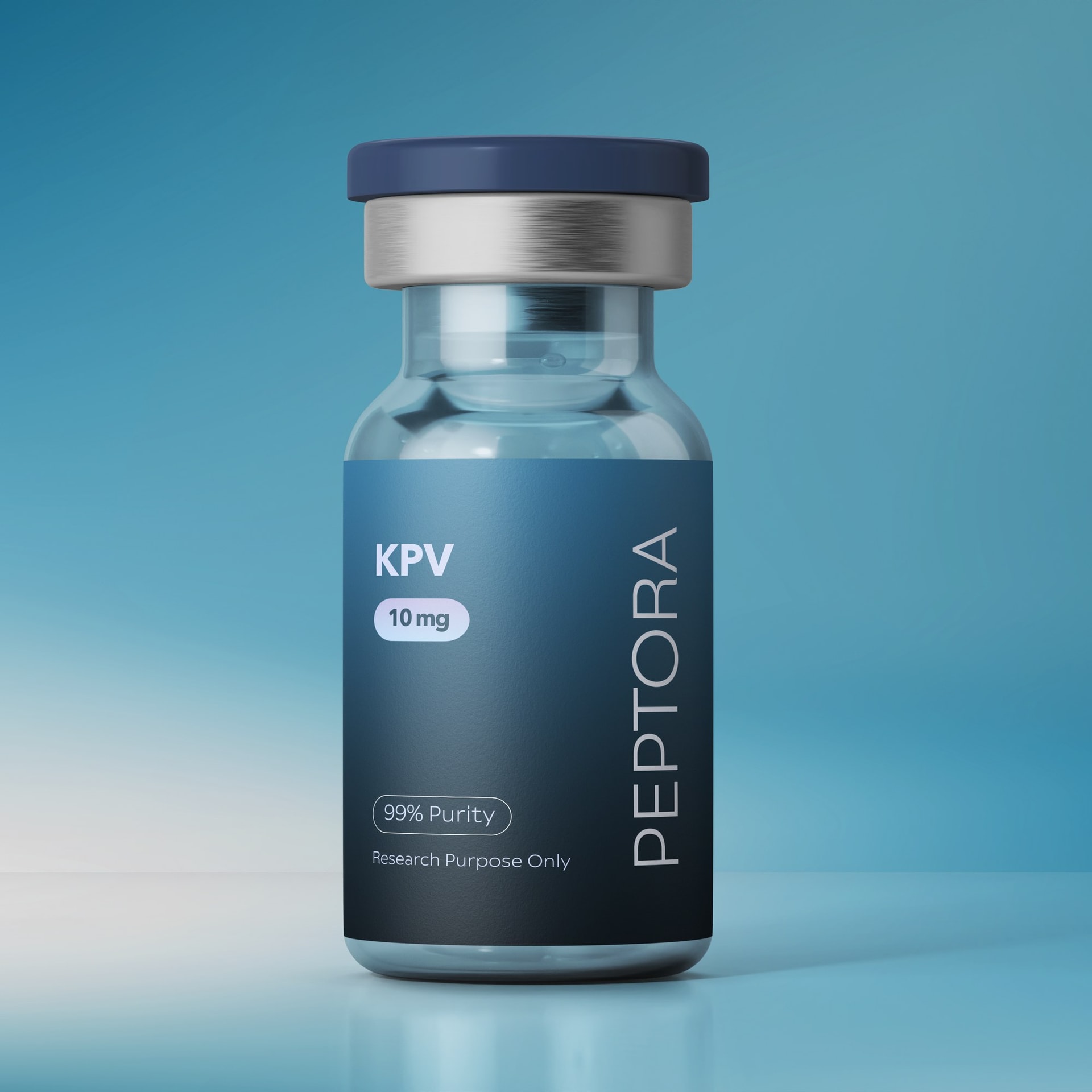



What is KPV?
KPV is one of the smallest peptides scientists study — a tripeptide, which just means it's only three building blocks long. Those three building blocks are the amino acids lysine, proline, and valine, and their one-letter codes spell out the name: K-P-V. A peptide itself is just a tiny protein — a short chain of these amino-acid building blocks.
What makes KPV interesting is where it comes from. It's the tail end of a bigger natural hormone called alpha-MSH (short for alpha-melanocyte-stimulating hormone). That parent hormone does two very different jobs: it can change skin pigment, and it can calm inflammation. The clever finding is that the tiny KPV tail seems to keep the calming side and leave the pigment side behind — a bit like keeping the useful part of a tool and trimming off the rest.
The quick version
Just three building blocks
Lysine-Proline-Valine — one of the shortest peptides in active research.
A fragment of a hormone
It's the tail of alpha-MSH, studied for its activity on inflammatory signaling without the pigment side.
Mostly preclinical
Studied largely in cell and animal models of inflammation, such as inflamed gut tissue.
Published lab results
Each lot's HPLC purity is listed on its certificate of analysis.
How it works, in plain terms
To picture KPV, start with its parent. Alpha-MSH is a natural hormone that, among other things, helps turn down inflammation — the body's redness-and-swelling response. Researchers wanted that calming action without the hormone's other effects, so they looked at its smallest active pieces. KPV, the three-building-block tail, turned out to keep most of the calming behavior on its own.
Here's what published studies describe, in everyday language:
- It acts on inflammation signals in lab models. In lab studies, KPV lowers the activity of a master "inflammation switch" inside cells (researchers call it NF-κB) and reduces inflammatory messengers.
- It may not need the usual docking spot. Interestingly, KPV appears to work even in cells without a functioning melanocortin-1 receptor — the docking spot the full hormone uses — so scientists think it may act at least partly through a different route.
- It travels into cells. Some research suggests KPV can be carried inside cells, where it may act directly on the inflammation machinery.
- It skips the pigment effect. Because it lacks the part of alpha-MSH that binds pigment-related receptors, it doesn't drive the skin-darkening the full hormone can.
What scientists actually study it for
Because it's a small, stable, anti-inflammatory fragment, KPV comes up most often in research on inflamed tissue. The main areas in the literature are:
- Gut inflammation — the most-studied area. KPV has been evaluated in mouse and rat models of inflammatory bowel disease (colitis), including studies that packaged it into nanoparticles or hydrogels to deliver it to the colon.
- Skin cells — how it signals inside human skin cells (keratinocytes), part of why it's of interest in skin-inflammation research.
- Immune activity — its effects on immune-cell behavior and the inflammatory messengers cells release.
- Delivery methods — a lot of recent work is really about *how* to deliver such a tiny, fragile peptide to the right tissue in a lab model.
Purity and testing (why the certificate matters)
In research, your results are only as trustworthy as the material you start with — and tiny peptides like KPV can be fragile, so quality really matters. Peptora's KPV lots are tested for purity by HPLC at an independent lab, with LC-MS as a second test to confirm it's the right molecule. Each lot's results are published online as a certificate of analysis (COA).
To learn what the numbers on a certificate actually mean, see the guide on what a certificate of analysis is and the research-peptide overview.
How it's handled in the lab
KPV ships as a freeze-dried powder (that's what lyophilized means — the water has been removed to keep it stable). Before it's used in research, it's mixed with bacteriostatic water — a special sterile water, sold separately. This step is called reconstitution, which just means "mixing the powder back into a liquid." A little care keeps the peptide intact so results stay reliable:
- 1Let the sealed vial warm up to room temperature before opening it.
- 2Add the water slowly down the side of the vial, then swirl gently — don't shake.
- 3Wait until the powder is fully dissolved before drawing anything out.
- 4Keep the mixed solution in the fridge, away from light.
Step-by-step details are in the reconstitution guide. Doing these the same way every time is one of the easiest ways to keep research consistent.
Scientific references
KPV is the C-terminal tripeptide of alpha-MSH and has been studied mostly in cell and animal models of inflammation, including several models of colitis. The studies below are provided for background, from PubMed. They describe research on the compound itself — not the laboratory research product Peptora supplies.
- 1Kannengiesser K, et al. Melanocortin-derived tripeptide KPV has anti-inflammatory potential in murine models of inflammatory bowel disease. Inflamm Bowel Dis. 2008;14(3):324-331. doi:10.1002/ibd.20334 (PMID: 18092346).
- 2Luger TA, Brzoska T. alpha-MSH related peptides: a new class of anti-inflammatory and immunomodulating drugs. Ann Rheum Dis. 2007;66 Suppl 3:iii52-iii55. doi:10.1136/ard.2007.079780 (PMID: 17934097).
- 3Brzoska T, et al. Terminal signal: anti-inflammatory effects of alpha-melanocyte-stimulating hormone related peptides beyond the pharmacophore. Adv Exp Med Biol. 2010;681:107-116. doi:10.1007/978-1-4419-6354-3_8 (PMID: 21222263).
- 4Elliott RJ, et al. alpha-Melanocyte-stimulating hormone, MSH 11-13 KPV and adrenocorticotropic hormone signalling in human keratinocyte cells. J Invest Dermatol. 2004;122(4):1010-1019. doi:10.1111/j.0022-202X.2004.22404.x (PMID: 15102092).
- 5Xiao B, et al. Orally Targeted Delivery of Tripeptide KPV via Hyaluronic Acid-Functionalized Nanoparticles Efficiently Alleviates Ulcerative Colitis. Mol Ther. 2017;25(7):1628-1640. doi:10.1016/j.ymthe.2016.11.020 (PMID: 28143741).
- 6Sun J, et al. Self-Cross-Linked Hydrogel of Cysteamine-Grafted gamma-Polyglutamic Acid Stabilized Tripeptide KPV for Alleviating TNBS-Induced Ulcerative Colitis in Rats. ACS Biomater Sci Eng. 2021;7(10):4859-4869. doi:10.1021/acsbiomaterials.1c00792 (PMID: 34547895).
Explore KPV
Independently lab tested, with each lot's certificate of analysis published online, fast U.S. shipping — for laboratory research use only.
View KPVKey takeaways
- KPV is a tripeptide — just three building blocks (lysine, proline, and valine) — that forms the tail end of the natural hormone alpha-MSH.
- Scientists study it because that tiny tail appears to keep alpha-MSH's activity on inflammatory signaling in lab models while dropping the skin-pigment effect.
- In lab studies it lowers a cellular "inflammation switch" (NF-κB) and inflammatory messengers, and it may act even without the receptor the full hormone uses.
- Its most-studied research area is gut inflammation (colitis) in mouse and rat models, along with skin-cell and immune-cell studies — for laboratory research only, not for people or animals.
- It ships as a freeze-dried powder. Lots are tested by an independent lab (HPLC, LC-MS), and each lot's results are published online as a certificate of analysis.
Frequently asked questions
This article is intended solely as an educational summary of publicly available scientific literature. Products offered by Peptora are supplied exclusively for laboratory research purposes and are not approved for human or veterinary use. The information presented should not be interpreted as medical advice, treatment recommendations, or clinical guidance.