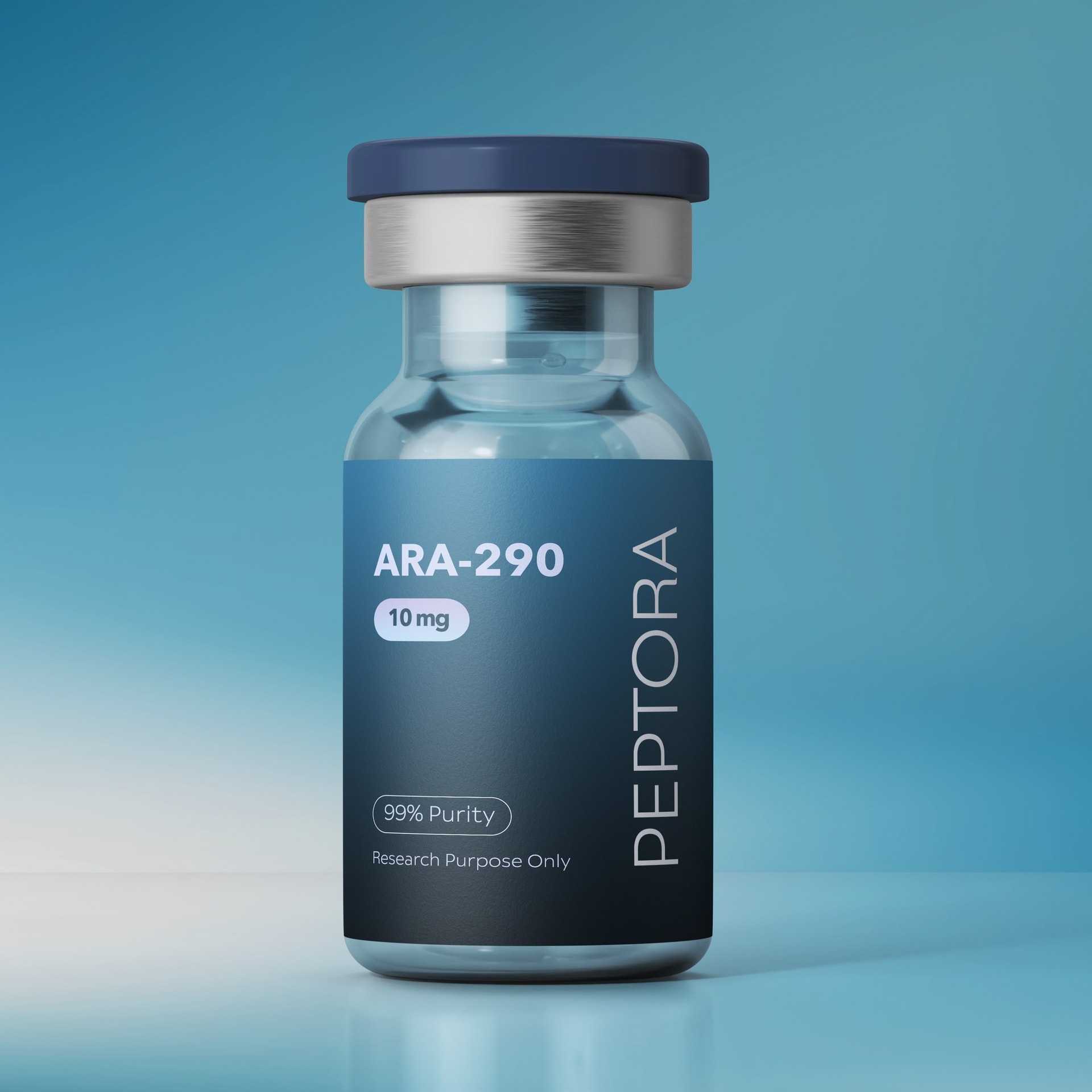



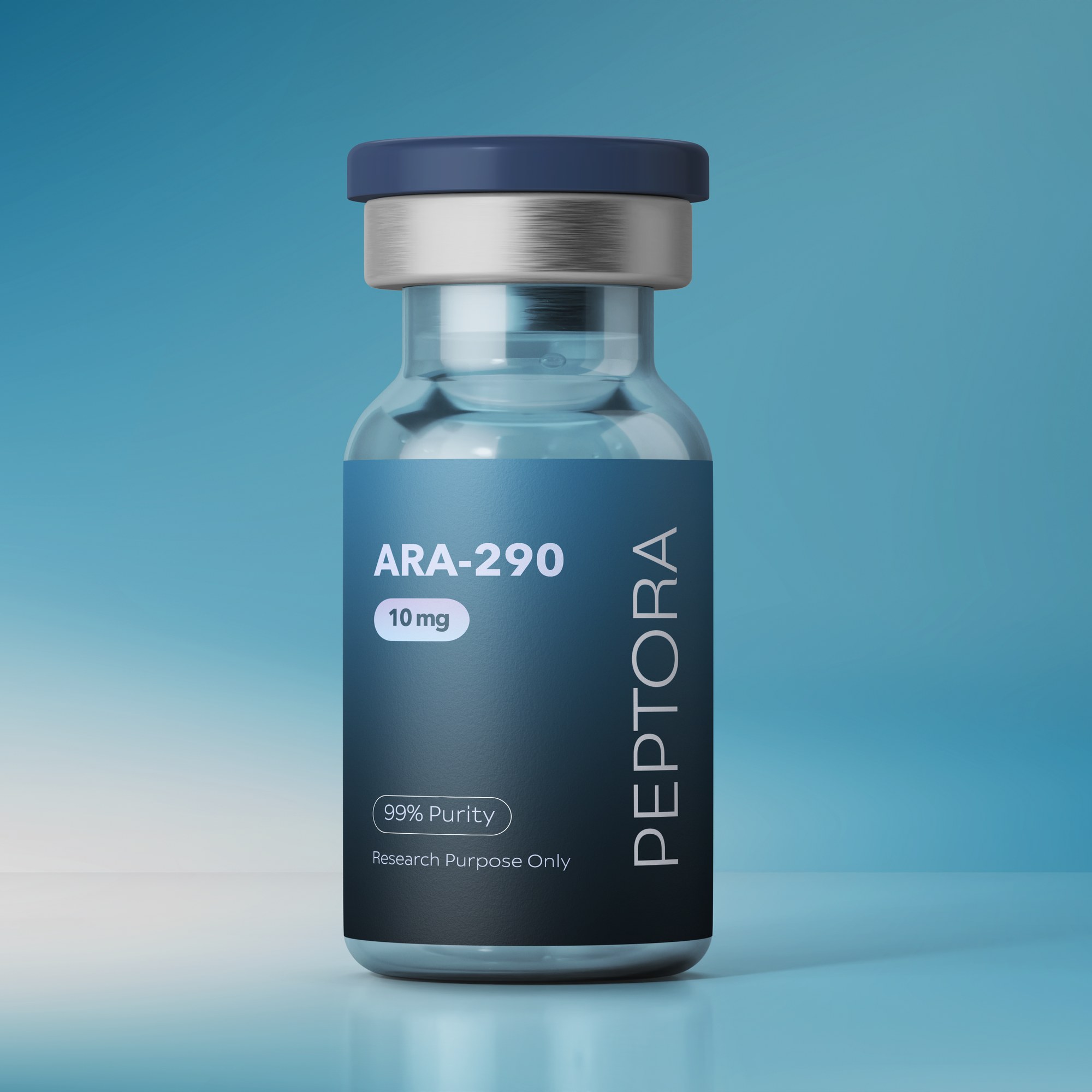
What is ARA-290 (Cibinetide)?
ARA-290 — also called cibinetide — is a peptide, which is just a tiny protein made of a short chain of building blocks. It was copied from one small piece of a natural hormone called erythropoietin (EPO for short). Most people know EPO for one thing: it tells the body to make more red blood cells. But researchers discovered EPO has a second, quieter job — it can switch on a repair-and-protect signal in tissue that has been injured or inflamed.
The catch is that using EPO itself to trigger repair is risky, because it also thickens the blood. So scientists took just the part of EPO responsible for the repair job — an 11-building-block stretch — and turned it into ARA-290. The result flips the repair switch only, and skips the red-blood-cell effect. That's the whole reason it draws scientific attention, and why you'll see it described as "non-erythropoietic" — a technical way of saying "it doesn't boost red blood cells."
The quick version
Copied from EPO
An 11-building-block peptide modeled on one part (helix B) of the hormone erythropoietin.
A single-receptor key
It acts on the innate repair receptor, but not the red-blood-cell receptor — the reason it lacks EPO's blood-thickening effect in studies.
Studied for nerves
Most research looks at small nerve fibers and neuropathy, in cells, animals, and early clinical trials.
Published lab results
Each lot's HPLC purity is listed on its certificate of analysis.
How it works, in plain terms
Cells listen for signals through receptors — think of a receptor as a docking spot on the outside of a cell, and a signal molecule as a key that fits it. EPO can fit two very different docking spots. One is the red-blood-cell docking spot (its classic job). The other only appears on tissue when that tissue is injured or inflamed — researchers call it the innate repair receptor, or the body's built-in "repair alarm."
ARA-290 was shaped to be a key that fits only the repair alarm. Here's what published studies describe, in everyday language:
- It targets the repair receptor, not the blood one. Because it skips the red-blood-cell docking spot, it doesn't raise red-cell counts the way EPO does.
- The repair receptor mostly shows up where there's damage. That means the signal is aimed at injured or stressed tissue rather than the whole body.
- It's tied to calming inflammation and protecting cells. In lab models, switching on this receptor is associated with reduced inflammation and tissue protection.
- A short life, a long effect. ARA-290 clears the bloodstream within minutes, yet studies report its biological effects last far longer — as if it flips a switch that stays on after the key is gone.
| Molecule | Red-blood-cell receptor | Injury-repair receptor | Boosts red blood cells? |
|---|---|---|---|
| Erythropoietin (EPO) | ✓ | ✓ | Yes |
| ARA-290 (cibinetide) | — | ✓ | No |
What scientists actually study it for
Because it aims at an injury-repair signal, ARA-290 shows up most in research on nerves and tissue protection. The main areas in the published literature are:
- Small nerve fibers — the tiny nerve endings in skin and cornea. In early trials, researchers measured whether ARA-290 was linked to more of these fibers using a non-invasive eye scan.
- Neuropathic pain (in research settings) — discomfort tied to damaged nerves, studied with questionnaires in small clinical trials and in animal models.
- Sarcoidosis and diabetes-related nerve loss — two conditions where small-fiber loss is common were the focus of early phase 2 studies.
- Tissue protection and inflammation — because the target receptor is a general repair signal, preclinical studies have evaluated it in models of injury and inflammation.
Purity and testing (why the certificate matters)
In research, your results are only as trustworthy as the material you start with. Peptora's ARA-290 lots are tested for purity by HPLC at an independent lab, with LC-MS as a second test to confirm it's the right molecule. Each lot's results are published online as a certificate of analysis (COA).
To learn what the numbers on a certificate actually mean, see the guide on what a certificate of analysis is and the research-peptide overview.
How it's handled in the lab
ARA-290 ships as a freeze-dried powder (that's what lyophilized means — the water has been removed to keep it stable). Before it's used in research, it's mixed with bacteriostatic water — a special sterile water, sold separately — a step called reconstitution ("mixing the powder back into a liquid"). A little care keeps the peptide intact so results stay reliable:
- 1Let the sealed vial warm up to room temperature before opening it.
- 2Add the water slowly down the side of the vial, then swirl gently — don't shake.
- 3Wait until the powder is fully dissolved before drawing anything out.
- 4Keep the mixed solution in the fridge, away from light.
Step-by-step details are in the reconstitution guide. Doing these the same way every time is one of the easiest ways to keep research consistent.
Scientific references
ARA-290 (cibinetide), a non-erythropoietic peptide engineered from erythropoietin, has been evaluated in preclinical models and in small early-phase clinical trials. The studies below are provided for background, from PubMed and ClinicalTrials.gov. They describe research on the compound itself — not the laboratory research product Peptora supplies.
- 1Brines M, et al. ARA 290, a nonerythropoietic peptide engineered from erythropoietin, improves metabolic control and neuropathic symptoms in patients with type 2 diabetes. Mol Med. 2015;20(1):658-666. doi:10.2119/molmed.2014.00215 (ClinicalTrials.gov: NCT01933529).
- 2Culver DA, et al. Cibinetide Improves Corneal Nerve Fiber Abundance in Patients With Sarcoidosis-Associated Small Nerve Fiber Loss and Neuropathic Pain. Invest Ophthalmol Vis Sci. 2017;58(6):BIO52-BIO60. doi:10.1167/iovs.16-21291 (NCT02039687).
- 3Collino M, Thiemermann C, Cerami A, Brines M. Flipping the molecular switch for innate protection and repair of tissues: Long-lasting effects of a non-erythropoietic small peptide engineered from erythropoietin. Pharmacol Ther. 2015;151:32-40. doi:10.1016/j.pharmthera.2015.02.005.
- 4Swartjes M, et al. Ketamine does not produce relief of neuropathic pain in mice lacking the β-common receptor (CD131). PLoS One. 2013;8(8):e71326. doi:10.1371/journal.pone.0071326.
- 5ClinicalTrials.gov registered studies of ARA 290 / cibinetide — e.g. NCT02039687 (sarcoidosis small-fiber neuropathy), NCT01933529 (type 2 diabetes), and NCT02070783 (healthy volunteers).
Explore ARA-290
Independently lab tested, with each lot's certificate of analysis published online, fast U.S. shipping — for laboratory research use only.
View ARA-290Key takeaways
- ARA-290 (cibinetide) is a small peptide copied from one part of the hormone erythropoietin (EPO), the hormone best known for making red blood cells.
- It was designed to act only on the "innate repair receptor" that appears on injured tissue — while skipping the red-blood-cell effect, which is why it's called non-erythropoietic.
- Most research studies small nerve fibers, neuropathic pain, tissue protection, and inflammation — in cells, animal models, and small early clinical trials.
- The clinical evidence is early and limited (phase 1–2), so it's a research tool, not a proven treatment. It's for laboratory research only, not for people or animals.
- It ships as a freeze-dried powder. Lots are tested by an independent lab (HPLC, LC-MS), and each lot's results are published online as a certificate of analysis.
Frequently asked questions
This article is intended solely as an educational summary of publicly available scientific literature. Products offered by Peptora are supplied exclusively for laboratory research purposes and are not approved for human or veterinary use. The information presented should not be interpreted as medical advice, treatment recommendations, or clinical guidance.