
What the word actually means
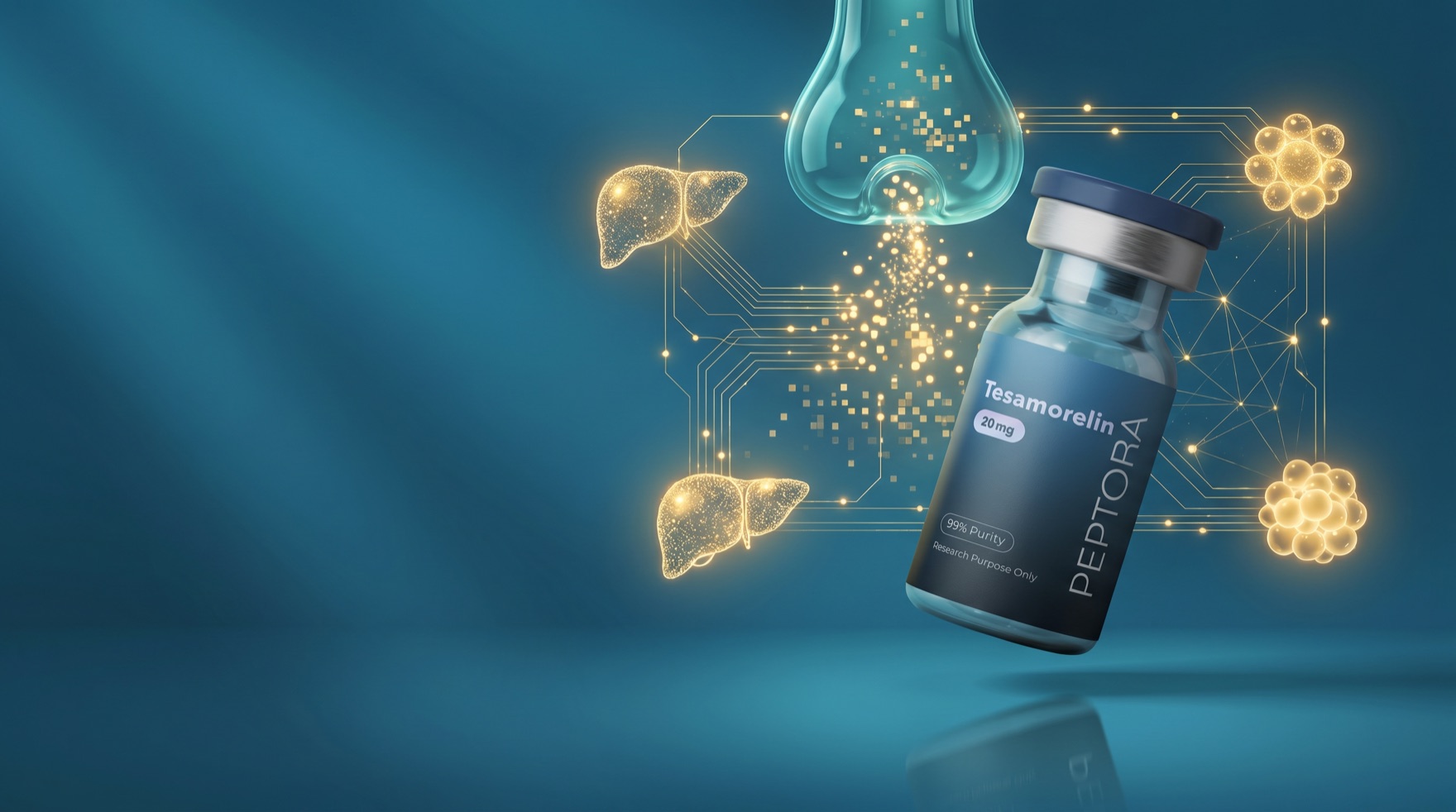
Secretagogue looks intimidating but breaks apart neatly: *secrete* + *-agogue*, which is an old word-ending meaning "leader" or "prompter." So a secretagogue is simply something that prompts a gland to release what it already makes. A growth hormone secretagogue prompts the pituitary gland — a small gland at the base of the brain — to release more of its own growth hormone.
That is the key distinction in this whole family. These compounds do not supply growth hormone from outside. They ask the gland to release more of its own, on the gland's own schedule. Published research describes that natural release as pulsatile — meaning it comes in bursts through the day rather than as a steady stream — and a secretagogue works by making those bursts bigger, not by replacing them.
The idea at a glance
Two doorbells, one gland
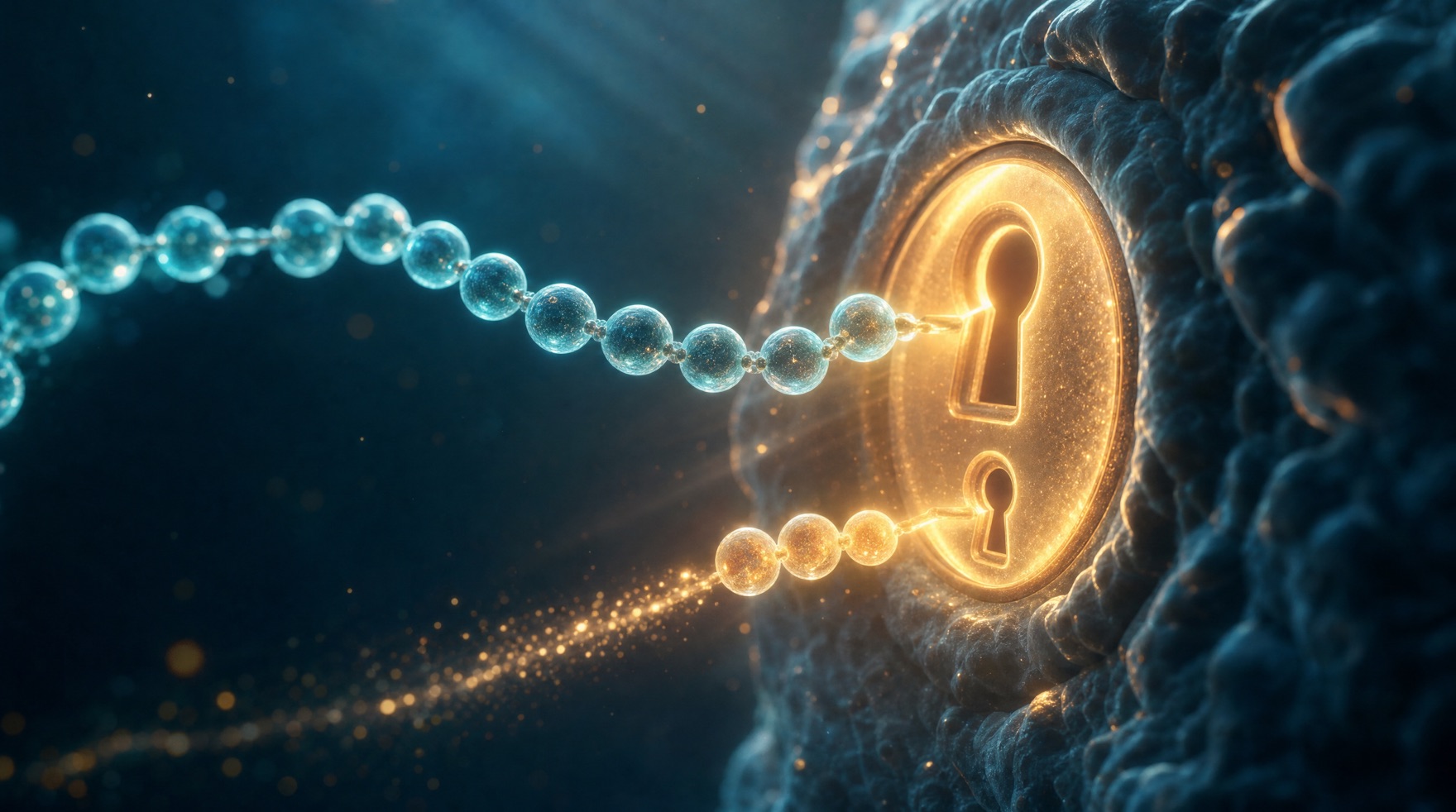
The pituitary responds to two separate signals — GHRH and ghrelin. Each has its own bell.
Bursts, not a steady stream
Growth hormone is released in pulses. Research describes secretagogues as making the pulses larger, not replacing them.
Two peptide families
GHRH copies (Sermorelin, CJC-1295, Tesamorelin) and ghrelin-style peptides (Ipamorelin and related compounds).
Lab use only
Studied in endocrine and body-composition research — never for use in people or animals outside a laboratory.
Explore a research-grade secretagogue
Sermorelin — 99%+ pure, a certificate of analysis with every batch, for laboratory research use only.
View SermorelinThe two doorbells on the gland
The most useful mental picture is a house with two separate doorbells, each wired to a different chime inside. Press either one and someone answers. Press both and the answer is louder than either alone. In the body, the two bells are:
- GHRH — short for growth hormone-releasing hormone, a 44-piece peptide made in the hypothalamus, a control centre just above the pituitary. This is the body's main everyday instruction to release growth hormone.
- Ghrelin — a 28-piece peptide discovered in the stomach in 1999. It presses a completely different bell, a receptor (docking spot) called GHS-R. Ghrelin is also involved in hunger signals, which is why it turns up in appetite research too.
There is also a brake. A third signal, somatostatin, works in the opposite direction — it quiets the release rather than prompting it. Published work describes the rhythm of growth hormone bursts as the result of GHRH, ghrelin, and somatostatin pushing and pulling on the same gland.
The ghrelin bell has an odd history worth knowing. Chemists built the first synthetic secretagogues in the 1970s and 1980s before anyone knew what natural signal they were imitating. The receptor was identified in 1996, and the body's own key for it — ghrelin — was not found until 1999. Researchers call that sequence reverse pharmacology: the copy came first, the original came later.
The two peptide families researchers use
Because there are two bells, there are two families of research peptides — one for each. Sorting any compound in this space starts with asking which bell it presses:
| Family | Which bell it presses | Examples studied in the literature | What it copies |
|---|---|---|---|
| GHRH analogs | The GHRH receptor | Sermorelin, CJC-1295, Tesamorelin | The hypothalamus signal |
| Ghrelin-style peptides | The GHS-R receptor | Ipamorelin, GHRP-family peptides | The stomach signal |
| Blends | Both bells at once | CJC-1295 + Ipamorelin, Tesamorelin + Ipamorelin | One of each |
The word analog just means a lab-made copy — usually one adjusted so it lasts longer than the natural version, which breaks down in minutes. Peptora carries research-grade versions across both families, including Sermorelin, Tesamorelin, CJC-1295 + Ipamorelin, and the Tesamorelin + Ipamorelin blend. The Sermorelin vs CJC-1295 vs Ipamorelin guide compares three of them directly.
Why blends pair one from each family
This is why you so often see a GHRH copy and a ghrelin-style peptide sold together in one vial. Published research on the two signals found that they do not simply add up — pressing both bells produces a larger response than either alone, an effect described in the literature as synergy. Studies have also described the two acting through different routes inside the cell, which is the mechanism usually offered to explain it.
One family member is worth singling out. Ipamorelin was described in 1998 as the first selective growth hormone secretagogue — meaning that in the reported experiments it prompted growth hormone release without stirring up several other hormones that earlier compounds in its family also affected. That selectivity is a large part of why it shows up so often in later research and in blends.
What scientists actually study them for
In published work, growth hormone secretagogues turn up in a few connected areas:
- How the release rhythm works — the basic biology of GHRH, ghrelin, and somatostatin shaping the pattern of growth hormone bursts.
- The IGF-1 signal — growth hormone prompts the liver to make IGF-1 (insulin-like growth factor 1), so IGF-1 is often what studies measure downstream.
- Body composition — the balance of lean tissue and fat, measured in animal models and in clinical trials of the compounds that have reached that stage.
- Diagnostic use — because these compounds prompt a measurable release, some have been investigated as a way to test how well a pituitary gland responds.
- Sleep and energy research — GHRH has been studied for a role in the sleep-wake cycle beyond its effect on the gland.
Why purity matters for this kind of research
Peptides in this family are small and short-lived, and experiments on them measure fine differences in timing and amount. Degraded or contaminated material shifts those measurements without announcing itself. Every batch of Peptora's secretagogue research peptides is checked to 99%+ purity by HPLC, confirmed by a second test (LC-MS) that proves it is the right molecule, and run through a full quality-control panel before it ships, with a certificate of analysis (COA) for that exact batch.
That paperwork is standard here, not an add-on. To learn what the numbers mean, see the guide on the certificate of analysis. These peptides ship as freeze-dried powder and are mixed with bacteriostatic water before research use — the reconstitution guide covers the steps.
Scientific references
This family has an unusually well-documented history, from the synthetic compounds of the 1980s through the identification of the receptor and its natural ligand. The papers below are the primary literature, from PubMed. They describe research on the compounds and the underlying biology themselves — not the laboratory research products Peptora supplies.
- 1Howard AD, et al. A receptor in pituitary and hypothalamus that functions in growth hormone release. Science. 1996;273(5277):974-977. doi:10.1126/science.273.5277.974 (PMID: 8688086).
- 2Kojima M, Hosoda H, Date Y, Nakazato M, Matsuo H, Kangawa K. Ghrelin is a growth-hormone-releasing acylated peptide from stomach. Nature. 1999;402(6762):656-660. doi:10.1038/45230 (PMID: 10604470).
- 3Smith RG. Development of growth hormone secretagogues. Endocr Rev. 2005;26(3):346-360. doi:10.1210/er.2004-0019 (PMID: 15814848).
- 4Raun K, et al. Ipamorelin, the first selective growth hormone secretagogue. Eur J Endocrinol. 1998;139(5):552-561. doi:10.1530/eje.0.1390552 (PMID: 9849822).
- 5Diéguez C, López M, Casanueva FF. Hypothalamic GHRH. Rev Endocr Metab Disord. 2025;26(3):297-303. doi:10.1007/s11154-025-09951-y (PMID: 39913072).
- 6Yang SK, Steyn F, Chen C. Influence of membrane ion channel in pituitary somatotrophs by hypothalamic regulators. Cell Calcium. 2012;51(3-4):231-239. doi:10.1016/j.ceca.2011.12.005 (PMID: 22243899).
- 7Grunfeld C, Dritselis A, Kirkpatrick P. Tesamorelin. Nat Rev Drug Discov. 2011;10(2):95-96. doi:10.1038/nrd3362 (PMID: 21283099).
Explore research-grade secretagogue peptides
Sermorelin, Tesamorelin, CJC-1295 + Ipamorelin — 99%+ pure, a certificate of analysis with every batch, for laboratory research use only.
View SermorelinKey takeaways
- "Secretagogue" means something that prompts a gland to release what it already makes — so a growth hormone secretagogue asks the pituitary for more of its own growth hormone rather than supplying it from outside.
- The gland has two separate doorbells: GHRH, made in the hypothalamus, and ghrelin, discovered in the stomach in 1999. A third signal, somatostatin, works as the brake.
- That splits the research peptides into two families — GHRH copies (Sermorelin, CJC-1295, Tesamorelin) and ghrelin-style peptides (Ipamorelin and related compounds).
- Blends usually pair one from each family, because published research describes a larger response when both bells are pressed than when either is pressed alone.
- Growth hormone is released in bursts rather than a steady stream, and the literature describes secretagogues as making the bursts larger rather than replacing them.
- Every Peptora peptide in this family is a laboratory research chemical only — 99%+ pure, verified by HPLC and LC-MS, with a certificate of analysis per batch.
Frequently asked questions
This article is intended solely as an educational summary of publicly available scientific literature. Products offered by Peptora are supplied exclusively for laboratory research purposes and are not approved for human or veterinary use. The information presented should not be interpreted as medical advice, treatment recommendations, or clinical guidance.