

The two-lock idea (start here)
These three names get compared constantly, and the comparison only makes sense once you know one thing: they are not three versions of the same compound. Two of them work one way, and the third works a completely different way.
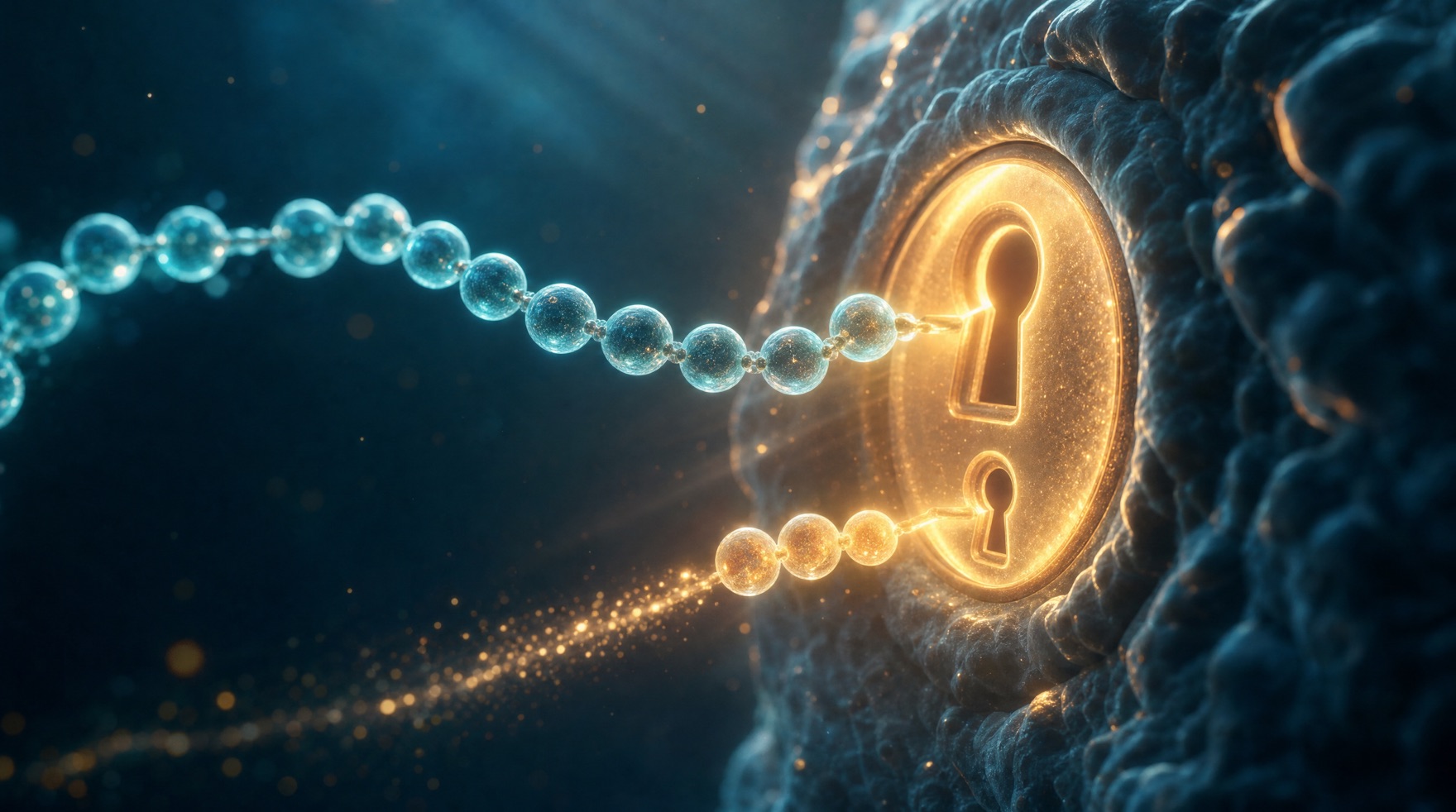
Here's the picture. The pituitary gland — a small gland at the base of the brain — is what releases growth hormone. Imagine a door on that gland with two separate locks on it, and either lock can open it:
- Lock #1 — the GHRH lock. The body's own key for this one is a hormone called GHRH (growth-hormone-releasing hormone). Sermorelin and CJC-1295 are both lab-made copies of that natural key.
- Lock #2 — the ghrelin lock. A completely different key fits here: a stomach hormone called ghrelin, discovered in 1999. Ipamorelin is a lab-made key cut to fit this second lock.
So the honest one-line summary is: Sermorelin vs CJC-1295 is a question of how long the key lasts. Ipamorelin vs either of them is a question of which lock you're using at all.
Explore secretagogues
Sermorelin and CJC-1295 + Ipamorelin — independently lab tested, with each lot's certificate of analysis published online, for laboratory research use only.
View SermorelinThe quick version
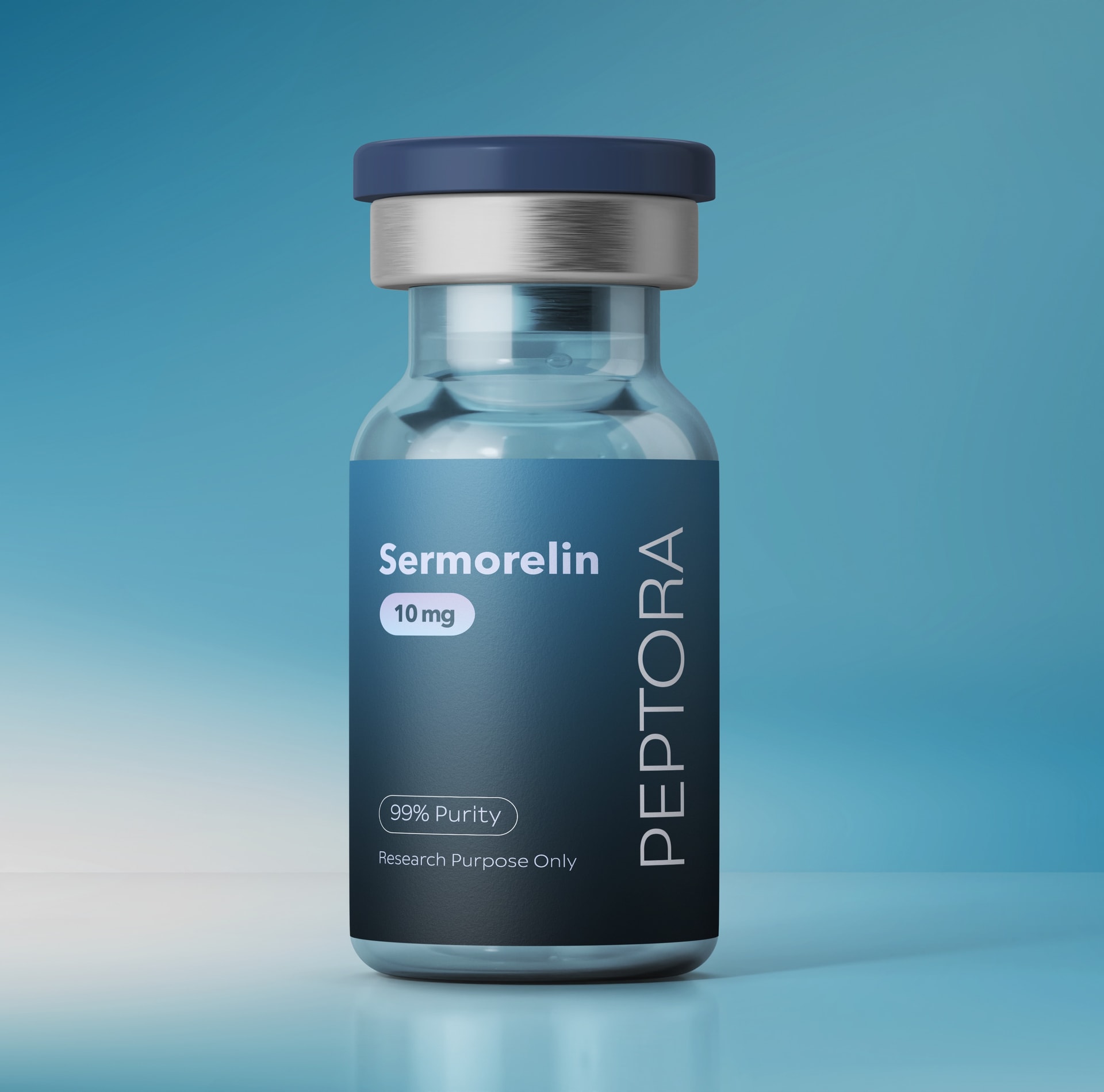
Sermorelin — the short copy
A 29-amino-acid copy of the front end of the natural GHRH key. Published work describes its time in the bloodstream as short — roughly 10–20 minutes.
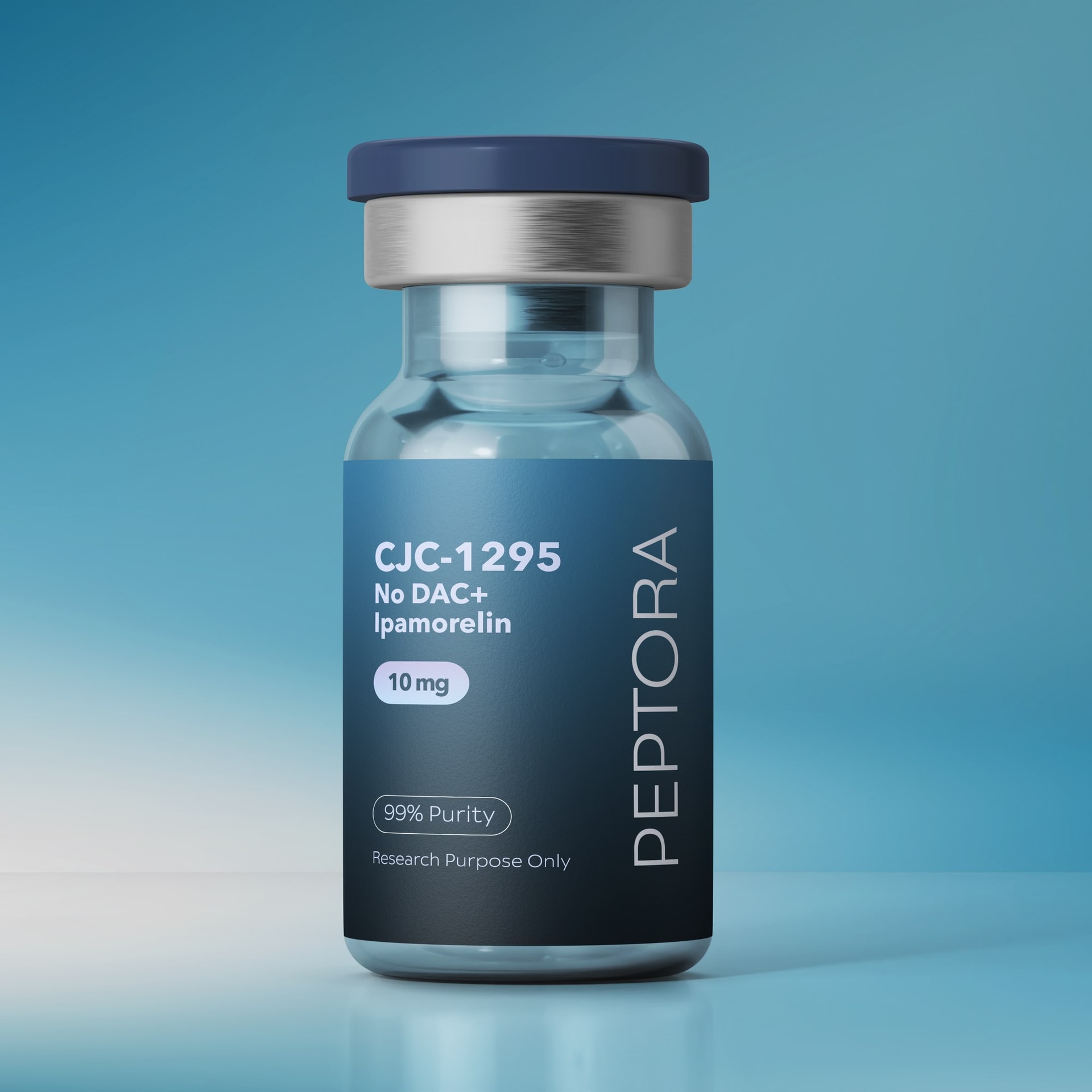
CJC-1295 — the long copy
The same GHRH idea, chemically modified to last far longer. A published trial estimated a half-life of about 6–8 days.
Ipamorelin — the other lock
Not a GHRH copy at all. It's a pentapeptide (a five-piece peptide) built to fit the ghrelin receptor, and it was described as the first *selective* one of its kind.
Same testing bar
All are tested by an independent lab (HPLC + LC-MS), with each lot's certificate of analysis published online.
Sermorelin vs CJC-1295: same lock, very different clock
Both are built from the same starting idea. The body's natural GHRH is a 44-piece peptide, and researchers found decades ago that the first 29 pieces alone still work. That 29-piece fragment is what Sermorelin is.
The catch is that it doesn't stick around. Published work on GHRH analogs puts sermorelin's time in the bloodstream at roughly 10 to 20 minutes in humans, because the kidneys filter it out and enzymes trim it from one end. That short window became the whole design problem for everything that followed.
CJC-1295 is one answer to that problem. It's the same GHRH concept with chemistry added to slow down how fast the body clears it. In a published, placebo-controlled trial in healthy adults, a single administration produced measurable increases in growth hormone and IGF-1 (a growth-related signal the liver makes in response), and the researchers estimated its half-life at about 5.8 to 8.1 days — an enormous difference from minutes.
That's the practical distinction researchers care about: not a different mechanism, a different duration. Chemists have explored the same idea in other ways too, such as attaching PEG (a polymer chain that makes a peptide harder for the body to clear quickly) to GHRH fragments.
Ipamorelin: why it's in a different category
Ipamorelin came out of an industry research program and was reported in 1998. It is a pentapeptide — a peptide made of five building blocks — and it does not resemble GHRH at all. Instead it acts through the ghrelin receptor (a docking spot originally known as the growth-hormone-secretagogue receptor), the same one the stomach hormone ghrelin uses.
The reason it drew attention wasn't potency — the original paper reported it was about as potent as the older compounds in that family. It was selectivity. Earlier ghrelin-type compounds tended to nudge other hormones along with growth hormone. In the published work, ipamorelin didn't raise those other markers meaningfully, even at levels far above the point where its growth-hormone effect had already plateaued. That's what led the authors to describe it as the first selective growth hormone secretagogue.
Because the two locks are genuinely separate, researchers often study a GHRH-type compound and a ghrelin-type compound together — which is exactly what a pairing like CJC-1295 + Ipamorelin is for. Combining them is its own experiment, not a double dose of one idea.
Side-by-side comparison
| Sermorelin | CJC-1295 | Ipamorelin | |
|---|---|---|---|
| Which lock | GHRH receptor | GHRH receptor | Ghrelin receptor |
| What it copies | First 29 pieces of natural GHRH | GHRH, chemically extended | Nothing natural — purpose-built |
| Size | 29 amino acids | GHRH analog (modified) | 5 amino acids (pentapeptide) |
| Reported duration | Short (~10–20 min in humans) | Long (half-life ~5.8–8.1 days) | Short-acting in published models |
| Known for | The original short GHRH fragment | Duration | Selectivity |
Peptora carries Sermorelin, the CJC-1295 + Ipamorelin pairing, and the Tesamorelin + Ipamorelin blend — each with its own certificate of analysis. For single-compound background, see the Sermorelin guide, the CJC-1295 + Ipamorelin guide, and the Tesamorelin guide.
Why researchers put all three side by side
Three reasons come up repeatedly in the literature:
- 1Two pathways, one output. Both locks open the same door, so comparing them is a clean way to study how the gland responds to different signals.
- 2Duration as a variable. Sermorelin and CJC-1295 are close enough chemically that the main difference between them is how long they persist — which makes them a natural pair for studying half-life (how long a compound lasts before the body clears half of it).
- 3Selectivity as a variable. Ipamorelin's published claim to fame is doing one thing without disturbing neighboring signals, which is a property researchers actively test for.
Purity, testing and lab handling
In research, your results are only as trustworthy as the material you start with. Peptora's lots are tested for purity by HPLC at an independent lab, with LC-MS as a second test to confirm they're the right molecules. Each lot's results are published online as a certificate of analysis (COA). To learn what the numbers mean, see the guide on what a certificate of analysis is.
All three ship as freeze-dried powder (the technical word is lyophilized). Before use in research each is reconstituted — mixed with water, specifically bacteriostatic water, sold separately:
- 1Let the sealed vial warm up to room temperature before opening it.
- 2Add the water slowly down the side of the vial, then swirl gently — don't shake.
- 3Wait until the powder is fully dissolved before drawing anything out.
- 4Keep the mixed solution in the fridge, away from light.
Step-by-step details are in the reconstitution guide.
Scientific references
These references, from PubMed, describe published research on each compound and on the two receptor pathways. They are provided for background about the compounds themselves — not the laboratory research products Peptora supplies, and not as any guide to use.
- 1Raun K, et al. Ipamorelin, the first selective growth hormone secretagogue. Eur J Endocrinol. 1998;139(5):552-561. doi:10.1530/eje.0.1390552 (PMID: 9849822).
- 2Teichman SL, et al. Prolonged stimulation of growth hormone (GH) and insulin-like growth factor I secretion by CJC-1295, a long-acting analog of GH-releasing hormone, in healthy adults. J Clin Endocrinol Metab. 2006;91(3):799-805. doi:10.1210/jc.2005-1536 (PMID: 16352683).
- 3Kojima M, et al. Ghrelin is a growth-hormone-releasing acylated peptide from stomach. Nature. 1999;402(6762):656-660. doi:10.1038/45230 (PMID: 10604470).
- 4Prakash A, Goa KL. Sermorelin: a review of its use in the diagnosis and treatment of children with idiopathic growth hormone deficiency. BioDrugs. 1999;12(2):139-157. doi:10.2165/00063030-199912020-00007 (PMID: 18031173).
- 5Esposito P, et al. PEGylation of growth hormone-releasing hormone (GRF) analogues. Adv Drug Deliv Rev. 2003;55(10):1279-1291. doi:10.1016/s0169-409x(03)00109-1 (PMID: 14499707).
- 6Grossman A, Savage MO, Besser GM. Growth hormone releasing hormone. Clin Endocrinol Metab. 1986;15(3):607-627. doi:10.1016/s0300-595x(86)80012-3 (PMID: 2429796).
- 7Memdouh S, et al. Advances in the detection of growth hormone releasing hormone synthetic analogs. Drug Test Anal. 2021;13(11-12):1871-1887. doi:10.1002/dta.3183 (PMID: 34665524).
Explore secretagogues
Independently lab tested, with each lot's certificate of analysis published online, fast U.S. shipping — for laboratory research use only.
View SermorelinKey takeaways
- These are not three versions of one compound. Think of one door on the pituitary gland with two separate locks — either can open it.
- Sermorelin and CJC-1295 both copy the body's natural GHRH key. The main published difference between them is duration, not mechanism.
- Sermorelin is a 29-piece fragment of natural GHRH, and published work describes its time in the bloodstream as short — roughly 10 to 20 minutes in humans.
- CJC-1295 is the long-lasting answer to that problem: a published trial in healthy adults estimated a half-life of about 5.8 to 8.1 days.
- Ipamorelin fits a different lock entirely — the ghrelin receptor — and the 1998 industry paper described it as the first selective growth hormone secretagogue.
- Because the two pathways are separate, researchers often study a GHRH-type and a ghrelin-type compound together, which is the reasoning behind pairings like CJC-1295 + Ipamorelin.
- All are supplied for laboratory research only — not medicines, and not for people or animals — with each lot's certificate of analysis published online.
Frequently asked questions
This article is intended solely as an educational summary of publicly available scientific literature. Products offered by Peptora are supplied exclusively for laboratory research purposes and are not approved for human or veterinary use. The information presented should not be interpreted as medical advice, treatment recommendations, or clinical guidance.