What is Epithalon (Epitalon)?
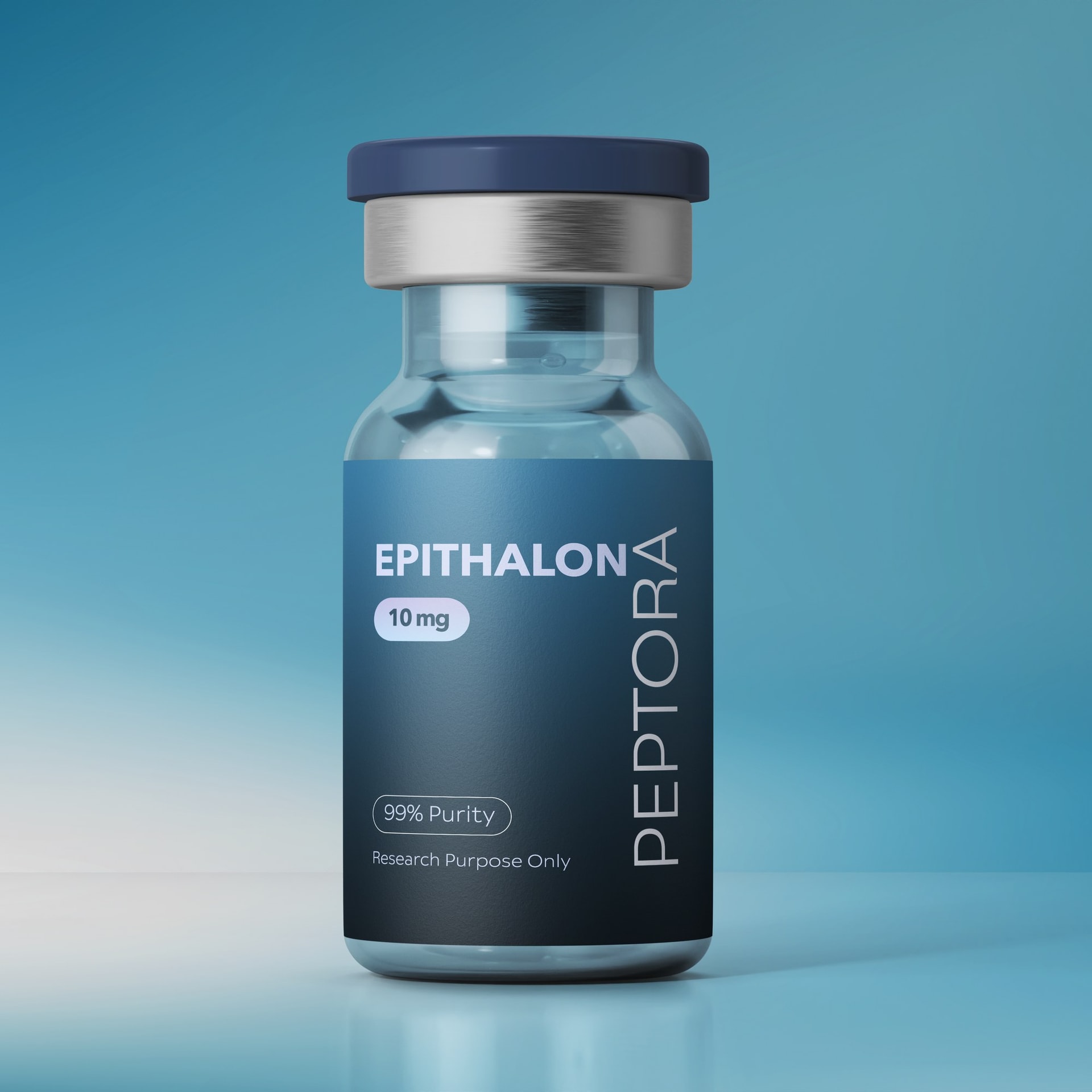
Epithalon — also spelled Epitalon — is a very small lab-made peptide. (A peptide is just a short chain of amino acids, the building blocks that make up proteins.) This one is tiny: only four amino acids, in the order Ala-Glu-Asp-Gly (sometimes shortened to AEDG). Russian scientists built it by copying the recipe of Epithalamin, a natural substance taken from the pineal gland — a small gland in the brain. So Epithalon is really a clean, exact copy of the key part of a natural brain extract that had been studied for decades.
Because it comes from the pineal gland, Epithalon is usually grouped with the aging-research peptides (scientists sometimes call these 'geroprotective,' meaning studied for protection against aging). Most of the published work looks at aging-related measures in cells and animals. One thing to be clear about: Epithalon is only for laboratory research. It is not a medicine, and it is not for use in people or animals.
The quick version
A four-piece peptide
A very short chain of just four amino acids: Ala-Glu-Asp-Gly.
From the pineal gland
Copied from Epithalamin, a natural substance from the brain's pineal gland used in aging research.
Studied in aging research
Looked at for aging-related questions and telomeres in early lab studies (cells and animals).
99%+ pure
Double-checked by lab testing (HPLC and LC-MS) and shipped with a certificate for every batch.
Explore research-grade Epithalon
99%+ pure, with a certificate of analysis for every batch, and fast U.S. shipping — for laboratory research use only.
View EpithalonWhere Epithalon came from
According to PubMed, the story starts with Epithalamin, a messy natural mix pulled from the pineal gland and studied in Soviet and Russian aging research starting in the late 1900s. Scientists reported that this mix seemed to affect melatonin (the body's sleep signal) and several aging-related measures in animals. To turn a messy mix into one clean, exact molecule, they figured out which amino acids it contained and built the short four-piece peptide Ala-Glu-Asp-Gly, naming it Epitalon (Epithalon).
A 2025 review calls Epithalon a very active little pineal peptide and sums up the ideas proposed for it over 25 years of study — including effects on making melatonin, on immune signals, and on certain enzymes (the body's tiny workers that speed up reactions). The same review points out that scientists still haven't fully mapped the peptide's exact structure and chemistry — a useful reminder to read this research carefully.
The telomere and aging research
The most talked-about work on Epithalon is about telomeres. Here's the idea: telomeres are like the little plastic tips on the ends of shoelaces, except they sit on the ends of your DNA and keep it from fraying. Each time a cell divides, they get a bit shorter. Telomerase is the body's tool for rebuilding them. In a lab-dish study using human cells that normally have this tool switched off, researchers reported that adding Epithalon switched the tool back on and made the telomeres longer. A follow-up reported those cells kept dividing past their usual limit. These are lab-dish findings in one specific type of cell:
- Switching the tool on — the telomere-rebuilding tool (telomerase) turned back on in cultured human cells.
- Longer telomeres — the DNA end-caps got longer in that same lab-dish model.
- More divisions — the treated cells kept dividing past their usual stopping point.
- Aging measures — lifespan and tumor rates studied in mice and other animals.
Beyond lab dishes, animal studies from the same research group have looked at Epithalon and lifespan and tumor rates in rodents, and the results changed depending on things like the lighting the animals lived under. This work is best read as a growing early-stage story, not a set of settled answers.
What scientists actually study it for
In the lab, Epithalon usually comes up in a few connected areas:
- Telomeres — the DNA end-caps and the tool that rebuilds them, in cultured human cells.
- Aging — aging-related measures and lifespan in animal studies.
- Sleep and hormone signals — a reported effect on making melatonin and on the daily body clock in animals.
- Antioxidants and tumors — the body's antioxidant defenses and tumor rates in early animal research.
For a wider look at how peptides are studied in aging research, see the guides on NAD+ and MOTS-c, and the research peptide overview.
Purity and testing (why the certificate matters)
In research, your results are only as trustworthy as the material you start with. Every batch of Epithalon from Peptora is checked to 99%+ purity by HPLC, confirmed by a second test (LC-MS) that proves it's the right molecule, and run through a full quality-control panel before it ships. Every order comes with a certificate of analysis (COA) for that exact batch.
For a tiny peptide whose exact structure hasn't always been well mapped, knowing you have the real thing — and that it's pure — is especially valuable for clear research. To learn what the numbers on a certificate mean, see the guide on certificates of analysis.
How it's handled in the lab
Epithalon ships as a freeze-dried powder (a dry powder with the water removed). Before it's used in research, it's mixed with bacteriostatic water — a special sterile water, sold separately. A little care keeps the peptide intact so the results stay reliable:
- 1Let the sealed vial warm up to room temperature before opening it.
- 2Add the water slowly down the side of the vial, then swirl gently — don't shake.
- 3Wait until the powder is fully dissolved before drawing anything out.
- 4Keep the mixed solution in the fridge, away from light.
Step-by-step details are in the reconstitution guide. Doing these the same way every time is one of the easiest ways to keep research consistent.
Scientific references
Epithalon has mostly been studied in cells and animals over about 25 years. The studies listed below are here for background, from PubMed. They describe research on the compound itself — not the laboratory research product Peptora supplies. Keep in mind that much of this work comes from a single research group and hasn't been widely confirmed in large trials.
- 1Araj SK, et al. Overview of Epitalon — Highly Bioactive Pineal Tetrapeptide with Promising Properties. Int J Mol Sci. 2025;26(6):2691. doi:10.3390/ijms26062691.
- 2Khavinson VKh, Bondarev IE, Butyugov AA. Epithalon peptide induces telomerase activity and telomere elongation in human somatic cells. Bull Exp Biol Med. 2003;135(6):590-592. doi:10.1023/A:1025493705728.
- 3Khavinson VKh, et al. Peptide promotes overcoming of the division limit in human somatic cell. Bull Exp Biol Med. 2004;137(5):503-506. doi:10.1023/B:BEBM.0000038164.49947.8c.
- 4Anisimov VN, et al. Inhibitory effect of the peptide epitalon on the development of spontaneous mammary tumors in HER-2/neu transgenic mice. Int J Cancer. 2002;101(1):7-10. doi:10.1002/ijc.10570.
- 5Anisimov VN, et al. Inhibitory effect of peptide Epitalon on colon carcinogenesis induced by 1,2-dimethylhydrazine in rats. Cancer Lett. 2002;183(1):1-8. doi:10.1016/S0304-3835(02)00090-3.
- 6Vinogradova IA, et al. Effect of Ala-Glu-Asp-Gly peptide on life span and development of spontaneous tumors in female rats exposed to different illumination regimes. Bull Exp Biol Med. 2007;144(6):825-830. doi:10.1007/s10517-007-0441-z.
Explore research-grade Epithalon
99%+ pure, with a certificate of analysis for every batch, and fast U.S. shipping — for laboratory research use only.
View EpithalonKey takeaways
- Epithalon (Epitalon) is a tiny lab-made peptide — four amino acids, Ala-Glu-Asp-Gly (AEDG) — copied from a natural pineal-gland substance called Epithalamin.
- It's grouped with the aging-research peptides, and most published work looks at aging-related measures in cells and animals.
- Its most-cited research reported that it switched on the telomere-rebuilding tool and made telomeres longer in cultured human cells — a lab-dish finding, not a conclusion about people.
- Much of the evidence comes from a single research group and cell or animal studies, and hasn't been widely confirmed in large trials.
- Every batch is 99%+ pure (checked by HPLC and LC-MS) and comes with a certificate of analysis, for laboratory research use only.
Frequently asked questions
This article is intended solely as an educational summary of publicly available scientific literature. Products offered by Peptora are supplied exclusively for laboratory research purposes and are not approved for human or veterinary use. The information presented should not be interpreted as medical advice, treatment recommendations, or clinical guidance.