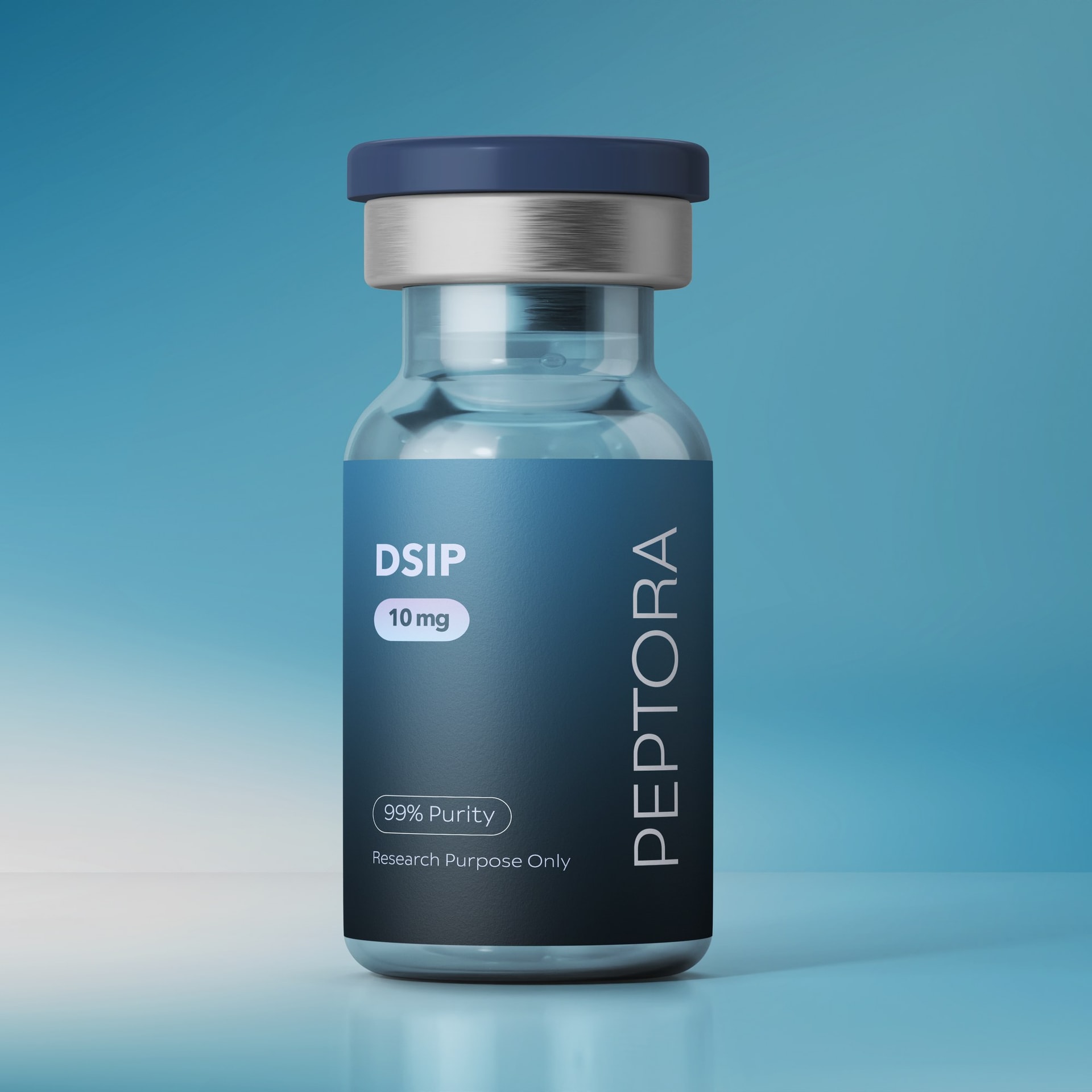


What is DSIP (Delta Sleep-Inducing Peptide)?
DSIP is short for Delta Sleep-Inducing Peptide. A peptide is just a tiny protein — a short chain of the same building blocks (amino acids) that make up bigger proteins. DSIP is a very small one: only nine building blocks long. Its name comes from "delta sleep", the deep, slow-wave stage of sleep that shows up as big, slow waves on a brain-activity readout.
The discovery story is a big part of why scientists find DSIP interesting. In the late 1970s, a research group in Basel, Switzerland, took blood from the brain-side veins of sleeping rabbits and isolated a substance that seemed to travel with sleep. They named it for that link. But here's the twist: in the decades since, no one has ever pinned down a receptor for it — the "docking spot" on a cell that a signaling molecule normally locks into. That missing piece is why researchers still call DSIP a bit of a riddle.
The quick version
A tiny natural peptide
Just nine building blocks long — one of the smallest signaling peptides scientists have named.
Named for deep sleep
"Delta sleep" is the slow-wave, deep stage of sleep it was first linked to in animal experiments.
Still a puzzle
Its exact job — and even its receptor — have never been fully worked out, which keeps it a research question.
Published lab results
Each lot's HPLC purity is listed on its certificate of analysis.
How it was discovered, in plain terms
The idea behind DSIP goes back a long way. For over a century, scientists wondered whether the body makes its own "sleep signals" — substances that build up and help tip us into sleep. In 1977, the Basel group thought they had found one. They noticed that blood taken from sleeping animals seemed to carry something that encouraged slow-wave sleep when given to other animals, and they isolated DSIP from it.
Since then, the picture has gotten more complicated rather than simpler. Here's what published reviews describe:
- The sleep link is debated. Some early animal studies reported more slow-wave sleep; others found little effect, and a 2006 review openly called the sleep connection "poorly documented."
- No receptor found. Unlike most signaling peptides, DSIP has never had a confirmed "docking spot" on cells identified — so exactly how it acts is unclear.
- It shows up all over the body. Lab studies have detected DSIP-like material in the brain and in other organs, hinting it may do more than one thing.
- A wide, scattered list of effects. Over the years researchers have reported effects on brain electrical activity, stress hormones, and body-clock (circadian) rhythms — but no single, agreed-upon role.
What scientists actually study it for
Because its exact role is unsettled, DSIP shows up across a surprisingly broad set of research areas. The most common ones in the literature are:
- Sleep research — measuring whether it shifts slow-wave (deep) sleep in animal experiments, using brain-activity recordings.
- Stress signals — how it interacts with stress-related hormones and the body's stress axis in lab models.
- Body-clock rhythms — its possible links to circadian (daily) timing and locomotor patterns.
- Nerve-cell recovery — more recent animal work has looked at whether it affects recovery after events like induced stroke, measured by motor-function tests.
Purity and testing (why the certificate matters)
In research, your results are only as trustworthy as the material you start with — and that's doubly true for a compound whose story is still being written. Peptora's DSIP lots are tested for purity by HPLC at an independent lab, with LC-MS as a second test to confirm it's the right molecule. Each lot's results are published online as a certificate of analysis (COA).
To learn what the numbers on a certificate actually mean, see the guide on what a certificate of analysis is and the research-peptide overview.
How it's handled in the lab
DSIP ships as a freeze-dried powder (that's what lyophilized means — the water has been removed to keep it stable). Before it's used in research, it's mixed with bacteriostatic water — a special sterile water, sold separately. This step is called reconstitution, which just means "mixing the powder back into a liquid." A little care keeps the peptide intact so results stay reliable:
- 1Let the sealed vial warm up to room temperature before opening it.
- 2Add the water slowly down the side of the vial, then swirl gently — don't shake.
- 3Wait until the powder is fully dissolved before drawing anything out.
- 4Keep the mixed solution in the fridge, away from light.
Step-by-step details are in the reconstitution guide. Doing these the same way every time is one of the easiest ways to keep research consistent.
Scientific references
DSIP was first isolated in 1977 and has been studied mostly in animal models and small observational studies; no confirmed receptor has been identified, and its role in sleep remains debated. The studies below are provided for background, from PubMed. They describe research on the compound itself — not the laboratory research product Peptora supplies.
- 1Graf MV, Kastin AJ. Delta-sleep-inducing peptide (DSIP): a review. Neurosci Biobehav Rev. 1984;8(1):83-93. doi:10.1016/0149-7634(84)90022-8 (PMID: 6145137).
- 2Graf MV, Kastin AJ. Delta-sleep-inducing peptide (DSIP): an update. Peptides. 1986;7(6):1165-1187. doi:10.1016/0196-9781(86)90148-8 (PMID: 3550726).
- 3Kovalzon VM, Strekalova TV. Delta sleep-inducing peptide (DSIP): a still unresolved riddle. J Neurochem. 2006;97(2):303-309. doi:10.1111/j.1471-4159.2006.03693.x (PMID: 16539679).
- 4Pollard BJ, Pomfrett CJ. Delta sleep-inducing peptide. Eur J Anaesthesiol. 2001;18(7):419-422. doi:10.1046/j.1365-2346.2001.00917.x (PMID: 11437870).
- 5van Kammen DP, et al. Delta sleep-inducing-peptide-like immunoreactivity (DSIP-LI) and delta sleep in schizophrenic volunteers. Sleep. 1992;15(6):519-525. doi:10.1093/sleep/15.6.519 (PMID: 1475566).
- 6Tukhovskaya EA, et al. Delta Sleep-Inducing Peptide Recovers Motor Function in SD Rats after Focal Stroke. Molecules. 2021;26(17):5173. doi:10.3390/molecules26175173 (PMID: 34500605).
Explore DSIP
Independently lab tested, with each lot's certificate of analysis published online, fast U.S. shipping — for laboratory research use only.
View DSIPKey takeaways
- DSIP (Delta Sleep-Inducing Peptide) is a tiny natural peptide — only nine building blocks long — first isolated from the blood of sleeping rabbits in 1977.
- Its name comes from "delta sleep," the deep, slow-wave stage of sleep it was first linked to in early animal experiments.
- It remains one of the field's open puzzles: no receptor has ever been confirmed, and the sleep link is still debated in the literature.
- Scientists study it in research on sleep patterns, stress signals, body-clock rhythms, and, more recently, nerve-cell recovery in animal models — for laboratory research only, not for people or animals.
- It ships as a freeze-dried powder. Lots are tested by an independent lab (HPLC, LC-MS), and each lot's results are published online as a certificate of analysis.
Frequently asked questions
This article is intended solely as an educational summary of publicly available scientific literature. Products offered by Peptora are supplied exclusively for laboratory research purposes and are not approved for human or veterinary use. The information presented should not be interpreted as medical advice, treatment recommendations, or clinical guidance.