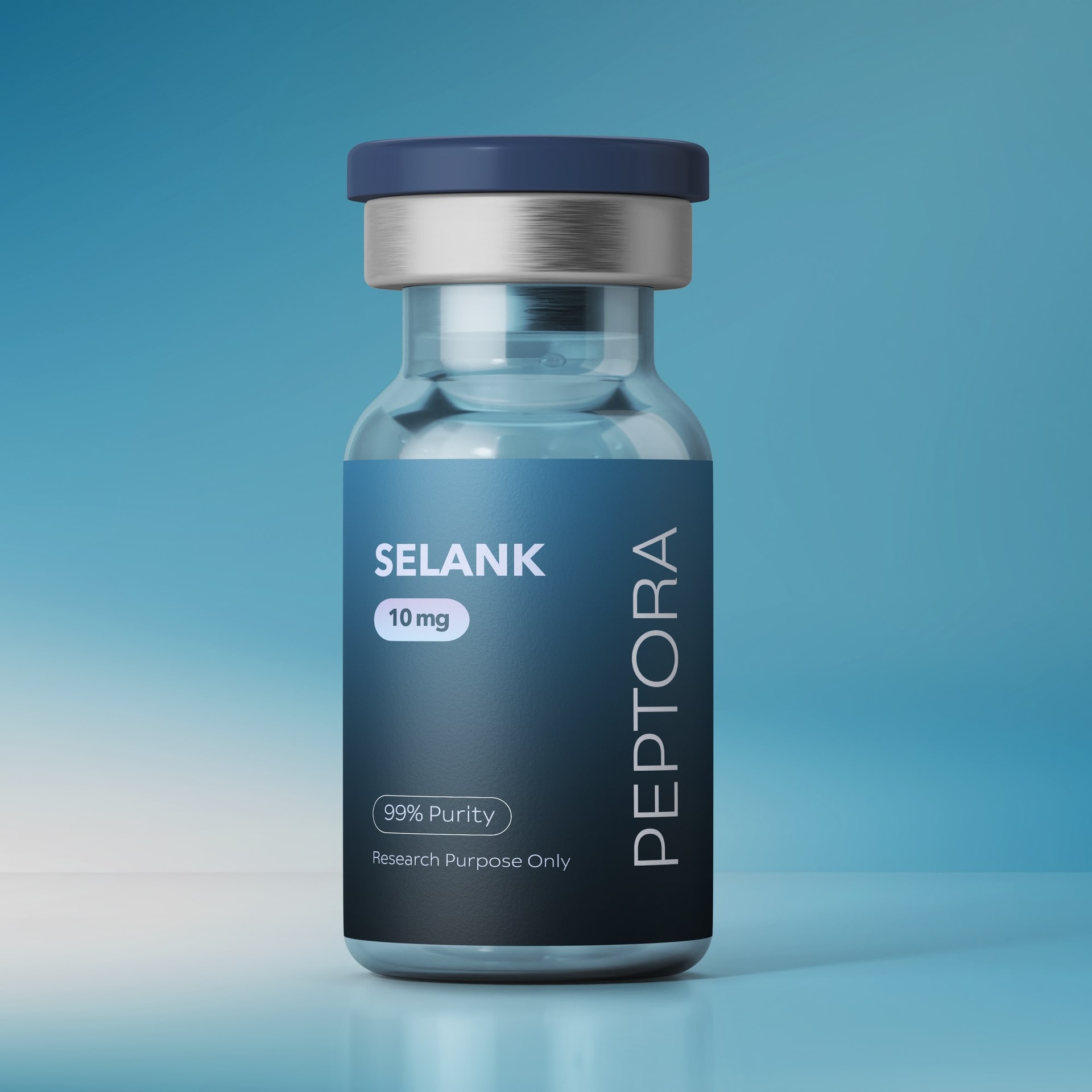



What is Selank?
Selank is a small lab-made peptide — a chain of seven amino acids: Thr-Lys-Pro-Arg-Pro-Gly-Pro. (A peptide is just a short chain of amino acids, the building blocks that make up proteins.) It's an analog of tuftsin — a lab-made version of tuftsin, an endogenous tetrapeptide fragment of immunoglobulin G (the antibody protein IgG) — with a short Pro-Gly-Pro tail added on the end, a change studied for its effect on the peptide's stability. In the published literature, Selank is studied mainly in anxiety-model and memory-model research in animals.
Selank was developed by scientists at the Institute of Molecular Genetics and the V.V. Zakusov Research Institute of Pharmacology of the Russian Academy of Sciences, and most of the published work on it comes from that group. One thing to be clear about: Selank is only for laboratory research. It is not a medicine, and it is not for use in people or animals.
The quick version
A seven-piece peptide
An analog of tuftsin (a small natural fragment of the antibody protein IgG), with a small tail added that is studied for its effect on stability.
The GABA pathway
Research describes Selank as a modulator of the brain's main inhibitory signaling system (GABA), rather than something that switches it on directly.
Research use only
Studied in anxiety, stress, and memory models — never for people or animals.
Published lab results
Each lot's HPLC purity is listed on its certificate of analysis.
Explore Selank
Independently lab tested, with each lot's certificate of analysis published online, and fast U.S. shipping — for laboratory research use only.
View SelankHow Selank is thought to work
Because Selank is a short peptide, scientists have looked at a few different paths to explain what it does. No single one fully explains the reported effects, but a few themes keep coming up:
- The brain's GABA system — lab tests describe Selank as a modulator of the brain's main inhibitory signal, GABA. The proposed mechanism is different from that of benzodiazepines like diazepam.
- The enkephalin (opioid-peptide) system — studies report that Selank affects enkephalins (natural opioid-peptide signals) in lab models, and that a blocker called naloxone can change the effects observed.
- Brain-cell growth and immune signals — because it's an analog of tuftsin, Selank has been looked at for effects on brain-cell growth signals and on immune-related genes in lab models.
One thing that comes up a lot: Selank has been studied together with benzodiazepines like diazepam, where early research looked at how the peptide changes their effect. This mix of signals is a big reason Selank draws interest as its own kind of research tool.
How Selank compares to similar compounds
Selank often comes up next to Semax, another lab-made peptide from the same Russian research programs. Both are short peptides studied in brain research, but they're built from different starting molecules and are studied for different things:
| Compound | Built from | What scientists study it for | Type |
|---|---|---|---|
| Selank | An analog of tuftsin | Anxiety / stress models | Short peptide (7 pieces) |
| Semax | A piece of ACTH | Memory / brain-cell protection | Short peptide (7 pieces) |
| Tuftsin | A natural fragment of IgG | Immune-signaling research | Endogenous tetrapeptide (4 pieces) |
Peptora carries versions of several related peptides, including Selank and Semax — each with its own certificate of analysis.
What scientists actually study it for
In the lab, Selank usually comes up in a few connected areas:
- Anxiety models — animal behavior tests (like a raised, open-armed maze) have been used to measure anxiety-like behavior in rodents.
- Stress and withdrawal — early research has looked at Selank in long-term-stress and drug-withdrawal tests.
- Memory models — some animal studies report memory-related and learning-behavior changes.
- Signaling pathways — GABA signaling, the enkephalin system, and neurotrophic signals have all been looked at to explain what's seen.
Purity and testing (why the certificate matters)
In research, your results are only as trustworthy as the material you start with. Peptora's Selank lots are tested for purity by HPLC at an independent lab, with LC-MS as a second test to confirm it's the right molecule. Each lot's results are published online as a certificate of analysis (COA).
Researchers often choose Peptora because this paperwork is standard here, not an extra. To learn what the numbers on a certificate mean, see the guide on the certificate of analysis.
How it's handled in the lab
Selank ships as a freeze-dried powder (a dry powder with the water removed). Before it's used in research, it's mixed with bacteriostatic water — a special sterile water, sold separately. A little care keeps the peptide intact so the results stay reliable:
- 1Let the sealed vial warm up to room temperature before opening it.
- 2Add the water slowly down the side of the vial, then swirl gently — don't shake.
- 3Wait until the powder is fully dissolved before drawing anything out.
- 4Keep the mixed solution in the fridge, away from light.
Step-by-step details are in the reconstitution guide. Doing these the same way every time is one of the easiest ways to keep research consistent.
Scientific references
Selank has been studied in cells, animals, and some human research over about two decades. The studies listed below are here for background, from PubMed. They describe research on the compound itself — not the laboratory research product Peptora supplies.
- 1Vyunova TV, Andreeva L, Shevchenko K, Myasoedov N. Peptide-based Anxiolytics: The Molecular Aspects of Heptapeptide Selank Biological Activity. Protein Pept Lett. 2018;25(10):914-923. doi:10.2174/0929866525666180925144642.
- 2Kasian A, Kolomin T, Andreeva L, et al. Peptide Selank Enhances the Effect of Diazepam in Reducing Anxiety in Unpredictable Chronic Mild Stress Conditions in Rats. Behav Neurol. 2017;2017:5091027. doi:10.1155/2017/5091027.
- 3Kolik LG, Nadorova AV, Kozlovskaya MM. Efficacy of peptide anxiolytic selank during modeling of withdrawal syndrome in rats with stable alcoholic motivation. Bull Exp Biol Med. 2014;157(1):52-55. doi:10.1007/s10517-014-2490-4.
- 4Panikratova YR, Lebedeva IS, Sokolov OY, et al. Functional Connectomic Approach to Studying Selank and Semax Effects. Dokl Biol Sci. 2020;490(1):9-11. doi:10.1134/S001249662001007X.
- 5Medvedev VE, Tereshchenko ON, Kost NV, et al. Optimization of the treatment of anxiety disorders with selank. Zh Nevrol Psikhiatr Im S S Korsakova. 2015;115(6):33-40. doi:10.17116/jnevro20151156133-40.
Explore Selank
Independently lab tested, with each lot's certificate of analysis published online, and fast U.S. shipping — for laboratory research use only.
View SelankKey takeaways
- Selank is a small lab-made peptide (Thr-Lys-Pro-Arg-Pro-Gly-Pro), an analog of tuftsin (an endogenous tetrapeptide fragment of immunoglobulin G) with a small tail added.
- Scientists study it mostly in animal anxiety-, stress-, and memory-model research.
- Published work describes how it interacts with GABA signaling, the enkephalin system, and neurotrophic signals.
- Much of the research comes from a single Russian research group and is still evolving, not clinically settled.
- Lots are tested by an independent lab (HPLC, LC-MS), and each lot's results are published online as a certificate of analysis. Supplied for research use only.
Frequently asked questions
This article is intended solely as an educational summary of publicly available scientific literature. Products offered by Peptora are supplied exclusively for laboratory research purposes and are not approved for human or veterinary use. The information presented should not be interpreted as medical advice, treatment recommendations, or clinical guidance.