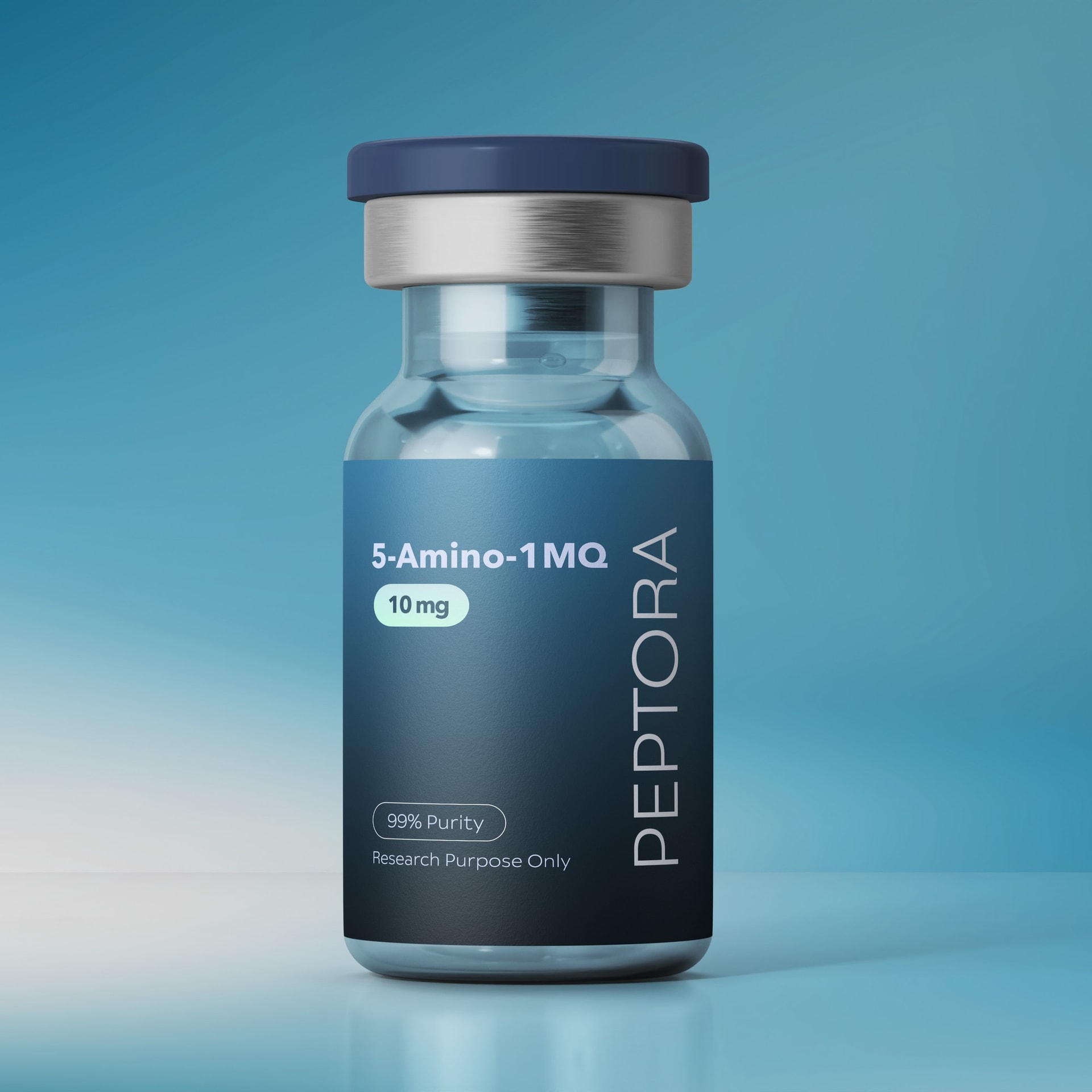



What is 5-Amino-1MQ?
5-Amino-1MQ is a small molecule — a compact lab-made chemical, not a peptide (a tiny protein) like most compounds in this library. Its job in research is to block an enzyme called NNMT. An enzyme is a cellular worker that speeds up a specific chemical reaction; NNMT's reaction quietly uses up two things a cell values. The easiest way to picture 5-Amino-1MQ: NNMT is like a leaky drain, and 5-Amino-1MQ is the plug. Its full chemical name is 5-amino-1-methylquinolinium, which is why you'll see it shortened to 5-Amino-1MQ or just 5MQ.
One important note up front: 5-Amino-1MQ is a research chemical for the laboratory only. It is not a medicine, and it is not for use in people or animals.
The quick version
It plugs one specific enzyme
It blocks NNMT — and, in lab tests, mostly leaves closely related enzymes alone.
It's about NAD+
By blocking NNMT, studies saw more NAD+ — a key energy-cycle molecule — kept inside fat cells.
Lab use only
Studied in fat-cell, metabolism, and cell-biology experiments — never for people or animals.
Published lab results
Each lot's HPLC purity is listed on its certificate of analysis.
Explore 5-Amino-1MQ
Independently lab tested, with each lot's certificate of analysis published online, fast U.S. shipping — for laboratory research use only.
View 5-Amino-1MQHow it works, in plain terms
To follow the research on 5-Amino-1MQ, it helps to know what NNMT actually does. NNMT (short for nicotinamide N-methyltransferase) takes vitamin B3 (nicotinamide) and tags it for disposal, using up a second helper molecule called SAM in the process. The catch: that same vitamin B3 could otherwise be recycled into NAD+, a molecule the cell's energy machinery depends on. So when NNMT is very active, it can quietly drain both NAD+ and SAM. Here's the plain-English version of what studies describe:
- Block the drain — 5-Amino-1MQ blocks NNMT, so less vitamin B3 gets tagged for disposal.
- More NAD+ and SAM — in fat-cell studies, blocking NNMT was tied to higher levels of both NAD+ and SAM inside the cells.
- Changes in fat handling — in mice fed a high-fat diet, blocking NNMT was linked to lower body weight and less white fat, without changing how much the animals ate.
Why scientists care about NNMT
NNMT started as a background player known mostly for its role in the liver. Interest jumped after researchers noticed a pattern in fat tissue:
| Observation in studies | Where it was seen |
|---|---|
| NNMT levels rise in obesity and diabetes | Fat tissue and liver of obese mice |
| Turning NNMT down protects against diet-induced weight gain | Mouse fat and liver (gene knockdown) |
| Blocking NNMT raises NAD+ and SAM in fat cells | Cultured adipocytes |
| NNMT is also studied in cancer biology | Various tumor-cell studies |
Because of that pattern, 5-Amino-1MQ is used as a research tool to switch NNMT off and watch what happens — a common way scientists test whether an enzyme really matters.
What scientists actually study it for
In the lab, 5-Amino-1MQ usually comes up in a few connected areas:
- Fat cells and metabolism — how blocking NNMT changes the way fat cells store and burn energy (in cells and animals).
- NAD+ biology — because NNMT sits next to the pathway that recycles NAD+, blocking it is a way to study NAD+ levels inside cells.
- Body weight in animal models — studies in mice fed a high-fat diet measured changes in weight and body fat.
- Cell biology and cancer research — NNMT is also studied in tumor cells, so 5-Amino-1MQ shows up as a tool there too.
Purity and testing (why the certificate matters)
In research, your results are only as trustworthy as the material you start with. Peptora's 5-Amino-1MQ lots are tested for purity by HPLC (a technique that separates out any impurities) at an independent lab, with a second test (mass spectrometry) to confirm it's the right molecule. Each lot's results are published online as a certificate of analysis (COA).
That paperwork is standard here, not an add-on. To learn what the numbers on a certificate actually mean, see the guide on what a certificate of analysis is.
How it's handled in the lab
5-Amino-1MQ ships as a lyophilized (freeze-dried) powder. Before it's used in research, it's reconstituted — mixed with a suitable sterile solvent such as bacteriostatic water, sold separately. A little care keeps the compound stable so results stay reliable:
- 1Let the sealed vial warm up to room temperature before opening it.
- 2Add the solvent slowly down the side of the vial, then swirl gently — don't shake.
- 3Wait until the powder is fully dissolved before drawing anything out.
- 4Keep the mixed solution in the fridge, away from light.
Step-by-step details are in the reconstitution guide. Doing these the same way every time is one of the easiest ways to keep research consistent.
Scientific references
The role of NNMT in metabolism and the use of small-molecule inhibitors such as 5-amino-1-methylquinolinium have been described in the studies below, drawn from PubMed. They describe research on the enzyme and the compound itself — not the laboratory research product Peptora supplies.
- 1Kraus D, et al. Nicotinamide N-methyltransferase knockdown protects against diet-induced obesity. Nature. 2014;508(7495):258-262. doi:10.1038/nature13198.
- 2Neelakantan H, et al. Selective and membrane-permeable small molecule inhibitors of nicotinamide N-methyltransferase reverse high fat diet-induced obesity in mice. Biochem Pharmacol. 2017;147:141-152. doi:10.1016/j.bcp.2017.11.007.
- 3Dimet-Wiley A, et al. Reduced calorie diet combined with NNMT inhibition establishes a distinct microbiome in DIO mice. Sci Rep. 2022;12(1):484. doi:10.1038/s41598-021-03670-5.
- 4Ehebauer F, et al. Glucose availability regulates nicotinamide N-methyltransferase expression in adipocytes. Life Sci. 2020;248:117474. doi:10.1016/j.lfs.2020.117474.
- 5Akar S, et al. Small molecule inhibitor of nicotinamide N-methyltransferase shows anti-proliferative activity in HeLa cells. J Obstet Gynaecol. 2021;41(8):1240-1245. doi:10.1080/01443615.2020.1854696.
- 6Yang M, et al. NAD metabolism enzyme NNMT in cancer-associated fibroblasts drives tumor progression and resistance to immunotherapy in urothelial bladder cancer. J Immunother Cancer. 2024;12(7):e009281. doi:10.1136/jitc-2024-009281.
Explore 5-Amino-1MQ
Independently lab tested, with each lot's certificate of analysis published online, fast U.S. shipping — for laboratory research use only.
View 5-Amino-1MQKey takeaways
- 5-Amino-1MQ is a small molecule (not a peptide) that blocks an enzyme called NNMT — its full chemical name is 5-amino-1-methylquinolinium.
- NNMT tags vitamin B3 for disposal and uses up NAD+ and SAM in the process; blocking it, in studies, kept more NAD+ inside fat cells.
- In mice on a high-fat diet, turning NNMT down was tied to lower body weight and less white fat without changing food intake.
- Scientists mostly use it as a research tool to study fat cells, NAD+ biology, and metabolism; NNMT is also studied in cancer biology. It's for laboratory research only — not a medicine, and not for people or animals.
- Lots are tested by an independent lab (HPLC, LC-MS), and each lot's results are published online as a certificate of analysis.
Frequently asked questions
This article is intended solely as an educational summary of publicly available scientific literature. Products offered by Peptora are supplied exclusively for laboratory research purposes and are not approved for human or veterinary use. The information presented should not be interpreted as medical advice, treatment recommendations, or clinical guidance.