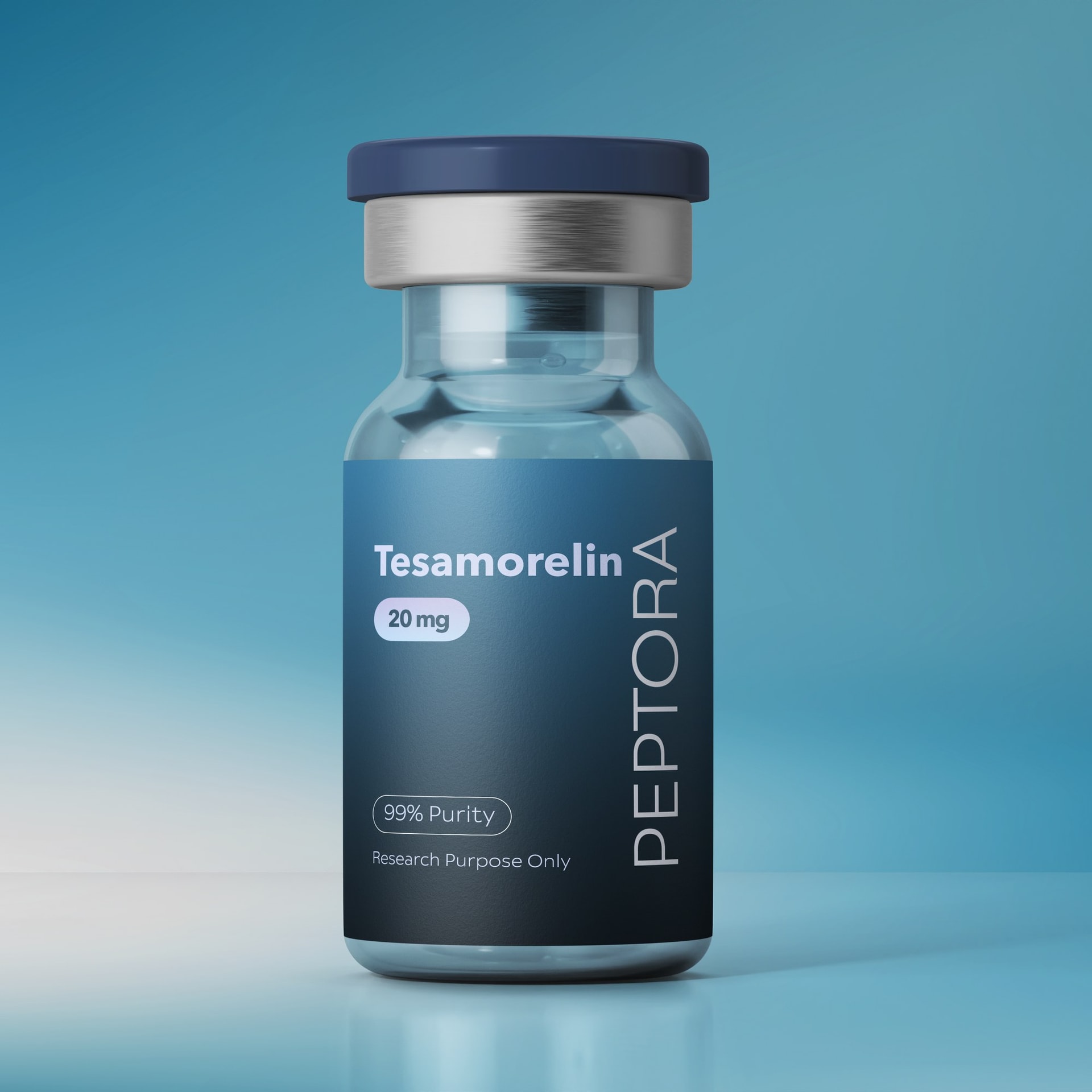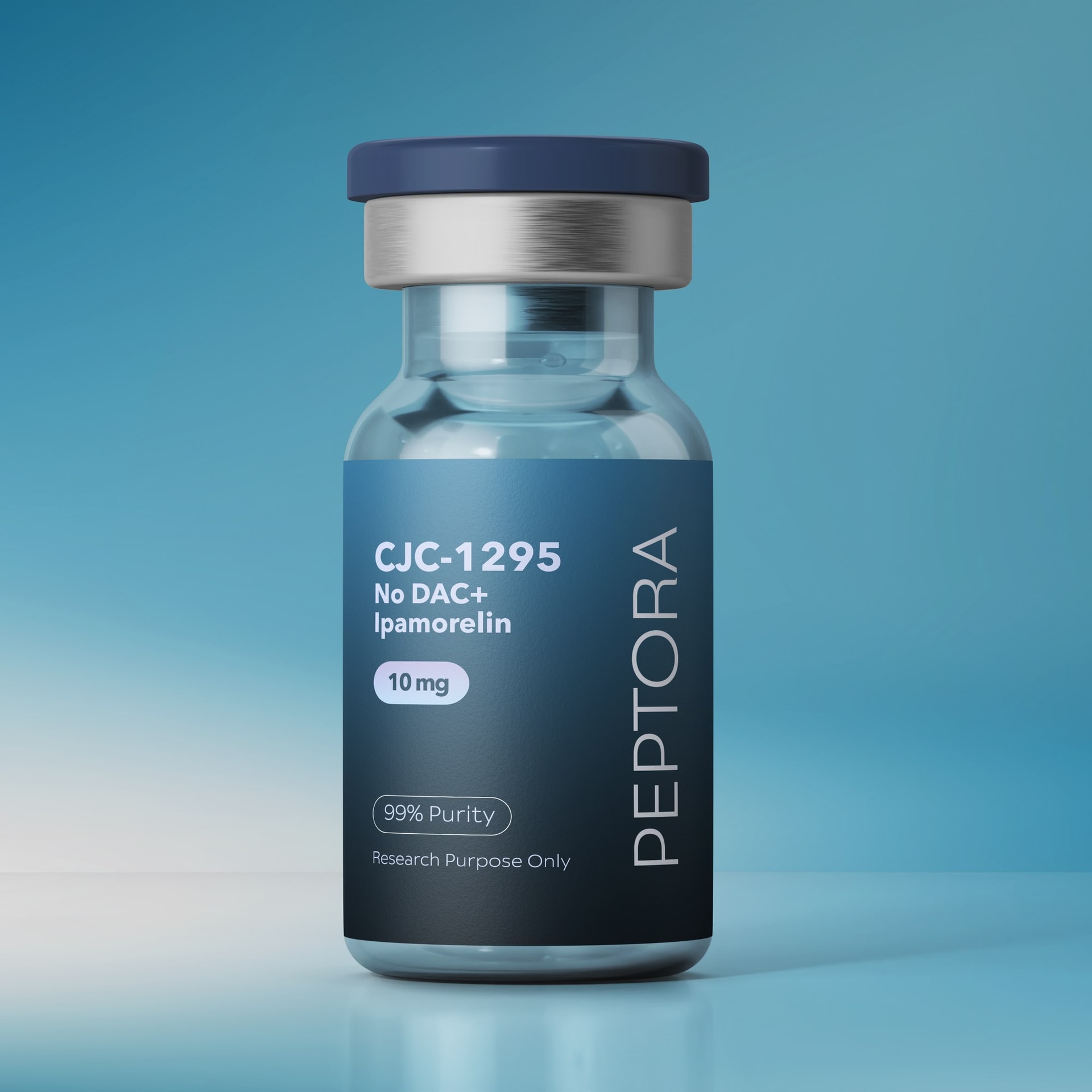



What is the Tesamorelin + Ipamorelin blend?
This is a blend of two peptides — and a peptide is just a tiny protein. Both peptides in this blend do the same broad job: they get the body's growth-hormone gland (a small gland in the head called the pituitary) to release growth hormone. But they do it through two different doors. That's the whole reason scientists find the pairing interesting to study — each peptide knocks on a different door, so putting them together is a different experiment than using either one by itself.
Tesamorelin is a lab-made copy (an analog) of the body's own "release some growth hormone" message, a signal called GHRH. Ipamorelin is a secretagogue — a word that just means "something that tells a gland to release a hormone" — and it works through a separate signal called the ghrelin pathway. One copies the body's main growth-hormone message; the other flips a second switch.
Explore the blend
Independently lab tested, with each lot's certificate of analysis published online, fast U.S. shipping — for laboratory research use only.
View Tesamorelin + IpamorelinThe quick version
Two peptides, two doors
Tesamorelin copies the body's GHRH signal; ipamorelin works through the separate ghrelin door.
Why study them together
Each one nudges the gland a different way, so the pair is its own experiment — not just a bigger dose of one peptide.
Growth hormone & IGF-1
Researchers watch how the gland's growth-hormone output — and a follow-on marker called IGF-1 — respond in lab models.
Published lab results
Each lot's HPLC purity is listed on its certificate of analysis.
How it works, in plain terms
A receptor is a docking spot on a cell — a little slot a signal fits into. An agonist is a key that fits that slot and switches it on. Each peptide in this blend is an agonist for a different receptor on the pituitary gland:
- Tesamorelin fits the GHRH receptor — the same slot the body's own "release growth hormone" message uses. Because it's a longer-lasting copy, researchers use it to study that main pathway.
- Ipamorelin fits a different slot (the ghrelin / growth-hormone-secretagogue receptor). In its original pharmacology work it was described as unusually *selective* — it nudged growth-hormone release without stirring up other hormones like cortisol as much as older compounds did.
The idea scientists explore is simple to picture: knock on two different doors of the same gland and see how it responds, compared with knocking on just one. Researchers often track growth hormone itself and a downstream marker called IGF-1 (a signal the liver makes after growth hormone rises) to measure what happened.
Meet each peptide in the blend
The two peptides come from different research families. Here's the plain-English version of each:
| Peptide | What it copies / does | Family |
|---|---|---|
| Tesamorelin | A lab-made, longer-lasting copy of the body's GHRH "release growth hormone" message | GHRH analog |
| Ipamorelin | A selective secretagogue that works through the separate ghrelin door | GHRP / secretagogue |
Peptora also carries each idea on its own, if a study calls for a single pathway: Tesamorelin by itself, and the related growth-hormone-secretagogue pairing CJC-1295 + Ipamorelin. Each product has its own certificate of analysis, published online.
What scientists actually study it for
In the lab, a two-signal growth-hormone blend usually comes up in a few connected areas:
- Growth-hormone release — how the gland responds when two different "go" signals arrive together, in lab models.
- IGF-1 — the follow-on marker that tends to rise after growth hormone does.
- Metabolism — how the growth-hormone system ties into the way the body handles fat, an area tesamorelin has been studied in on its own.
- Body composition — muscle and fat measurements in controlled research settings.
Purity and testing (why the certificate matters)
With a blend, purity matters twice — you want both peptides to be exactly what the label says. Peptora's lots are tested for purity by HPLC at an independent lab, with LC-MS as a second test to confirm the molecules are correct. Each lot's results are published online as a certificate of analysis (COA).
That paperwork is standard here, not an add-on. To learn what the numbers on a certificate actually mean, see the guide on what a certificate of analysis is.
How it's handled in the lab
The blend ships as a freeze-dried powder (the technical word is lyophilized). Before it's used in research, it's reconstituted — that just means mixed with water, specifically bacteriostatic water, a sterile water sold separately. A little care keeps the peptides intact so results stay reliable:
- 1Let the sealed vial warm up to room temperature before opening it.
- 2Add the water slowly down the side of the vial, then swirl gently — don't shake.
- 3Wait until the powder is fully dissolved before drawing anything out.
- 4Keep the mixed solution in the fridge, away from light.
Step-by-step details are in the reconstitution guide. Doing these the same way every time is one of the easiest ways to keep research consistent.
Scientific references
These references, from PubMed, describe research on each peptide individually. They are provided for background about the compounds themselves — not about the laboratory research product Peptora supplies, and not as any guide to use.
- 1Raun K, et al. Ipamorelin, the first selective growth hormone secretagogue. Eur J Endocrinol. 1998;139(5):552-561. doi:10.1530/eje.0.1390552 (PMID: 9849822).
- 2Falutz J, et al. Long-term safety and effects of tesamorelin, a growth hormone-releasing factor analogue, in HIV patients with abdominal fat accumulation. AIDS. 2008;22(14):1719-1728. doi:10.1097/QAD.0b013e32830a5058 (PMID: 18690162).
- 3Spooner LM, Olin JL. Tesamorelin: a growth hormone-releasing factor analogue for HIV-associated lipodystrophy. Ann Pharmacother. 2012;46(2):240-247. doi:10.1345/aph.1Q629 (PMID: 22298602).
- 4Adrian S, et al. The growth hormone releasing hormone analogue, tesamorelin, decreases muscle fat and increases muscle area in adults with HIV. J Frailty Aging. 2019;8(3):154-159. doi:10.14283/jfa.2018.45 (PMID: 31237318).
- 5Lu J, et al. The growth hormone secretagogue receptor 1a agonists, anamorelin and ipamorelin, inhibit cisplatin-induced weight loss in ferrets. Physiol Behav. 2024;284:114644. doi:10.1016/j.physbeh.2024.114644 (PMID: 39043357).
Explore Tesamorelin + Ipamorelin
Independently lab tested, with each lot's certificate of analysis published online, fast U.S. shipping — for laboratory research use only.
View Tesamorelin + IpamorelinKey takeaways
- Tesamorelin + Ipamorelin is a blend of two peptides (tiny proteins) that both get the body's growth-hormone gland to release growth hormone — through two different "doors."
- Tesamorelin is a lab-made copy of the body's own GHRH signal; ipamorelin is a selective secretagogue that works through the separate ghrelin pathway.
- Scientists study the pair together because using both signals at once is a different experiment than using either one alone.
- It shows up in lab research on growth-hormone release, the follow-on marker IGF-1, metabolism, and body composition. It's for laboratory research only — not a medicine, and not for people or animals.
- Lots are tested by an independent lab (HPLC, LC-MS), and each lot's results are published online as a certificate of analysis.
- It ships as a freeze-dried (lyophilized) powder and is mixed with bacteriostatic water before it's used in the lab.
Frequently asked questions
This article is intended solely as an educational summary of publicly available scientific literature. Products offered by Peptora are supplied exclusively for laboratory research purposes and are not approved for human or veterinary use. The information presented should not be interpreted as medical advice, treatment recommendations, or clinical guidance.