
The short answer
Selank and Semax get talked about as a pair for a good reason: they were developed by the same group of Russian researchers, at what is now the National Research Center "Kurchatov Institute," and they are both very short peptides — tiny proteins, just a handful of building blocks each. So people assume they are two flavors of the same thing.
They are not. Picture two dials on one control panel. Selank is the dial researchers study for turning the brain's alarm signals down — the anxiety-and-stress side. Semax is the dial studied for turning growth-and-attention signals up — the learning-and-repair side. Same panel, opposite directions.
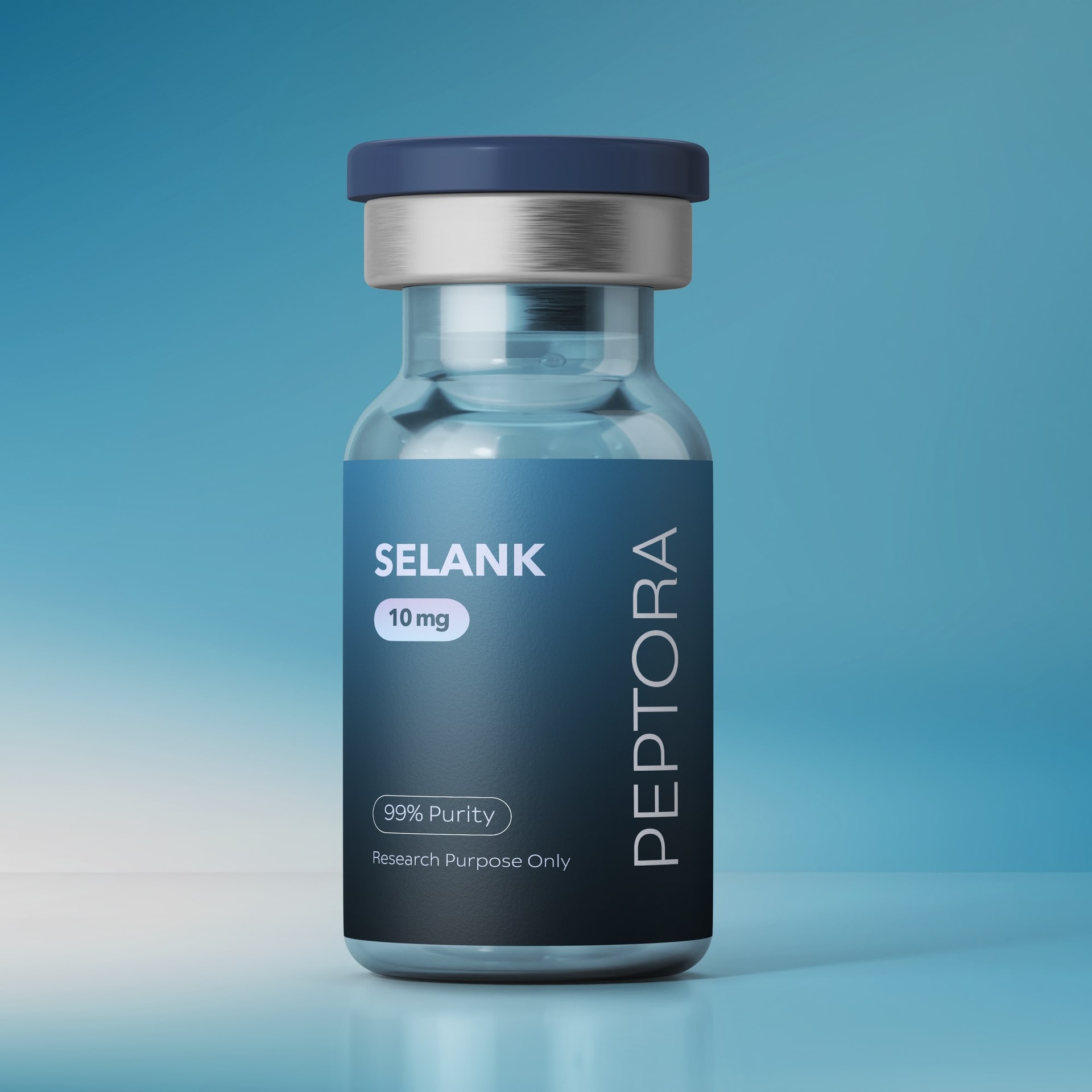
Explore research-grade Selank
99%+ pure, a certificate of analysis with every batch — for laboratory research use only.
View SelankThe quick version
Selank — the calm dial
A 7-piece peptide based on tuftsin, a natural immune fragment. Studied in anxiety and stress models.
Semax — the growth dial
A 7-piece peptide copying part of the hormone ACTH, minus the hormone part. Studied around BDNF and learning.
Same lab, different parents
Both came from the same Russian institute — but from completely different natural molecules.
Lab use only
Peptora supplies both as research chemicals — never for people or animals.
Selank: turning the alarm down
Selank starts somewhere unexpected — the immune system. The body makes a small natural fragment called tuftsin, which is best known for helping immune cells do their work. Researchers took tuftsin and attached a short stabilizing tail to it, producing a seven-amino-acid peptide that survives longer than the fragment it came from. That is Selank.
An analog, by the way, is just a lab-made copy of a natural molecule with small changes on purpose — usually to make it last longer or act more selectively. Selank is a tuftsin analog.
In published research it has mostly been investigated in anxiety and stress models in animals. One frequently cited study looked at whether Selank changed the effect of diazepam — a well-known calming drug — in rats under chronic mild stress. Other work has examined its effects during withdrawal modeling. Reviews describe it as acting on calming signal systems rather than binding one single receptor the way a classic drug does, and note that its mechanism is still being characterized.
Semax: turning the growth signal up
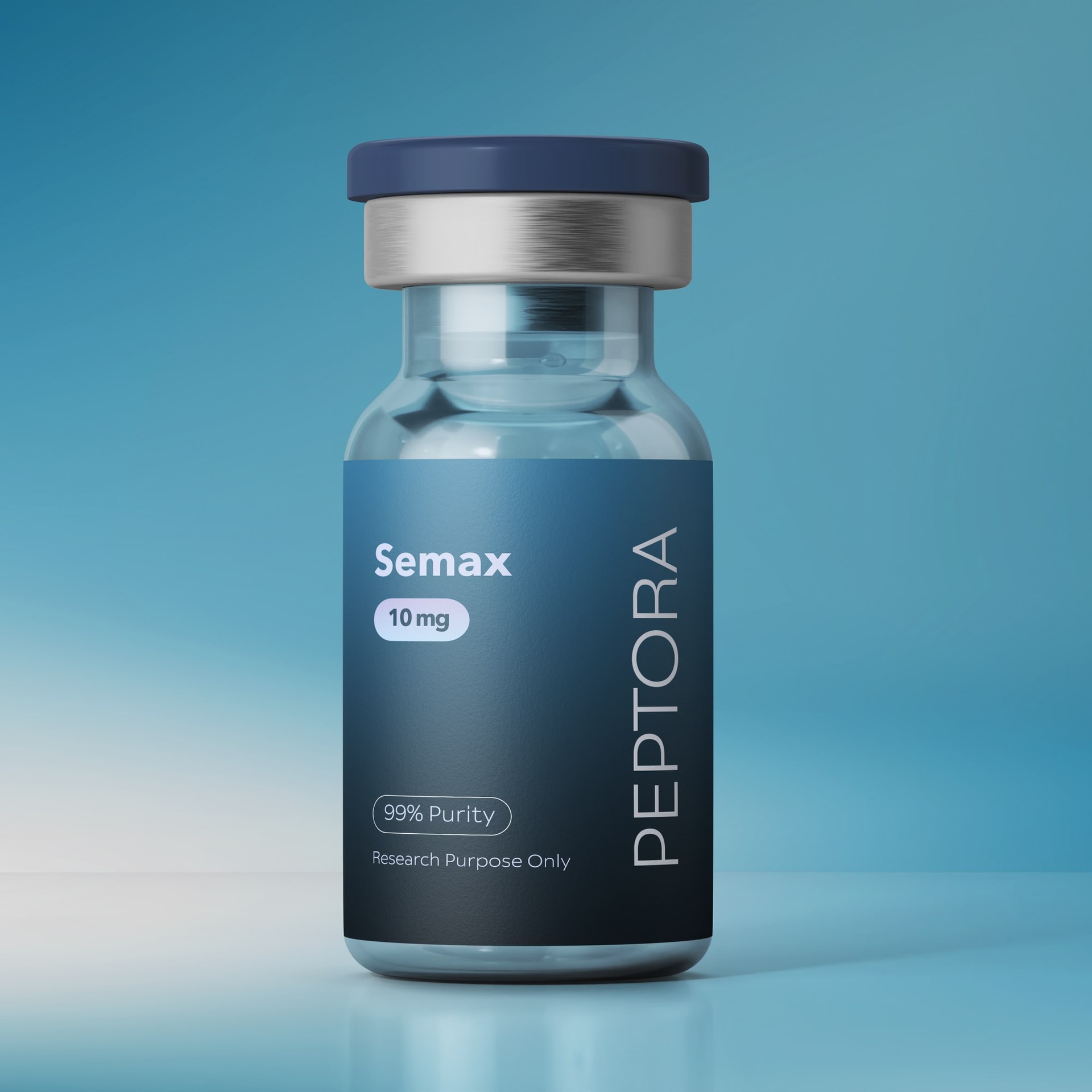
Semax has a completely different parent. The body makes a hormone called ACTH (adrenocorticotropic hormone), which among other things tells the adrenal glands to release stress hormones. Researchers took just a short fragment of it — the piece labeled ACTH(4-10) — and added a stabilizing tail. Crucially, that fragment on its own does not carry the hormone-releasing job. So Semax keeps the brain-signal side and leaves the hormone side behind.
The research angle here is growth factors. BDNF — brain-derived neurotrophic factor — is a protein the brain uses to build and maintain connections between nerve cells; think of it as fertilizer for wiring. Published rat studies reported that Semax changed BDNF and related gene activity in the hippocampus, the brain region most associated with memory. Other work described effects on the brain's dopamine and serotonin systems in rodents, and a 2024 study examined Semax alongside another ACTH(4-10) analog in a chronic-stress rat model.
Side by side
| Selank | Semax | |
|---|---|---|
| Built from | Tuftsin (an immune-system fragment) | ACTH(4-10) (a hormone fragment) |
| Length | 7 amino acids | 7 amino acids |
| Direction studied | Calming / stress-reducing signals | Growth, attention and repair signals |
| Signature research marker | Behavior in anxiety and stress models | BDNF and neurotrophin gene activity |
| Does it carry a hormone effect? | No — it is not hormonal | No — the fragment leaves that part behind |
| Developed by | Institute of Molecular Genetics, Russian Academy of Sciences | Institute of Molecular Genetics, Russian Academy of Sciences |
One study that is genuinely useful here looked at both peptides in the same experiment, using a functional connectomic approach — a way of mapping which brain regions act in step with one another — and reported different connectivity patterns for each. That is the clearest published signal that these are not two names for one effect. Peptora carries research-grade Selank and Semax, each with its own certificate of analysis.
Why they get confused (and what actually matters)
- Same origin. Both came out of the same Russian institute and the same research program, so they are almost always published and reviewed together.
- Same shape on paper. Both are seven amino acids long and both end in the same short stabilizing tail — which makes them look like siblings in a sequence table.
- Same shelf label. Both get lumped under "nootropic peptides," a broad bucket that hides the difference in what they are actually studied for.
- Different parents, though. One descends from an immune fragment, the other from a hormone fragment. That is the difference that decides which research question each one fits.
For deeper single-compound coverage, see the Selank guide and the Semax guide. If a term here was new, the peptide glossary defines the basics in plain words.
Purity and handling
Short peptides are delicate, and with compounds whose literature is still developing, the quality of your starting material matters even more — a weak or contaminated sample produces a result nobody can interpret. Both are checked to 99%+ purity by HPLC — a machine that separates a sample into its parts so you can see exactly how much of it is the peptide you ordered — and confirmed by LC-MS, a second test proving the molecule is the right one. Every order ships with a certificate of analysis (COA) for that exact batch.
Both arrive lyophilized (freeze-dried) and are reconstituted — mixed with bacteriostatic water — before research use. Let the sealed vial reach room temperature, add water slowly down the side of the vial, swirl instead of shaking, and keep the mixed solution refrigerated and out of light. Step-by-step details are in the reconstitution guide.
Scientific references
The sources below are listed for background, from PubMed. Much of this literature is preclinical and published in Russian-language journals. These studies describe research on the molecules themselves — not the laboratory research products Peptora supplies.
- 1Vyunova TV, Andreeva L, Shevchenko K, Myasoedov N. Peptide-based Anxiolytics: The Molecular Aspects of Heptapeptide Selank Biological Activity. Protein Pept Lett. 2018;25(10):914-923. doi:10.2174/0929866525666180925144642.
- 2Kasian A, Kolomin T, Andreeva L, et al. Peptide Selank Enhances the Effect of Diazepam in Reducing Anxiety in Unpredictable Chronic Mild Stress Conditions in Rats. Behav Neurol. 2017;2017:5091027. doi:10.1155/2017/5091027.
- 3Kolik LG, Nadorova AV, Kozlovskaya MM. Efficacy of peptide anxiolytic selank during modeling of withdrawal syndrome in rats with stable alcoholic motivation. Bull Exp Biol Med. 2014;157(1):52-55. doi:10.1007/s10517-014-2490-4.
- 4Dolotov OV, Karpenko EA, Inozemtseva LS, et al. Semax, an analog of ACTH(4-10) with cognitive effects, regulates BDNF and trkB expression in the rat hippocampus. Brain Res. 2006;1117(1):54-60. doi:10.1016/j.brainres.2006.07.108.
- 5Eremin KO, Kudrin VS, Saransaari P, et al. Semax, an ACTH(4-10) analogue with nootropic properties, activates dopaminergic and serotoninergic brain systems in rodents. Neurochem Res. 2005;30(12):1493-1500. doi:10.1007/s11064-005-8826-8.
- 6Agapova TY, Agniullin YV, Shadrina MI, et al. Neurotrophin gene expression in rat brain under the action of Semax, an analogue of ACTH 4-10. Neurosci Lett. 2007;417(2):201-205. doi:10.1016/j.neulet.2007.02.042.
- 7Inozemtseva LS, Yatsenko KA, Glazova NY, et al. Antidepressant-like and antistress effects of the ACTH(4-10) synthetic analogs Semax and Melanotan II on male rats in a model of chronic unpredictable stress. Eur J Pharmacol. 2024;984:177068. doi:10.1016/j.ejphar.2024.177068 (PMID: 39442746).
- 8Panikratova YR, Lebedeva IS, Sokolov OY, et al. Functional Connectomic Approach to Studying Selank and Semax Effects. Dokl Biol Sci. 2020;490(1):9-11. doi:10.1134/S001249662001007X.
Explore research-grade Semax
99%+ pure, a certificate of analysis with every batch, fast U.S. shipping — for laboratory research use only.
View SemaxKey takeaways
- Selank and Semax come from the same Russian research institute and are both seven amino acids long — which is why they are constantly confused.
- They descend from completely different natural molecules: Selank from tuftsin, an immune-system fragment; Semax from ACTH(4-10), a hormone fragment.
- Selank has mostly been investigated in anxiety and stress models — the "turn the alarm down" direction.
- Semax has mostly been investigated around BDNF and other growth-factor signals in the brain — the "turn growth up" direction.
- Semax keeps the brain-signal part of ACTH without the hormone-releasing part, which is the point of using only the fragment.
- Most of the published work on both is preclinical and in Russian-language journals; findings there are not established clinical conclusions.
- Peptora supplies both as laboratory research chemicals at 99%+ purity with a batch-specific certificate of analysis — never for people or animals.
Frequently asked questions
This article is intended solely as an educational summary of publicly available scientific literature. Products offered by Peptora are supplied exclusively for laboratory research purposes and are not approved for human or veterinary use. The information presented should not be interpreted as medical advice, treatment recommendations, or clinical guidance.