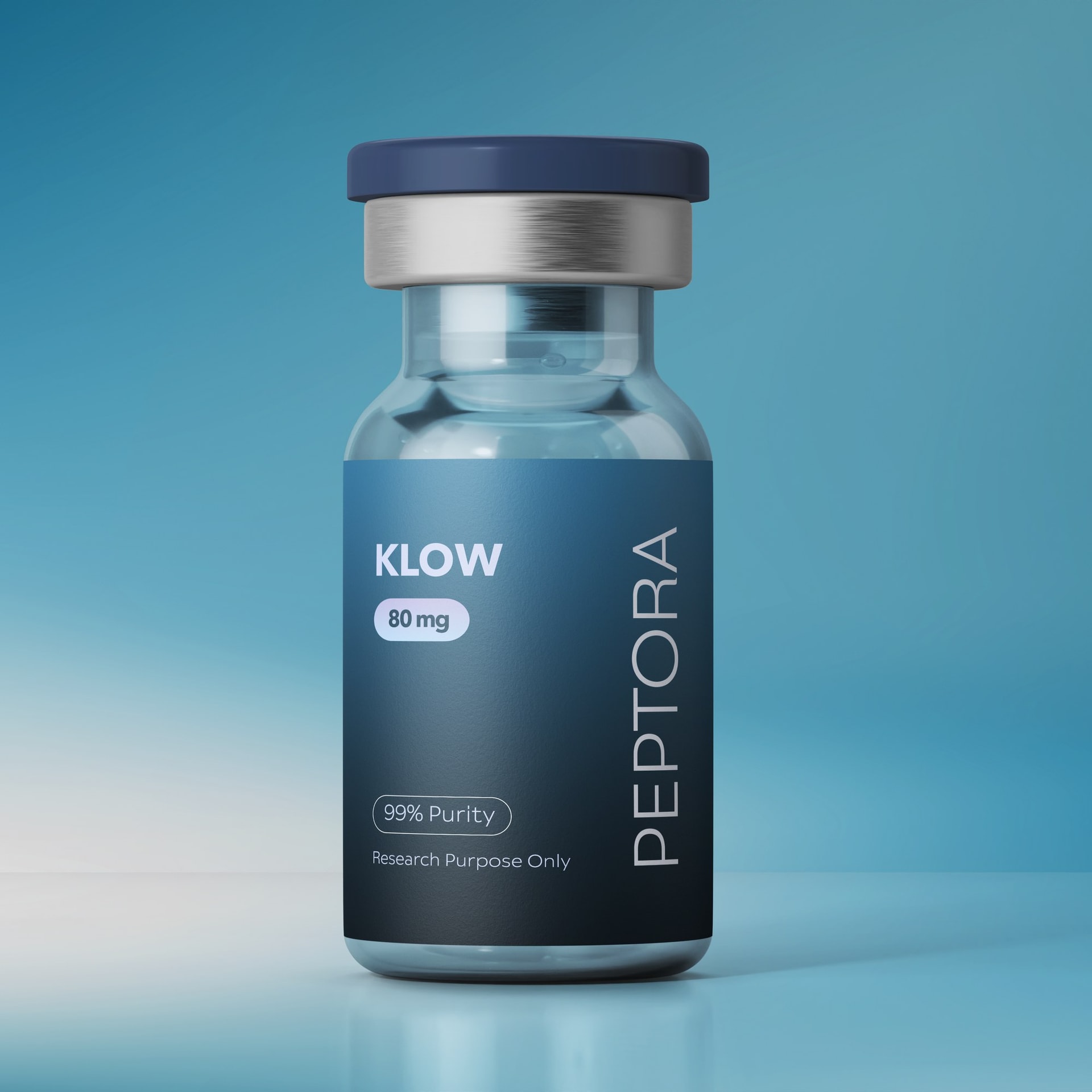


What is KLOW?
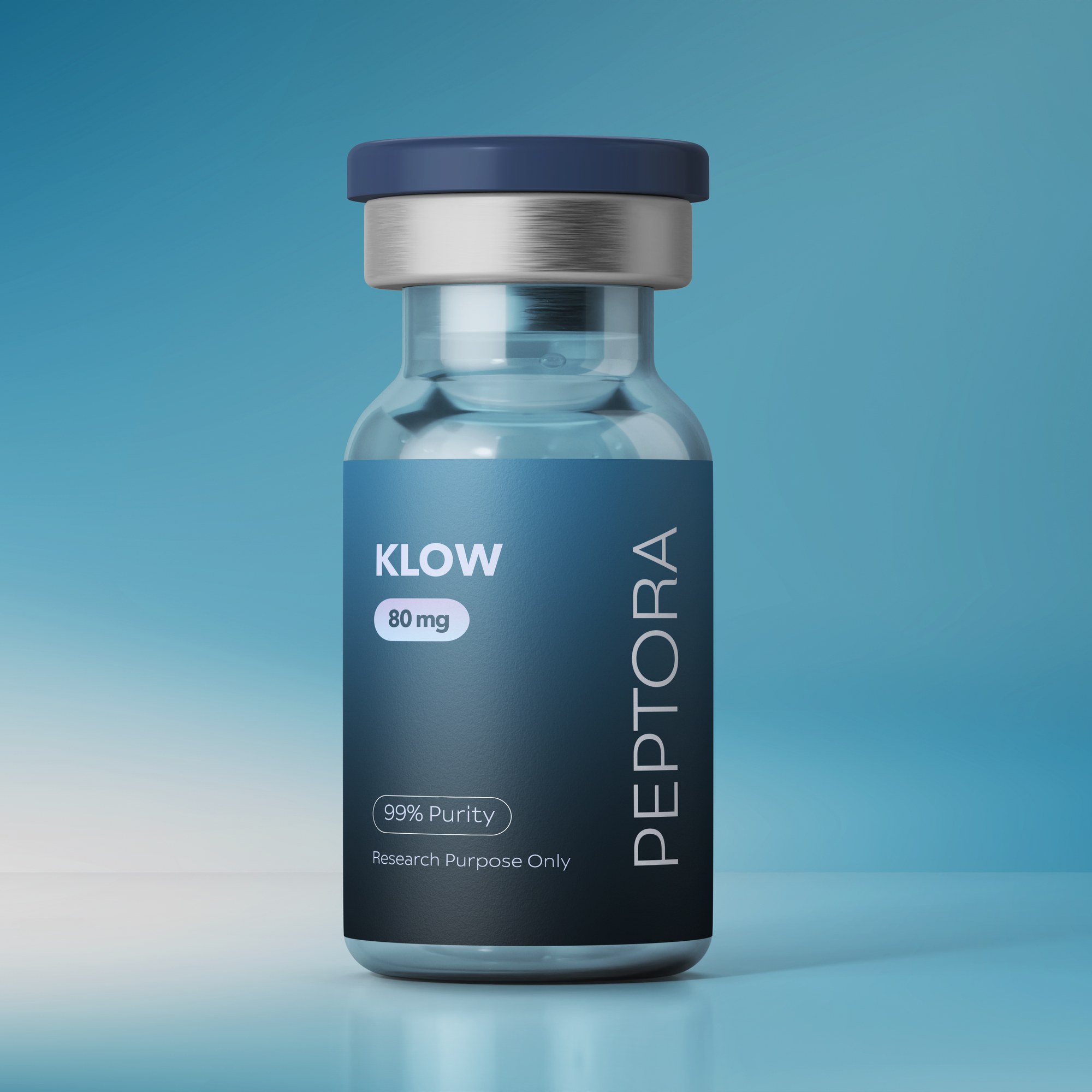
KLOW is Peptora's name for a research blend — one vial that holds four different peptides (a peptide is just a tiny protein) mixed together. The four are KPV, GHK-Cu, BPC-157, and TB-500. The easiest way to picture a blend is to think of it as a small team: instead of one worker, you get four, and each one has a specialty. KPV is studied in inflammatory-signaling research, GHK-Cu in skin and collagen research, and BPC-157 and TB-500 are two of the most-studied peptides in tissue-repair research.
The quickest way to place it: KLOW is the [GLOW blend](/research/glow) plus one extra peptide, KPV. And, as with everything in this library, KLOW is a research chemical for the laboratory only — not a medicine, and not for use in people or animals.
The four peptides at a glance
KPV — the alpha-MSH tripeptide
A tiny three-part peptide (lysine-proline-valine) — the tail end of a natural signal called alpha-MSH. Studied in inflammatory-signaling lab models.
GHK-Cu — the copper peptide
A three-part peptide that carries a copper atom. Studied in skin, collagen, and wound-repair research.
BPC-157 — the gut-derived peptide
A pentadecapeptide (a 15-piece peptide) first found in the stomach. One of the most-studied peptides in tissue-repair research.
TB-500 — the actin peptide
A lab-made piece of a natural protein (thymosin beta-4). Studied for cell movement and tissue-repair signals.
Explore KLOW
Independently lab tested, with each lot's certificate of analysis published online, fast U.S. shipping — for laboratory research use only.
View KLOWWhat's inside, and what each part does
A blend is only as clear as its parts, so here's each peptide in plain terms. Three of the four already have their own full guide if you want to go deeper:
- KPV — a three-letter peptide (Lys-Pro-Val) that is the active tail of a natural body signal called alpha-MSH. Preclinical studies have evaluated it in models of intestinal inflammation, where research suggests it dampens inflammatory messengers inside cells.
- [GHK-Cu](/research/ghk-cu) — a natural human peptide that binds a copper atom. In published lab studies it has been investigated for its links to collagen, skin remodeling, and blood-vessel formation (angiogenesis, or growing new blood vessels).
- [BPC-157](/research/bpc-157) — a peptide originally identified in stomach fluid. Preclinical (animal and cell) studies have evaluated it in models of tendon, ligament, muscle, and gut-lining repair.
- [TB-500](/research/tb-500) — a lab-made fragment of thymosin beta-4, a protein the body releases after injury. Research suggests it plays a role in cell migration (cells moving to where they're needed) and new blood-vessel growth.
KLOW vs GLOW: what's the difference?
The two blends are close cousins. Both are studied in the same tissue-repair and skin research areas; KLOW simply adds a fourth peptide, KPV, whose research is focused on inflammation. Here's the side-by-side:
| Peptide | In GLOW? | In KLOW? | Most-studied research area |
|---|---|---|---|
| KPV | — | ✓ | Inflammation signals (lab models) |
| GHK-Cu | ✓ | ✓ | Skin, collagen, tissue remodeling |
| BPC-157 | ✓ | ✓ | Tendon, ligament, muscle, gut-lining repair |
| TB-500 | ✓ | ✓ | Cell movement, blood-vessel growth |
Peptora carries both — the four-peptide KLOW and the three-peptide GLOW — plus the individual peptides GHK-Cu, BPC-157, and TB-500, each with its own certificate of analysis.
What scientists actually study it for
Because KLOW's four parts overlap in tissue-repair, skin, and inflammatory-signaling research, the blend usually comes up in a few connected research areas:
- Inflammation signals — the KPV part, which has been investigated in models of intestinal and cellular inflammation.
- Tissue repair — the BPC-157 and TB-500 parts, the two most-studied peptides in wound- and soft-tissue-repair experiments.
- Skin and collagen — the GHK-Cu part, studied in models of skin structure and collagen.
- Blood-vessel formation — angiogenesis shows up across the published research on several of these peptides.
Purity and testing (why the certificate matters)
In research, your results are only as trustworthy as the material you start with — and a four-peptide blend raises the bar again: every one of the four has to be present, in the right amount. Peptora's KLOW lots are tested for purity by HPLC at an independent lab, with a second test (LC-MS) to confirm the molecules are what they should be. Each lot's results are published online as a certificate of analysis (COA).
That paperwork is standard here, not an add-on. To learn what the numbers on a certificate actually mean, see the guide on the certificate of analysis.
How it's handled in the lab
KLOW ships as a freeze-dried powder (the technical word is lyophilized, which just means the water was removed to keep it stable). Before it's used in research, it's reconstituted — mixed back with bacteriostatic water, a special sterile water sold separately. A little care keeps all four peptides intact:
- 1Let the sealed vial warm up to room temperature before opening it.
- 2Add the water slowly down the side of the vial, then swirl gently — don't shake.
- 3Wait until the powder is fully dissolved before drawing anything out.
- 4Keep the mixed solution in the fridge, away from light.
Step-by-step details are in the reconstitution guide. Doing these the same way every time is one of the easiest ways to keep research consistent.
Scientific references
KLOW is a research blend, so there is no clinical trial on the mixture itself. The studies below are the primary literature on its individual peptides, from PubMed. They describe research on the compounds themselves — not the laboratory research product Peptora supplies.
- 1Kannengiesser K, et al. Melanocortin-derived tripeptide KPV has anti-inflammatory potential in murine models of inflammatory bowel disease. Inflamm Bowel Dis. 2008;14(3):324-331. doi:10.1002/ibd.20334.
- 2Dalmasso G, et al. PepT1-mediated tripeptide KPV uptake reduces intestinal inflammation. Gastroenterology. 2008;134(1):166-178. doi:10.1053/j.gastro.2007.10.026.
- 3Xiao B, et al. Orally Targeted Delivery of Tripeptide KPV via Hyaluronic Acid-Functionalized Nanoparticles Efficiently Alleviates Ulcerative Colitis. Mol Ther. 2017;25(7):1628-1640. doi:10.1016/j.ymthe.2016.11.020.
- 4Pickart L. The human tri-peptide GHK and tissue remodeling. J Biomater Sci Polym Ed. 2008;19(8):969-988. doi:10.1163/156856208784909435.
- 5Gwyer D, Wragg NM, Wilson SL. Gastric pentadecapeptide body protection compound BPC 157 and its role in accelerating musculoskeletal soft tissue healing. Cell Tissue Res. 2019;377(2):153-159. doi:10.1007/s00441-019-03016-8.
- 6Goldstein AL, Hannappel E, Sosne G, Kleinman HK. Thymosin β4: a multi-functional regenerative peptide. Basic properties and clinical applications. Expert Opin Biol Ther. 2012;12(1):37-51. doi:10.1517/14712598.2012.634793.
Explore KLOW
Four research peptides in one vial, independently lab tested, with each lot's certificate of analysis published online — for laboratory research use only.
View KLOWKey takeaways
- KLOW is Peptora's name for a research blend that puts four peptides — KPV, GHK-Cu, BPC-157, and TB-500 — in one freeze-dried vial.
- The simplest way to place it: KLOW is the GLOW blend plus one extra peptide, KPV, whose research is focused on inflammation.
- Think of it like a small team: KPV is studied in inflammatory-signaling research, GHK-Cu in skin and collagen research, and BPC-157 and TB-500 are two of the most-studied peptides in tissue-repair research.
- It shows up in lab research on tissue-repair, skin, and inflammatory-signaling models. It's for laboratory research only — not a medicine, and not for people or animals.
- Lots are tested by an independent lab (HPLC, LC-MS), and each lot's results are published online as a certificate of analysis.
Frequently asked questions
This article is intended solely as an educational summary of publicly available scientific literature. Products offered by Peptora are supplied exclusively for laboratory research purposes and are not approved for human or veterinary use. The information presented should not be interpreted as medical advice, treatment recommendations, or clinical guidance.