

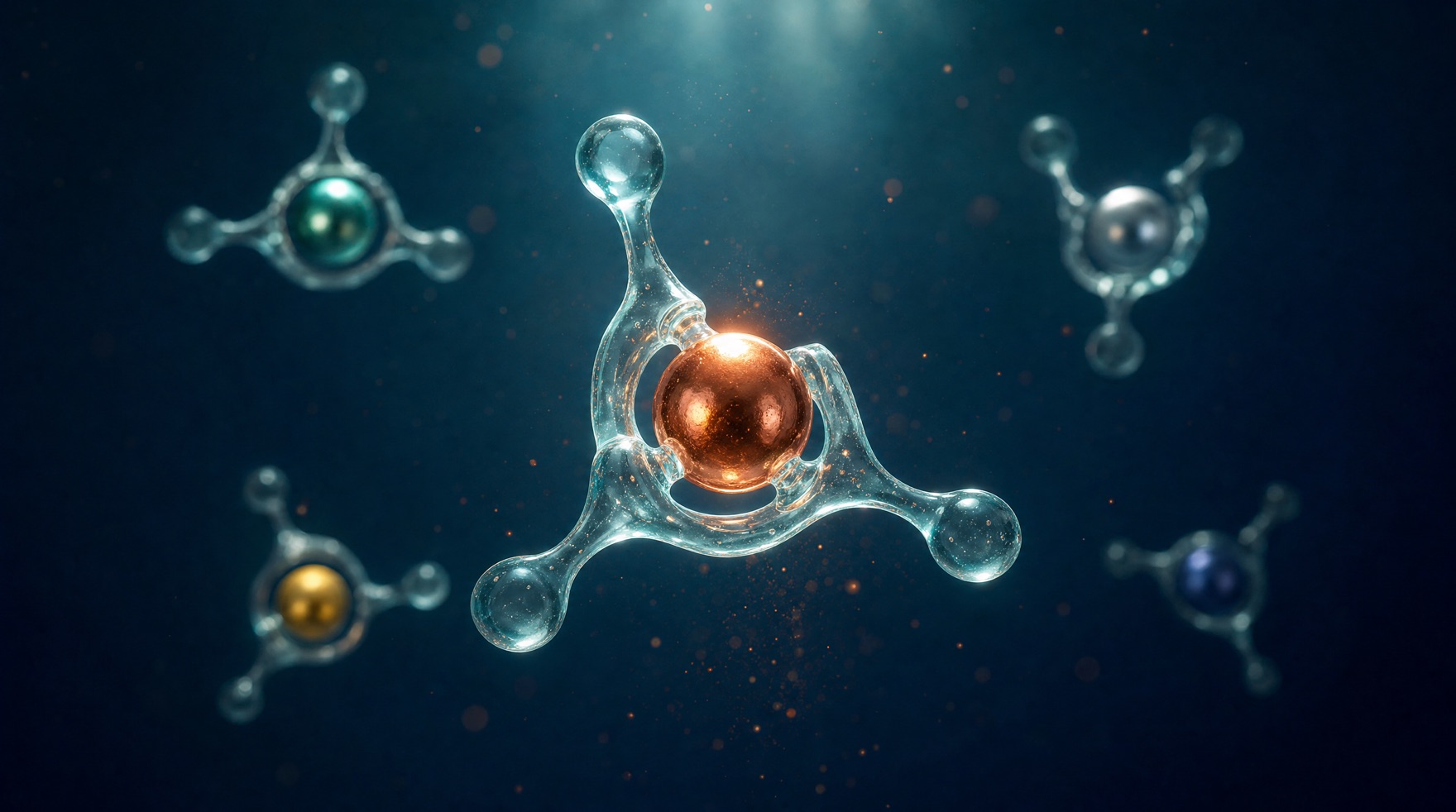
"Copper peptide" is a category, not a compound
This is the first thing that trips people up. Copper peptide isn't the name of one specific molecule — it describes any peptide (a tiny protein) that holds onto a copper atom. There are quite a few of them, and they are not interchangeable.
The simplest way to picture it: the peptide is a delivery van, and the copper is the cargo. Change the van and you change where the cargo goes, how tightly it's held, and what happens when it arrives. Loose copper on its own behaves very differently from copper held in a specific peptide.
GHK-Cu is one particular van — and by a wide margin the most-studied one. GHK stands for glycyl-L-histidyl-L-lysine, its three building blocks. It's naturally occurring: it was identified in human blood plasma in 1973, and published work notes that its grip on copper is comparable to the copper-transport site on albumin, the body's main carrier protein in blood.
Explore GHK-Cu
Independently lab tested, with each lot's certificate of analysis published online, fast U.S. shipping — for laboratory research use only.
View GHK-CuThe quick version
The van and the cargo
The peptide is a carrier; the copper is what it carries. Both parts matter — swap either and you get a different compound.
GHK-Cu is the natural one
Found in human plasma in 1973. Its copper grip is described as similar to albumin, the body's own copper-carrying blood protein.
Why compare at all
Comparing GHK-Cu against copper alone and against analogues — lab-made variants — is how researchers separate the copper's role from the peptide's.
Same testing bar
Tested by an independent lab (HPLC + LC-MS), with each lot's certificate of analysis published online.
So why do scientists study this one so much?
Because it keeps showing up in more places than anyone expected. In preclinical work — that means studies in cells and animals, before any human trials — GHK and GHK-Cu have been investigated for effects on collagen and elastin (the proteins that give skin its structure and stretch), on the growth of new blood vessels, and on how repair cells behave at a wound site.
One early cell-culture study from a French university group reported that GHK-Cu increased the production of glycosaminoglycans — long sugar chains that form part of the scaffolding between cells — and, notably, that the effect was biphasic: it peaked at very low concentrations and then tapered off as concentrations rose. That kind of result is a reminder that "more" is not automatically "more effect," which is exactly the sort of thing researchers want to characterize.
More recently, gene-profiling work has reported that GHK influences the activity of a large number of human genes, which is one proposed explanation for why a single small molecule shows up across so many different research areas.
GHK-Cu vs the alternatives
Researchers have run this comparison several ways. Each one isolates a different question.
Against copper on its own
This is the obvious control: if you just supply copper without the peptide, do you get the same result? A 1995 study at the University of Florence tested GHK-Cu alongside plain copper acetate in a wound model, and found the peptide complexes behaved differently from equivalent amounts of copper by itself. The peptide isn't just packaging.
Against lab-made analogues
An analogue is a lab-made variant — same basic idea, deliberately altered structure. The same 1995 study compared natural GHK-Cu against three synthetic analogues and reported no significant difference between the natural peptide and its closest variant in that particular model. That's a useful, unglamorous finding: it suggests the effect isn't hyper-specific to one exact sequence, and it's the kind of comparison that keeps a field honest.
Against other topical agents
Some of the more direct comparisons come from veterinary research. A controlled study in rabbits compared a tripeptide-copper complex against zinc oxide and an untreated control in open-wound models, and reported faster wound-area reduction in the copper-peptide group. Another rat study reported accelerated closure in wounds with restricted blood supply, alongside lower levels of certain inflammation markers.
| Comparison | The question it answers | What published work reports |
|---|---|---|
| GHK-Cu vs copper alone | Does the peptide carrier matter? | The complexes behaved differently from equivalent plain copper |
| GHK-Cu vs synthetic analogues | How specific is the exact sequence? | No significant difference vs its closest analogue in one wound model |
| GHK-Cu vs zinc oxide | How does it stack up against another agent? | Faster wound-area reduction reported in a rabbit study |
| GHK vs GHK-Cu | Is the copper required? | Both forms are studied; published reviews describe overlapping activity |
Peptora carries GHK-Cu individually, plus the GLOW and KLOW blends that include it — each with its own certificate of analysis. For single-compound background, see the GHK-Cu guide, the GLOW guide, and the KLOW guide.
A handling quirk worth knowing
Copper peptides come with a practical wrinkle that plain peptides don't have: the copper makes them sensitive to their chemical surroundings. A formulation study at the University of Auckland reported that GHK-Cu is strongly hydrophilic — it strongly prefers water over oil — and that it held up well in water and in mildly acidic-to-neutral conditions, but broke down under basic or oxidizing conditions.
The practical takeaway for a lab: what you dissolve it in and what you store it next to genuinely matters. Researchers have explored carriers such as liposomes — tiny fatty bubbles used to hold a substance — partly for this reason.
Purity, testing and lab handling
In research, your results are only as trustworthy as the material you start with. Peptora's GHK-Cu lots are tested for purity by HPLC at an independent lab, with LC-MS as a second test to confirm it's the right molecule. Each lot's results are published online as a certificate of analysis (COA). To learn what the numbers mean, see the guide on what a certificate of analysis is.
GHK-Cu ships as a freeze-dried powder (the technical word is lyophilized). Before use in research it is reconstituted — mixed with water, specifically bacteriostatic water, sold separately:
- 1Let the sealed vial warm up to room temperature before opening it.
- 2Add the water slowly down the side of the vial, then swirl gently — don't shake.
- 3Wait until the powder is fully dissolved before drawing anything out.
- 4Keep the mixed solution in the fridge, away from light.
Step-by-step details are in the reconstitution guide.
Scientific references
These references, from PubMed, describe published research on GHK, GHK-Cu and related copper complexes. They are provided for background about the compounds themselves — not the laboratory research product Peptora supplies, and not as any guide to use.
- 1Pickart L. The human tri-peptide GHK and tissue remodeling. J Biomater Sci Polym Ed. 2008;19(8):969-988. doi:10.1163/156856208784909435 (PMID: 18644225).
- 2Pickart L, Margolina A. Regenerative and Protective Actions of the GHK-Cu Peptide in the Light of the New Gene Data. Int J Mol Sci. 2018;19(7):1987. doi:10.3390/ijms19071987 (PMID: 29986520).
- 3Pickart L, Vasquez-Soltero JM, Margolina A. The human tripeptide GHK-Cu in prevention of oxidative stress and degenerative conditions of aging. Oxid Med Cell Longev. 2012;2012:324832. doi:10.1155/2012/324832 (PMID: 22666519).
- 4Buffoni F, Pino R, Dal Pozzo A. Effect of tripeptide-copper complexes on the process of skin wound healing and on cultured fibroblasts. Arch Int Pharmacodyn Ther. 1995;330(3):345-360. (PMID: 8836453).
- 5Wegrowski Y, Maquart FX, Borel JP. Stimulation of sulfated glycosaminoglycan synthesis by the tripeptide-copper complex glycyl-L-histidyl-L-lysine-Cu2+. Life Sci. 1992;51(13):1049-1056. doi:10.1016/0024-3205(92)90504-i (PMID: 1522753).
- 6Canapp SO, et al. The effect of topical tripeptide-copper complex on healing of ischemic open wounds. Vet Surg. 2003;32(6):515-523. doi:10.1111/j.1532-950x.2003.00515.x (PMID: 14648529).
- 7Cangul IT, et al. Evaluation of the effects of topical tripeptide-copper complex and zinc oxide on open-wound healing in rabbits. Vet Dermatol. 2006;17(6):417-423. doi:10.1111/j.1365-3164.2006.00551.x (PMID: 17083573).
- 8Badenhorst T, Svirskis D, Wu Z. Physicochemical characterization of native glycyl-l-histidyl-l-lysine tripeptide for wound healing and anti-aging: a preformulation study for dermal delivery. Pharm Dev Technol. 2016;21(2):152-160. doi:10.3109/10837450.2014.979944 (PMID: 25384620).
- 9Dymek M, et al. Liposomes as Carriers of GHK-Cu Tripeptide for Cosmetic Application. Pharmaceutics. 2023;15(10):2485. doi:10.3390/pharmaceutics15102485 (PMID: 37896245).
Explore GHK-Cu
Independently lab tested, with each lot's certificate of analysis published online, fast U.S. shipping — for laboratory research use only.
View GHK-CuKey takeaways
- "Copper peptide" describes a whole category — any tiny protein carrying a copper atom — not one specific compound. Think of the peptide as a delivery van and the copper as its cargo.
- GHK-Cu is the most-studied member of that category. GHK is naturally occurring, identified in human blood plasma in 1973, and its grip on copper is described as comparable to albumin, the body's own copper-carrying blood protein.
- Researchers compare GHK-Cu against plain copper to test whether the peptide carrier actually matters — a 1995 study reported the complexes behaved differently from equivalent amounts of copper acetate alone.
- The same study compared GHK-Cu with three lab-made analogues and reported no significant difference against its closest variant, suggesting the effect is not hyper-specific to one exact sequence.
- Much of the direct comparison evidence is preclinical and veterinary — rat and rabbit wound models, and cell cultures — not human clinical trials.
- Copper peptides are chemically fussier than plain peptides: published formulation work reports GHK-Cu is strongly water-preferring and degrades under basic or oxidizing conditions, so what you dissolve and store it in matters.
- Peptora's GHK-Cu is tested by an independent lab (HPLC and LC-MS), with each lot's certificate of analysis published online, supplied as a freeze-dried powder for laboratory research only.
Frequently asked questions
This article is intended solely as an educational summary of publicly available scientific literature. Products offered by Peptora are supplied exclusively for laboratory research purposes and are not approved for human or veterinary use. The information presented should not be interpreted as medical advice, treatment recommendations, or clinical guidance.