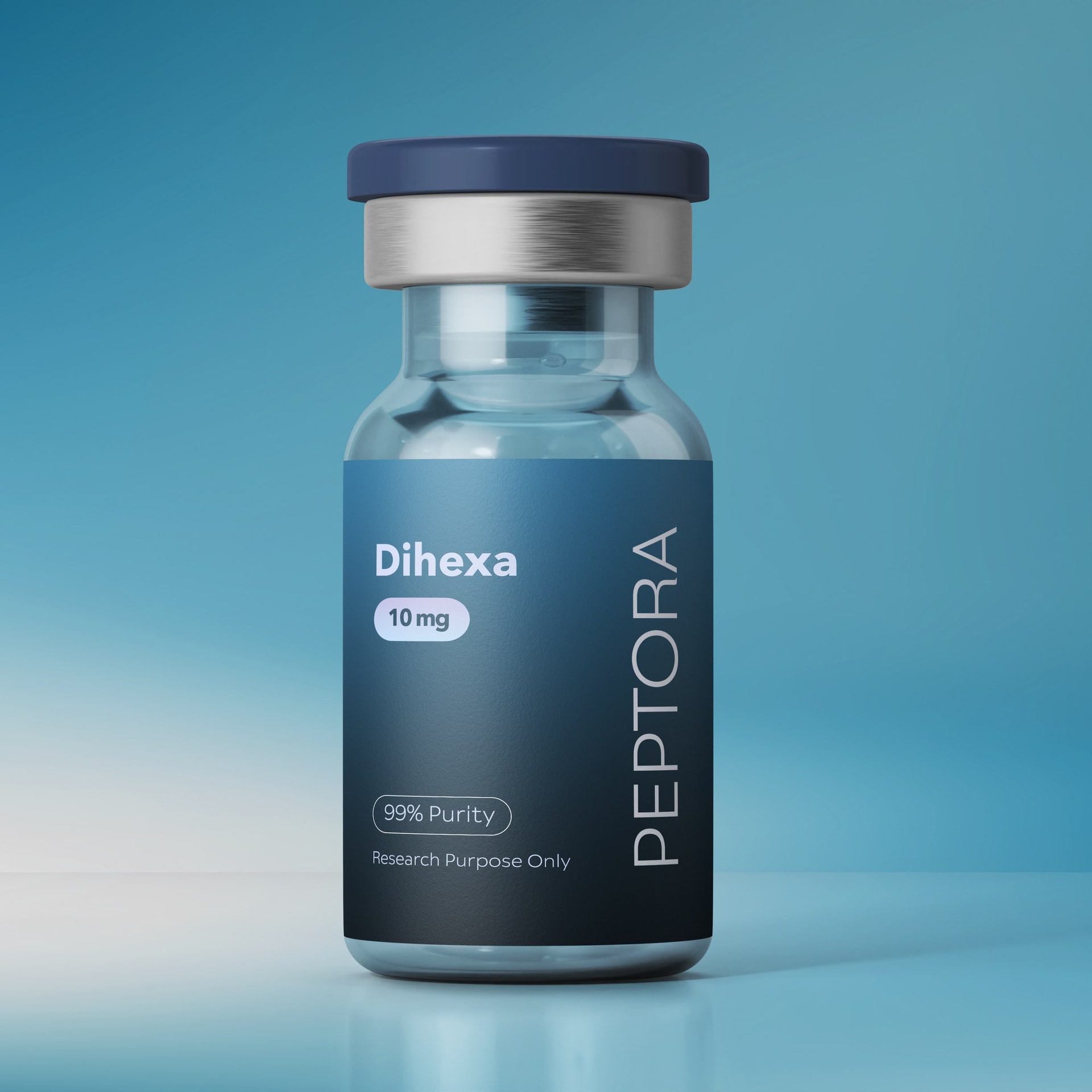


What is Dihexa?
Dihexa is a lab-made copy — scientists call it an analog — of a small natural brain messenger called angiotensin IV. An analog is just a redesigned version of a natural molecule, tweaked to behave better in an experiment. In Dihexa's case, the natural messenger was interesting but very fragile: the body broke it down almost instantly, and it couldn't cross into the brain. So researchers at Washington State University re-engineered it to be sturdier and brain-penetrant, and called the result Dihexa (its formal lab name is N-hexanoic-Tyr-Ile-(6)-aminohexanoic amide, and it's also been labeled PNB-0408).
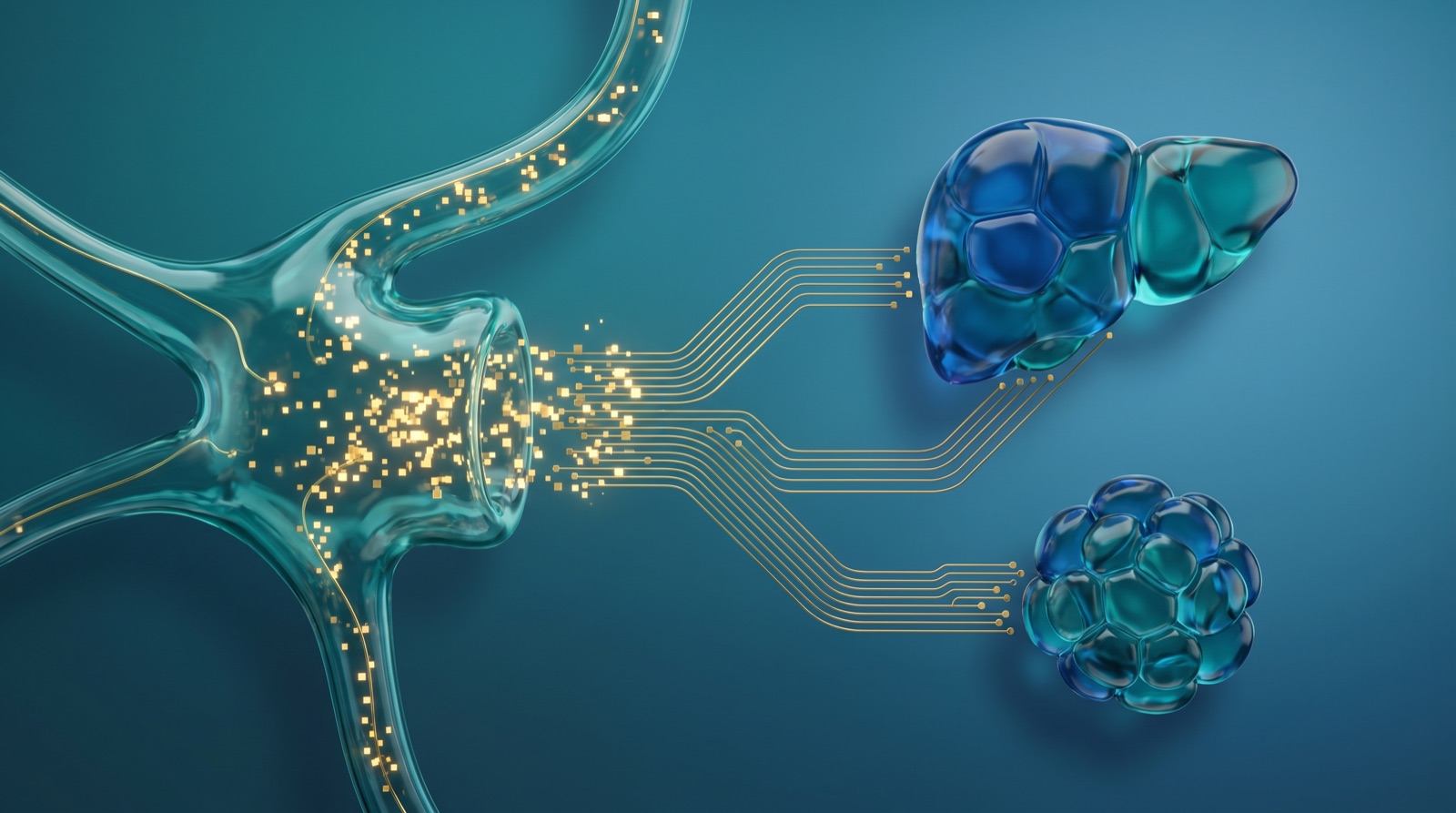
The reason it drew so much attention is what it seems to do in the lab. Think of the body as having its own "grow-and-connect" repair signal — a protein called HGF (hepatocyte growth factor) — that cells, including nerve cells, use to build and rebuild connections. Dihexa appears to act like a booster for that signal: research suggests it helps HGF do its job more strongly, a bit like a small helper that makes a key turn more easily in its lock.
The quick version
A redesigned messenger
A lab-made analog of the brain peptide angiotensin IV, rebuilt to last longer and reach the brain.
Amplifies the HGF signal
In lab studies it amplifies HGF, the body's own "grow-and-connect" signal for cells.
Studied for connections
Most research looks at whether it helps nerve cells form new links (synapses) in models of memory.
Published lab results
Each lot's HPLC purity is listed on its certificate of analysis.
How it works, in plain terms
Start with the natural messenger. Angiotensin IV is a small peptide in the brain that early studies linked to learning and memory. The problem: it fell apart too fast and couldn't reach the brain from outside. Scientists trimmed it down to its most important few building blocks and then chemically toughened it — the result was Dihexa, which is stable enough to be taken by mouth in animal studies and can cross into the brain.
Here's what published studies describe, in everyday language:
- It teams up with HGF. Research suggests Dihexa binds to HGF — the body's "grow-and-connect" protein — and helps switch on HGF's docking spot on cells (a receptor called c-Met).
- It's tied to new connections. In lab studies, turning up that signal is associated with nerve cells growing more spines and forming new synapses — the junctions where brain cells talk to each other.
- It was built to last. The whole point of the redesign was stability and brain access, which is why it's studied where the natural messenger couldn't be.
- Its exact mechanism is still debated. Scientists have proposed more than one explanation for how the underlying messenger acts, and research on the details is ongoing.
What scientists actually study it for
Because it targets a growth-and-repair signal and reaches the brain, Dihexa shows up most in neuroscience research. The main areas in the literature are:
- Learning and memory — its original focus. In rodent studies it's been evaluated in memory tasks (like the Morris water maze) and in aged-animal and chemically-impaired models.
- Synapse formation — whether boosting the HGF signal helps nerve cells build new connections, studied directly in nerve-cell cultures.
- Brain aging and neurodegeneration models — it's been examined in preclinical Alzheimer's- and Parkinson's-related models as a research tool.
- Cell protection and repair — because HGF is a general repair signal, some studies look at it in other cell types, from inner-ear cells to nerve-repair models.
Purity and testing (why the certificate matters)
In research, your results are only as trustworthy as the material you start with. Peptora's Dihexa lots are tested for purity by HPLC at an independent lab, with LC-MS as a second test to confirm it's the right molecule. Each lot's results are published online as a certificate of analysis (COA).
To learn what the numbers on a certificate actually mean, see the guide on what a certificate of analysis is and the research-peptide overview.
How it's handled in the lab
Dihexa ships as a freeze-dried powder (that's what lyophilized means — the water has been removed to keep it stable). Because it's an oily, water-shy molecule, labs often note it needs care to dissolve; the usual first step is mixing with bacteriostatic water — a special sterile water, sold separately — a process called reconstitution ("mixing the powder back into a liquid"). A little care keeps the material intact so results stay reliable:
- 1Let the sealed vial warm up to room temperature before opening it.
- 2Add the liquid slowly down the side of the vial, then swirl gently — don't shake.
- 3Give it time to fully dissolve before drawing anything out.
- 4Keep the mixed solution in the fridge, away from light.
Step-by-step details are in the reconstitution guide. Doing these the same way every time is one of the easiest ways to keep research consistent.
Scientific references
Dihexa (also called N-hexanoic-Tyr-Ile-(6)-aminohexanoic amide or PNB-0408) is a metabolically stabilized analog of angiotensin IV and has been studied mostly in cell and animal models. The studies below are provided for background, from PubMed. They describe research on the compound itself — not the laboratory research product Peptora supplies.
- 1McCoy AT, et al. Evaluation of metabolically stabilized angiotensin IV analogs as procognitive/antidementia agents. J Pharmacol Exp Ther. 2012;344(1):141-154. doi:10.1124/jpet.112.199497 (PMID: 23055539).
- 2Wright JW, Kawas LH, Harding JW. The development of small molecule angiotensin IV analogs to treat Alzheimer's and Parkinson's diseases. Prog Neurobiol. 2015;125:26-46. doi:10.1016/j.pneurobio.2014.11.004 (PMID: 25455861).
- 3Wright JW, Harding JW. The Brain Hepatocyte Growth Factor/c-Met Receptor System: A New Target for the Treatment of Alzheimer's Disease. J Alzheimers Dis. 2015;45(4):985-1000. doi:10.3233/JAD-142814 (PMID: 25649658).
- 4Uribe PM, et al. Hepatocyte growth factor mimetic protects lateral line hair cells from aminoglycoside exposure. Front Cell Neurosci. 2015;9:3. doi:10.3389/fncel.2015.00003 (PMID: 25674052).
- 5Sun X, et al. AngIV-Analog Dihexa Rescues Cognitive Impairment and Recovers Memory in the APP/PS1 Mouse via the PI3K/AKT Signaling Pathway. Brain Sci. 2021;11(11):1487. doi:10.3390/brainsci11111487 (PMID: 34827486).
- 6Wells RG, et al. Effects of an Angiotensin IV Analog on 3-Nitropropionic Acid-Induced Huntington's Disease-Like Symptoms in Rats. J Huntingtons Dis. 2024;13(1):55-66. doi:10.3233/JHD-231507 (PMID: 38489193).
Explore Dihexa
Independently lab tested, with each lot's certificate of analysis published online, fast U.S. shipping — for laboratory research use only.
View DihexaKey takeaways
- Dihexa is a lab-made copy (analog) of the natural brain messenger angiotensin IV, re-engineered at Washington State University to survive longer and reach the brain.
- Its main scientific interest is that, in lab studies, it seems to boost the body's own HGF "grow-and-connect" repair signal and its docking spot (c-Met) on cells.
- Turning up that signal is associated in research with nerve cells forming new connections (synapses), which is why it's studied in memory and brain-aging models.
- The evidence is preclinical and model-dependent — some studies are positive, but at least one 2024 model reported no protective effect — so it's a research tool, not a proven treatment. It's for laboratory research only, not for people or animals.
- It ships as a freeze-dried powder. Lots are tested by an independent lab (HPLC, LC-MS), and each lot's results are published online as a certificate of analysis.
Frequently asked questions
This article is intended solely as an educational summary of publicly available scientific literature. Products offered by Peptora are supplied exclusively for laboratory research purposes and are not approved for human or veterinary use. The information presented should not be interpreted as medical advice, treatment recommendations, or clinical guidance.