
The short answer
The body does not have one single "I'm full" signal. It has several, and they come from different places at different moments. Two of them get studied more than any others, and they are the two this guide is about.
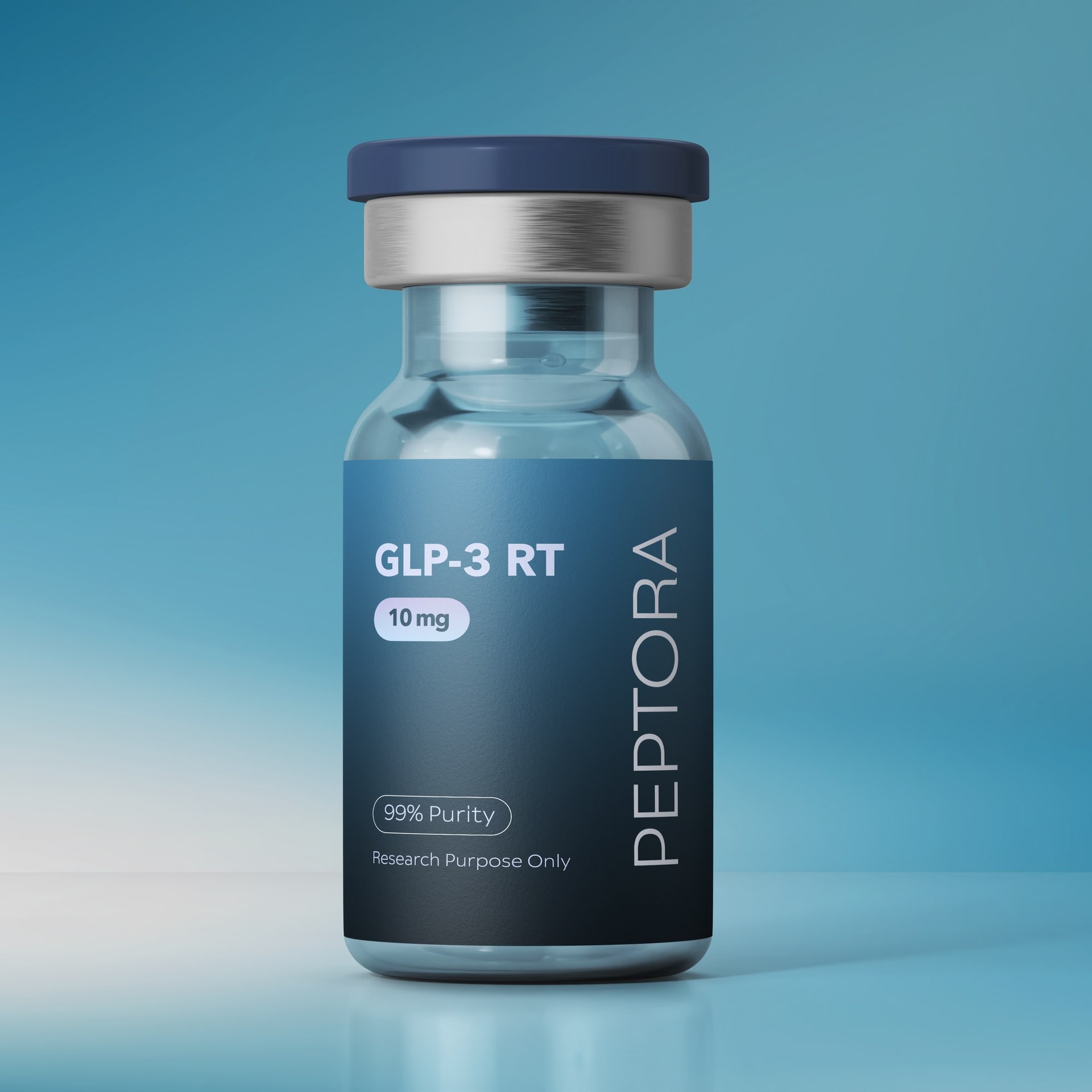
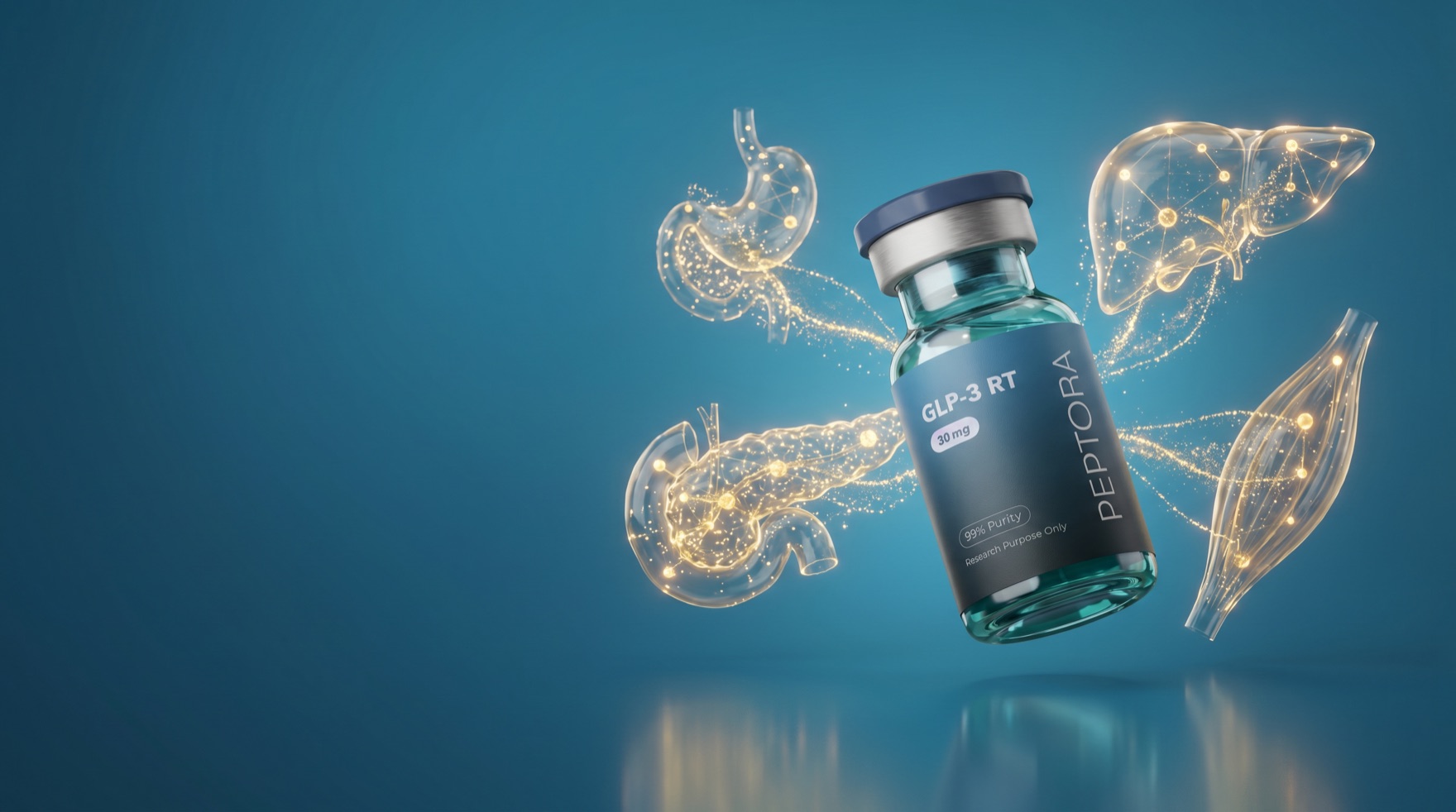
GLP-1 is a message the gut sends once food has actually arrived. Amylin is a message the pancreas sends, released at the same moment as insulin. Cagrilintide is a lab-made copy of amylin. The GLP-1 compounds people talk about — SEMA, and the multi-signal ones like TRZ and GLP-3 RT — are lab-made copies of that gut message instead.
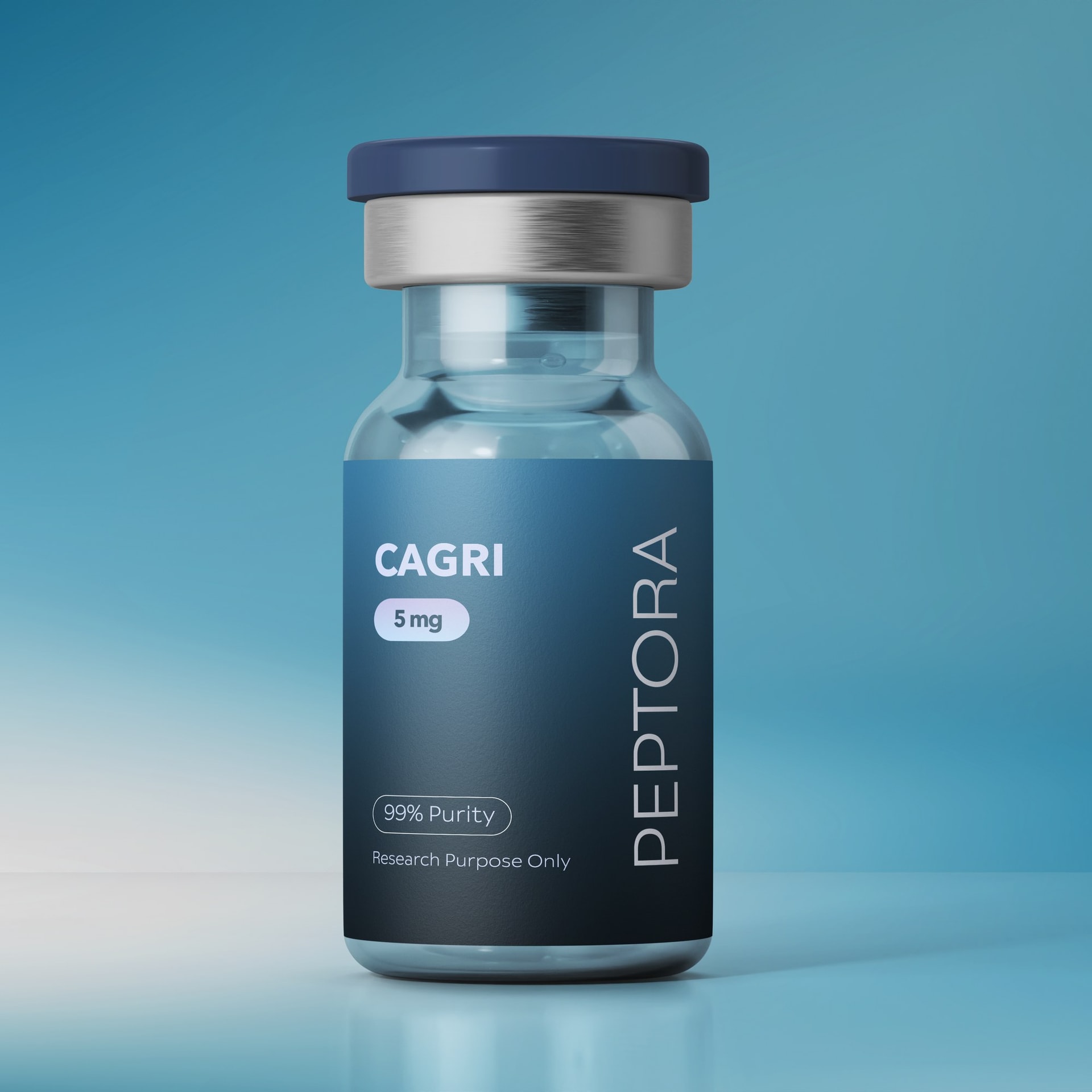
Explore research-grade Cagrilintide
99%+ pure, a certificate of analysis with every batch — for laboratory research use only.
View CAGRIThe quick version
Amylin — the pancreas signal
Released alongside insulin every time you eat. Cagrilintide is the long-lasting lab-made copy of it.
GLP-1 — the gut signal
Released by the intestine after food arrives. SEMA and the multi-signal compounds copy this one.
Different docking spots
Amylin's docking spot is built from two parts. The GLP-1 docking spot is a single, ordinary one.
Lab use only
Peptora supplies these as research chemicals — never for people or animals.
Amylin: the signal cagrilintide copies
Every time you eat, the pancreas releases insulin. What fewer people know is that it releases a second, much smaller hormone at the same time, in the same package. That hormone is amylin. Where insulin's job is mostly about moving sugar out of the blood, amylin's published role is about pace and portion — it has been described as slowing how fast the stomach empties and as part of the brain's satiety signaling, the biology of feeling like you have had enough.
Amylin itself is a difficult molecule to work with. Left alone, it clumps together into sticky fibers, which is a real problem if you are trying to make a stable research compound out of it. Chemists at the manufacturer published the work of redesigning it — changing pieces of the chain so it would not clump, and attaching a fatty tail so it would last far longer in circulation. The result was cagrilintide (sometimes written AM833), described in the *Journal of Medicinal Chemistry* in 2021.
GLP-1: the signal the other family copies
GLP-1 stands for glucagon-like peptide-1, and it comes from a completely different place: the lining of the intestine. It is released when food physically arrives, which is why it belongs to a group of hormones called incretins — the body's "food has landed" messengers. In published work it is described as prompting insulin release, slowing stomach emptying, and acting on appetite centers in the brain.
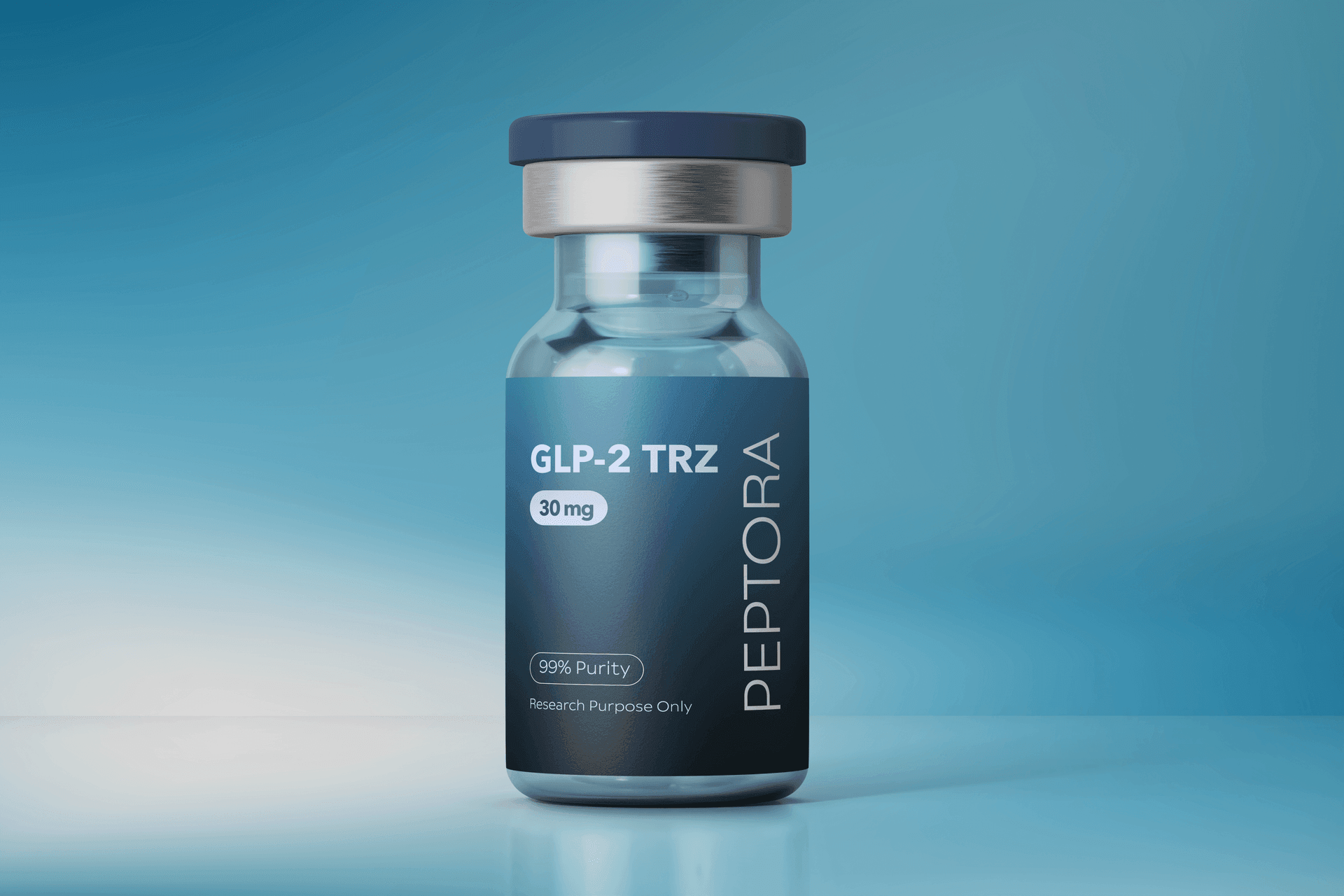
That is the pathway the best-known metabolic research compounds copy. Some copy only GLP-1. Others copy GLP-1 plus a second incretin called GIP — that is TRZ. And one copies three signals at once by adding glucagon — that is GLP-3 RT. All of them are still working inside the same incretin family. Cagrilintide is not.
The part that makes them genuinely different
A receptor is a docking spot on the surface of a cell — the place a signal has to land before anything happens. Most receptors are a single protein. The amylin receptor is not.
Published pharmacology describes the amylin docking spot as a two-part assembly: a calcitonin receptor paired with a small helper protein called a RAMP. Swap in a different RAMP and you get a slightly different amylin receptor — there are three versions. A 2022 paper in *Science* used cryo-electron microscopy, a technique that freezes molecules and photographs them at near-atomic detail, to map how amylin actually sits in that two-part pocket.
The GLP-1 receptor has no such helper. It is one protein, doing one job. So while both compounds are described as reducing food intake in published studies, they are not competing for the same landing spot — which is the mechanical reason researchers have looked at what happens when both pathways are engaged at once.
Side by side
| Cagrilintide (amylin) | GLP-1 compounds | |
|---|---|---|
| Copies which natural signal | Amylin | GLP-1 (an incretin) |
| Where the natural signal comes from | The pancreas, alongside insulin | The lining of the intestine |
| Docking spot | Two-part: calcitonin receptor + RAMP helper | A single receptor protein |
| Who developed it | Its manufacturer | Separate developers |
| Research stage | Phase 2 alone; phase 3 in combination | Phase 3 and beyond |
| Peptora product | CAGRI | GLP-2 TRZ, GLP-3 RT |
Why researchers keep studying them together
Because the two pathways are separate, the obvious scientific question is what happens when you engage both. That question has been asked in published clinical research, and it is the reason the pairing has a name of its own: CagriSema — cagrilintide plus SEMA.
- 12021, phase 1b. A trial run at a single U.S. centre tested rising doses of cagrilintide given alongside SEMA, mainly to check safety and how the two behaved in the body together. Reported in *The Lancet*.
- 22021, phase 2. A 26-week dose-finding trial across ten countries tested cagrilintide on its own against placebo and against an existing GLP-1 comparator. Also reported in *The Lancet*.
- 32025, phase 3. Two large 68-week trials — REDEFINE 1 and REDEFINE 2 — reported results for the combination in the *New England Journal of Medicine*. All of this work was funded by the manufacturer.
Purity and handling
Amylin analogues are fussy molecules — the whole reason cagrilintide had to be redesigned is that natural amylin clumps. That makes starting material quality matter more, not less. Every batch Peptora supplies is checked to 99%+ purity by HPLC — a machine that separates a sample into its parts so you can see exactly how much of it is the peptide you ordered — and confirmed by LC-MS, a second test proving the molecule is the right one.
Both families ship lyophilized (freeze-dried) and are reconstituted — mixed with bacteriostatic water — before research use. Warm the sealed vial to room temperature first, add the water slowly down the side, swirl rather than shake, and keep the mixed solution cold and out of light. Full steps are in the reconstitution guide, and what a certificate of analysis means explains the paperwork. Peptora carries research-grade CAGRI, GLP-2 TRZ, and GLP-3 RT, each with its own certificate.
Scientific references
The sources below are listed for background, from PubMed and ClinicalTrials.gov. They describe research on the molecules themselves — not the laboratory research products Peptora supplies.
- 1Kruse T, Hansen JL, Dahl K, et al. Development of Cagrilintide, a Long-Acting Amylin Analogue. J Med Chem. 2021;64(15):11183-11194. doi:10.1021/acs.jmedchem.1c00565 (PMID: 34288673).
- 2Lau DCW, Lancet. 2021;398(10317):2160-2172. doi:10.1016/S0140-6736(21)01751-7 (ClinicalTrials.gov: NCT03856047).
- 3Enebo LB, Lancet. 2021;397(10286):1736-1748. doi:10.1016/S0140-6736(21)00845-X (NCT03600480).
- 4Garvey WT, N Engl J Med. 2025;393(7):635-647. doi:10.1056/NEJMoa2502081 (REDEFINE 1; NCT05567796).
- 5Davies MJ, N Engl J Med. 2025;393(7):648-659. doi:10.1056/NEJMoa2502082 (REDEFINE 2; NCT05394519).
- 6Cao J, Belousoff MJ, Liang YL, et al. A structural basis for amylin receptor phenotype. Science. 2022;375(6587):eabm9609. doi:10.1126/science.abm9609 (PMID: 35324283).
- 7Poyner DR, Sexton PM, Marshall I, et al. International Union of Pharmacology. XXXII. The mammalian calcitonin gene-related peptides, adrenomedullin, amylin, and calcitonin receptors. Pharmacol Rev. 2002;54(2):233-246. doi:10.1124/pr.54.2.233 (PMID: 12037140).
- 8D'Ascanio AM, Mullally JA, Frishman WH. Cagrilintide: A Long-Acting Amylin Analog for the Treatment of Obesity. Cardiol Rev. 2024;32(1):83-90. doi:10.1097/CRD.0000000000000513 (PMID: 36883831).
Explore research-grade CAGRI
99%+ pure, a certificate of analysis with every batch, fast U.S. shipping — for laboratory research use only.
View CAGRIKey takeaways
- Because the two pathways are separate, published clinical research has looked at engaging both at once — the cagrilintide-plus-SEMA combination known as CagriSema.
- The body has more than one "I've had enough" signal. Cagrilintide copies amylin, which comes from the pancreas; GLP-1 compounds copy a signal that comes from the gut.
- Amylin is released at the same moment as insulin, in the same package — a completely different route from the incretin messengers.
- The amylin docking spot is a two-part assembly (a calcitonin receptor plus a small helper protein called a RAMP). The GLP-1 docking spot is a single protein.
- Because the two pathways are separate, published clinical research has looked at engaging both at once — the cagrilintide-plus-SEMA combination known as CagriSema.
- Peptora supplies CAGRI, GLP-2 TRZ, and GLP-3 RT as laboratory research chemicals at 99%+ purity with a batch-specific certificate of analysis — never for people or animals.
Frequently asked questions
This article is intended solely as an educational summary of publicly available scientific literature. Products offered by Peptora are supplied exclusively for laboratory research purposes and are not approved for human or veterinary use. The information presented should not be interpreted as medical advice, treatment recommendations, or clinical guidance.