

What is Cagrilintide (CAGRI)?
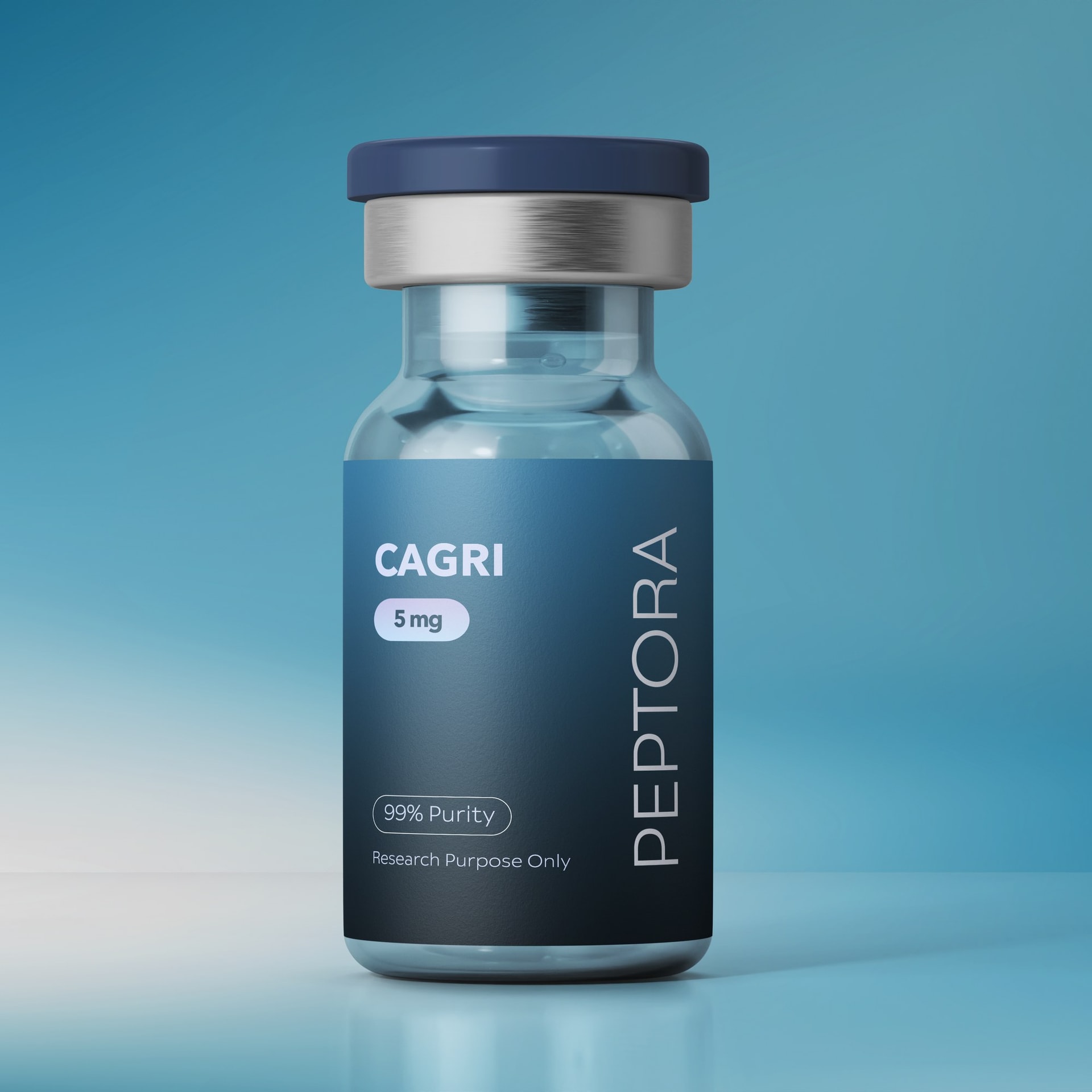
Cagrilintide — sold by Peptora under the research name CAGRI — is a lab-made, long-lasting copy of amylin. Amylin is a natural hormone the pancreas releases along with insulin after you eat, and its job is to signal that you're full. Cagrilintide was built as a tweaked, sturdier version (with a fat tail added) so it stays active in the body much longer than natural amylin does. It plugs into the body's amylin docking spots rather than the ones the GLP-1 compounds use — which is why scientists call it an amylin copy, not a GLP-1 or GIP compound.
Scientists have studied Cagrilintide both by itself and, notably, paired with the GLP-1 compound SEMA — a combination the research calls CagriSema. This guide uses its usual research name, Cagrilintide (CAGRI). It is meant only for laboratory research and is not a medicine — not for people or animals.
The quick version
A copy of a fullness hormone
A sturdier, long-lasting copy of amylin, the pancreas hormone that signals you're full.
The fullness angle
Amylin signals have been studied in the brain areas tied to both everyday hunger and the reward side of eating.
Studied in combos
Often studied next to SEMA — the pairing called CagriSema — to see if two fullness signals add up in research models.
99%+ pure
Double-checked by lab testing (HPLC + LC-MS) and shipped with a certificate for every batch.
Explore research-grade Cagrilintide
99%+ pure, a certificate of analysis with every batch, fast U.S. shipping — for laboratory research use only.
View Cagrilintide (CAGRI)How it works, in plain terms
Amylin is one of the body's natural "I'm full" hormones. It's released along with insulin after a meal, and scientists have studied how it signals fullness through docking spots in the brain. Cagrilintide was built to copy that same signal and make it last longer:
- Amylin docking spots — the spots on cells that amylin plugs into to send its fullness signal in research.
- Everyday hunger — brain areas studied for their role in normal, day-to-day hunger and energy balance.
- The reward side of eating — the "food feels good" circuits studied in appetite research.
According to PubMed, the chemists who built Cagrilintide had one big problem to solve: natural amylin clumps together easily, which makes it hard to work with. They reported that adding a fat tail and changing part of the sequence gave them a steady, long-lasting copy that could be used on a once-a-week schedule in clinical research.
How it compares to the GLP-1 compounds
Cagrilintide often comes up next to the GLP-1 family of research compounds, but it works a different way. Instead of using the GLP-1, GIP, or glucagon docking spots, it uses the amylin system. That's why scientists study it as something that could work alongside those compounds rather than doing the same thing. Here's how it lines up:
| Compound | Main system it uses | GLP-1 | Type |
|---|---|---|---|
| Cagrilintide (CAGRI) | Amylin | — | Amylin copy |
| SEMA | Gut "meal" signal | ✓ | One switch (GLP-1) |
| TRZ (GLP-2 TRZ) | Gut "meal" signal | ✓ | Two switches (GLP-1/GIP) |
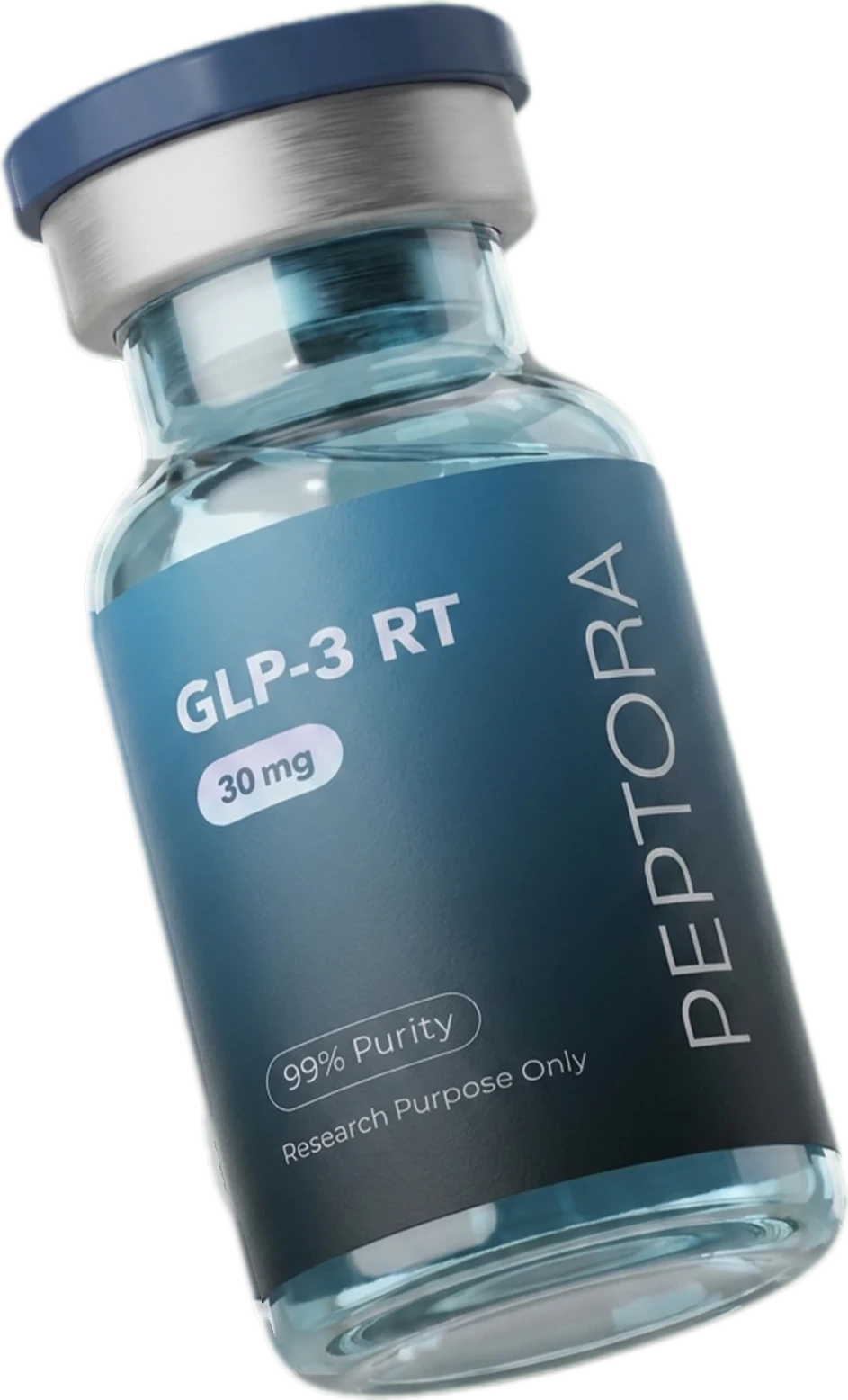
| GLP-3 RT (GLP-3 RT) | Gut "meal" signal | ✓ | Three switches |
Because the amylin system and the gut "meal" signals are separate but related, scientists have looked at whether pairing them adds up to more than either alone — the idea behind the CagriSema combo. Peptora carries research-grade versions of several of these, including Cagrilintide (CAGRI), GLP-3 RT, and TRZ (GLP-2 TRZ), each with its own certificate of analysis.
What scientists actually study it for
In lab and clinical research, Cagrilintide comes up in a few connected areas:
- Amylin signals — how a long-lasting amylin copy sends fullness signals compared with natural amylin and an older, shorter-acting copy called pramlintide.
- Appetite — how much test subjects eat and how full they feel, tied to amylin activity in research models.
- Body weight — how different amounts change results, in early animal and clinical research.
- Combinations — the CagriSema pairing with SEMA, studied to see if the two fullness signals add up.
Purity and testing (why the certificate matters)
In research, your results are only as trustworthy as the material you start with. Every batch of Cagrilintide from Peptora is checked to 99%+ purity by HPLC, confirmed by a second test (LC-MS) that proves it's the right molecule, and run through a full quality-control panel before it ships. Every order comes with a certificate of analysis (COA) for that exact batch, so you can match the material to its paperwork.
Amylin copies clump together especially easily, so knowing you have the right molecule at the right purity really matters for reliable work. To learn what the numbers on a certificate actually mean, see the guide on certificates of analysis.
How it's handled in the lab
Cagrilintide ships as a freeze-dried powder. Before it's used in research, it's mixed with bacteriostatic water — a special sterile water, sold separately. A little care keeps the peptide intact so the results stay reliable:
- 1Let the sealed vial warm up to room temperature before opening it.
- 2Add the water slowly down the side of the vial, then swirl gently — don't shake.
- 3Wait until the powder is fully dissolved before drawing anything out.
- 4Keep the mixed solution in the fridge, away from light.
Step-by-step details are in the reconstitution guide. Doing these the same way every time is one of the easiest ways to keep research consistent.
Scientific references
Cagrilintide (also called AM833) has been tested in clinical trials run by its manufacturer, including early dose-finding studies and the larger phase 3 CagriSema (REDEFINE) program. The studies listed below are here for background, from PubMed and ClinicalTrials.gov. They describe research on the compound itself — not the laboratory research product Peptora supplies.
- 1Lau DCW, et al. Lancet. 2021;398(10317):2160-2172. doi:10.1016/S0140-6736(21)01751-7 (ClinicalTrials.gov: NCT03856047).
- 2Kruse T, et al. Development of Cagrilintide, a Long-Acting Amylin Analogue. J Med Chem. 2021;64(15):11183-11194. doi:10.1021/acs.jmedchem.1c00565.
- 3Garvey WT, et al. N Engl J Med. 2025;393(7):635-647. doi:10.1056/NEJMoa2502081 (NCT05567796).
- 4D'Ascanio AM, et al. Cagrilintide: A Long-Acting Amylin Analog for the Treatment of Obesity. Cardiol Rev. 2024;32(1):83-90. doi:10.1097/CRD.0000000000000513.
- 5Panou T, et al. Amylin analogs for the treatment of obesity without diabetes: present and future. Expert Rev Clin Pharmacol. 2024;17(11):1005-1013. doi:10.1080/17512433.2024.2409403.
- 6Eržen S, et al. Amylin, Another Important Neuroendocrine Hormone for the Treatment of Diabesity. Int J Mol Sci. 2024;25(3):1517. doi:10.3390/ijms25031517.
Explore research-grade Cagrilintide (CAGRI)
99%+ pure, a certificate of analysis with every batch, fast U.S. shipping — for laboratory research use only.
View Cagrilintide (CAGRI)Key takeaways
- Cagrilintide (Peptora's CAGRI) is a lab-made, long-lasting copy of amylin, the pancreas hormone that signals you're full.
- It works through the body's amylin docking spots — a different system from the GLP-1, GIP, and glucagon ones the incretin compounds use.
- It's studied both on its own and paired with SEMA, a combo the research calls CagriSema.
- Published research on Cagrilintide is shared for background only — these are research findings, not proven results or dosing advice; the product is for laboratory research use only.
- Peptora's Cagrilintide is 99%+ pure with a certificate of analysis in every order.
Frequently asked questions
This article is intended solely as an educational summary of publicly available scientific literature. Products offered by Peptora are supplied exclusively for laboratory research purposes and are not approved for human or veterinary use. The information presented should not be interpreted as medical advice, treatment recommendations, or clinical guidance.