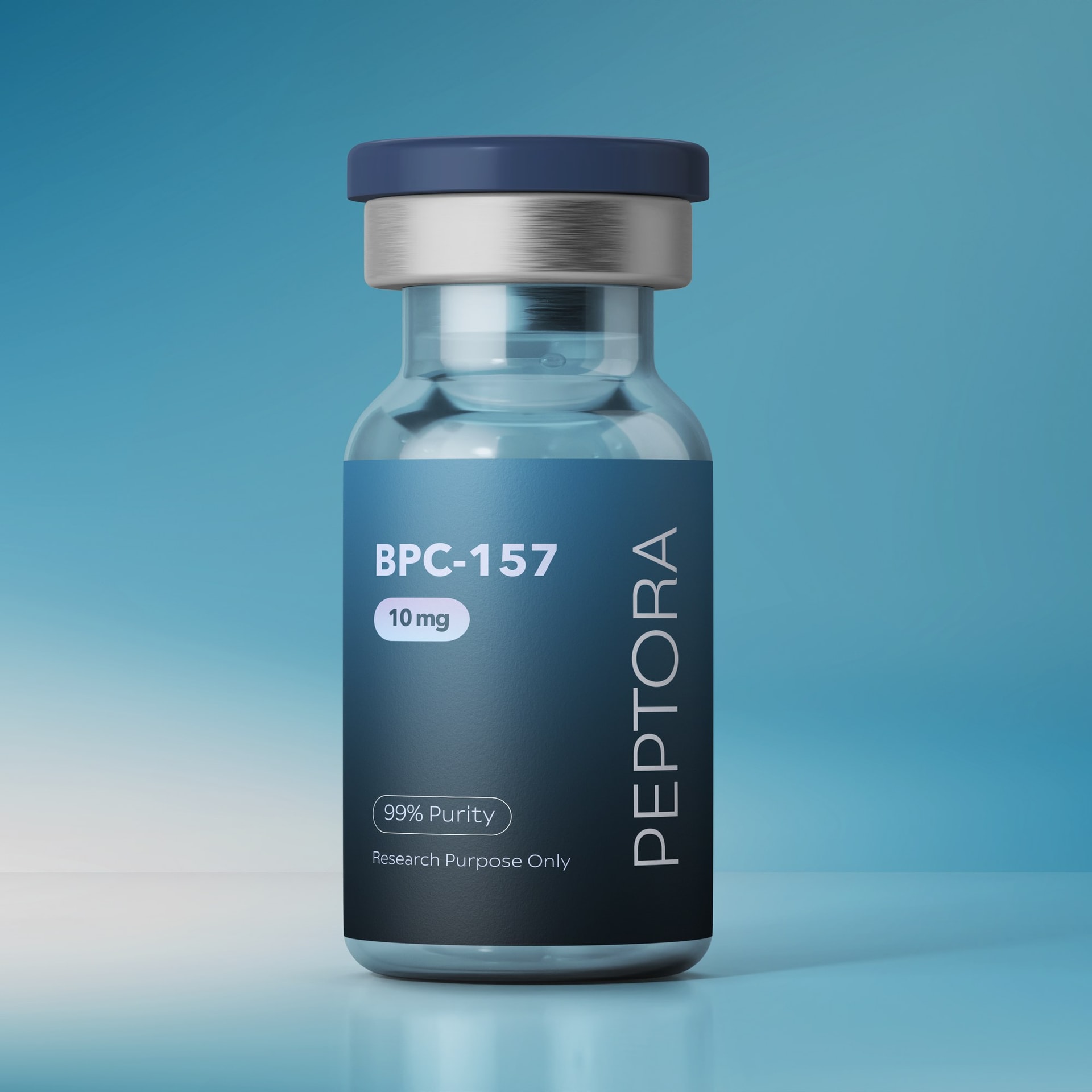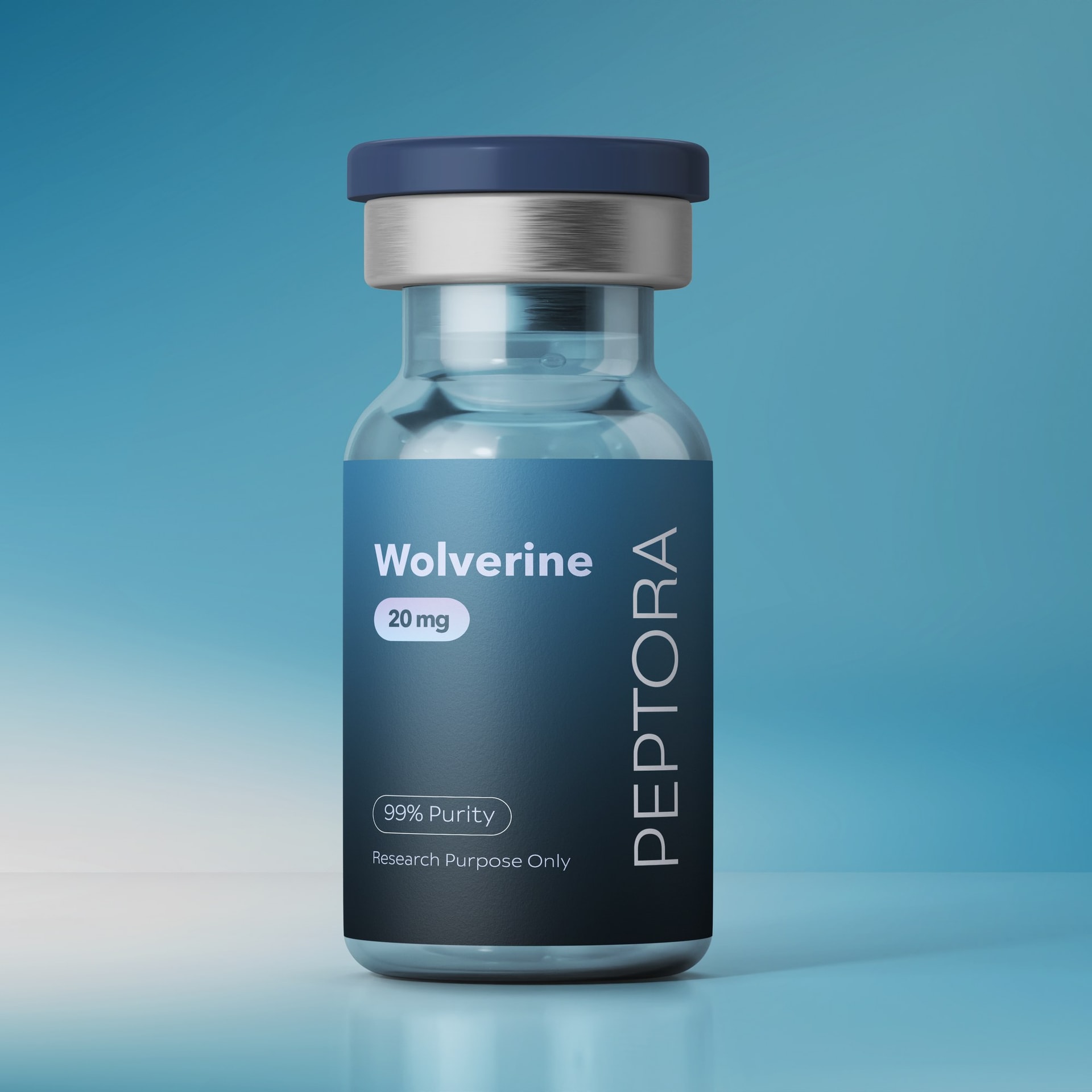


What BPC-157 and TB-500 are
Both are peptides — tiny proteins — and both are studied in research about how tissue repairs itself. That shared theme is why people compare them. But they come from different places:
- BPC-157 is a lab-made fragment (a small piece) linked to a protein found in the stomach. Scientists have studied it broadly in tissue-repair experiments, often looking at how it affects the growth of new blood vessels.
- TB-500 is a lab-made copy of part of a natural body protein called thymosin beta-4. That protein's main day job is helping cells move to where they're needed, so TB-500 is studied a lot around cell movement and repair.
So the easiest way to hold them apart: BPC-157 comes from a stomach-protein story and is studied around blood-vessel growth; TB-500 comes from the thymosin beta-4 story and is studied around cells moving to a repair site.
Explore the peptides
BPC-157 and TB-500 — independently lab tested, with each lot's certificate of analysis published online, for laboratory research use only.
View BPC-157The quick version
BPC-157 — blood-vessel angle
A stomach-protein-linked fragment, studied a lot for angiogenesis — the growth of new blood vessels — in repair models.
TB-500 — cell-movement angle
A copy of part of thymosin beta-4, a protein that helps cells relocate to where repair is happening.
Why study them together
They're thought to work through different routes, so researchers compare them — and blends like Wolverine pair them.
Same testing bar
Both are tested by an independent lab (HPLC + LC-MS), with each lot's certificate of analysis published online.
How they're thought to work differently
This is where the two part ways. A quick word first: angiogenesis just means the growth of new blood vessels, and actin is a bit of scaffolding inside cells that helps them hold their shape and move around.
- BPC-157 — in preclinical research (studies in cells and animals, before any human trials), it has been investigated for how it affects blood-vessel growth and the healing of tissues like tendon and ligament in lab models.
- TB-500 (thymosin beta-4) — the natural protein it copies works on actin, which is central to how cells move. Research has evaluated it in models of cell migration, survival, and repair, including in the heart.
In plain terms: one line of research leans toward building the supply lines (new blood vessels), and the other leans toward helping cells get to the worksite (cell movement). Neither is a proven outcome — these are the angles scientists explore.
Side-by-side comparison
| BPC-157 | TB-500 | |
|---|---|---|
| Origin story | Fragment linked to a stomach protein | Copy of part of thymosin beta-4 |
| Most-studied angle | New blood-vessel growth (angiogenesis) | Cell movement (via actin) |
| Research stage | Mostly preclinical (cells & animals) | Mostly preclinical (cells & animals) |
| Often paired in | Blends like Wolverine | Blends like Wolverine |
Peptora carries BPC-157 and TB-500 individually, plus the Wolverine blend that pairs them — each with its own certificate of analysis. For single-compound background, see the BPC-157 guide and the TB-500 guide.
Why researchers often study them together
Because the two are thought to work through different routes, pairing them is its own experiment — not just more of one idea. That's the reasoning behind blends such as Wolverine, which combines both. Studying them together lets researchers look at whether two different research pathways behave differently side by side than either does alone.
Purity and testing (why the certificate matters)
In research, your results are only as trustworthy as the material you start with. Peptora's BPC-157 and TB-500 lots are tested for purity by HPLC at an independent lab, with LC-MS as a second test to confirm they're the right molecules. Each lot's results are published online as a certificate of analysis (COA).
To learn what the numbers on a certificate actually mean, see the guide on what a certificate of analysis is.
How they're handled in the lab
Both ship as freeze-dried powder (the technical word is lyophilized). Before use in research, each is reconstituted — mixed with water, specifically bacteriostatic water, sold separately. The same simple care applies to both:
- 1Let the sealed vial warm up to room temperature before opening it.
- 2Add the water slowly down the side of the vial, then swirl gently — don't shake.
- 3Wait until the powder is fully dissolved before drawing anything out.
- 4Keep the mixed solution in the fridge, away from light.
Step-by-step details are in the reconstitution guide.
Scientific references
These references, from PubMed, describe preclinical research on each peptide. They are provided for background about the compounds themselves — not the laboratory research products Peptora supplies, and not as any guide to use.
- 1Seiwerth S, et al. Stable gastric pentadecapeptide BPC 157 and wound healing. Front Pharmacol. 2021;12:627533. doi:10.3389/fphar.2021.627533 (PMID: 34267654).
- 2Cerovecki T, et al. Pentadecapeptide BPC 157 (PL 14736) improves ligament healing in the rat. J Orthop Res. 2010;28(9):1155-1161. doi:10.1002/jor.21107 (PMID: 20225319).
- 3Sikiric P, et al. Fistulas healing. Stable gastric pentadecapeptide BPC 157 therapy. Curr Pharm Des. 2020;26(25):2991-3000. doi:10.2174/1381612826666200424180139 (PMID: 32329684).
- 4Goldstein AL, Kleinman HK. Advances in the basic and clinical applications of thymosin β4. Expert Opin Biol Ther. 2015;15 Suppl 1:S139-S145. doi:10.1517/14712598.2015.1011617 (PMID: 26096726).
- 5Bock-Marquette I, et al. Thymosin beta-4 activates integrin-linked kinase and promotes cardiac cell migration, survival and cardiac repair. Nature. 2004;432(7016):466-472. doi:10.1038/nature03000 (PMID: 15565145).
Explore BPC-157 and TB-500
Independently lab tested, with each lot's certificate of analysis published online, fast U.S. shipping — for laboratory research use only.
View BPC-157Key takeaways
- BPC-157 and TB-500 are two of the most-studied peptides in tissue-repair research, and they come from different origins.
- BPC-157 is a lab-made fragment linked to a stomach protein, studied a lot for how it affects new blood-vessel growth (angiogenesis).
- TB-500 is a lab-made copy of part of thymosin beta-4, a natural protein that helps cells move to where repair is happening.
- Because they're thought to work through different routes, researchers often study them side by side — and blends like Wolverine pair them.
- Most of the research on both is preclinical (cells and animals). They're for laboratory research only — not medicines, and not for people or animals.
- Both are tested by an independent lab (HPLC and LC-MS), with each lot's certificate of analysis published online, and ship as freeze-dried powder.
Frequently asked questions
This article is intended solely as an educational summary of publicly available scientific literature. Products offered by Peptora are supplied exclusively for laboratory research purposes and are not approved for human or veterinary use. The information presented should not be interpreted as medical advice, treatment recommendations, or clinical guidance.