
What triple agonism means
Start with two words. A receptor is a docking spot on the surface of a cell — a lock. An agonist is something that fits that lock and switches it on — a key. So an agonist for one receptor is a key cut for one lock. Triple agonism is what happens when chemists design a single molecule shaped so it fits three different locks at once.
The three locks in this case are called GLP-1, GIP, and glucagon — three natural signals the body already uses to deal with food and energy. Older research compounds in this family fit one of them. Newer ones fit two. A triple agonist fits all three, which is why you will also see the phrase unimolecular ("one molecule") used to describe them: it is genuinely one peptide, not three mixed together.
The idea at a glance
Receptor = a lock
A docking spot on a cell that only accepts a certain shape. Nothing happens until something fits it.
Agonist = a key that turns it on
A molecule that fits the lock and switches the signal on. The opposite, a blocker, is called an antagonist.
Triple = one key, three locks
A single peptide designed so the same molecule fits GLP-1, GIP, and glucagon receptors.
Lab use only
Studied in metabolism and body-weight experiments in cells and animals — never for people or animals outside a lab.
Explore a research-grade triple agonist
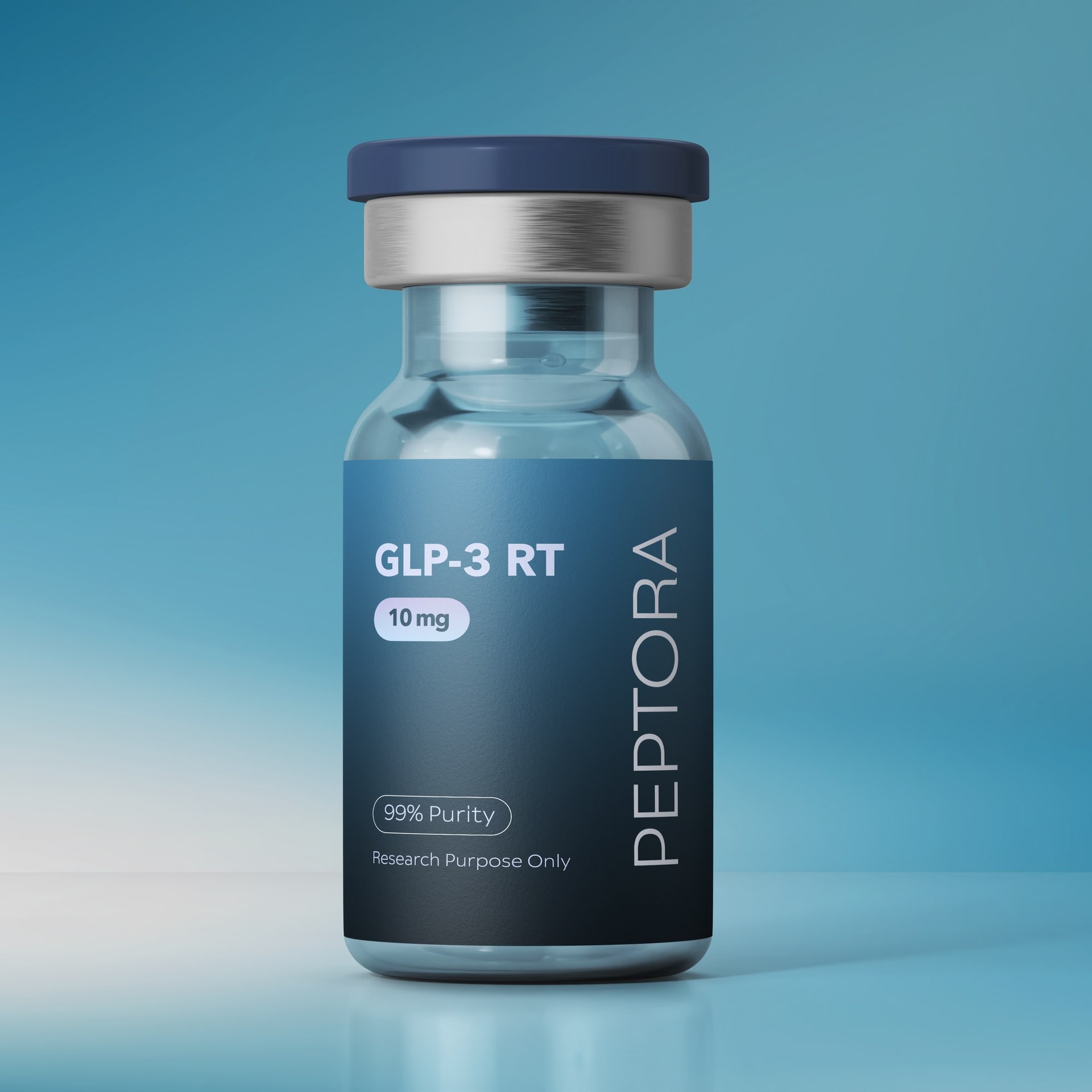
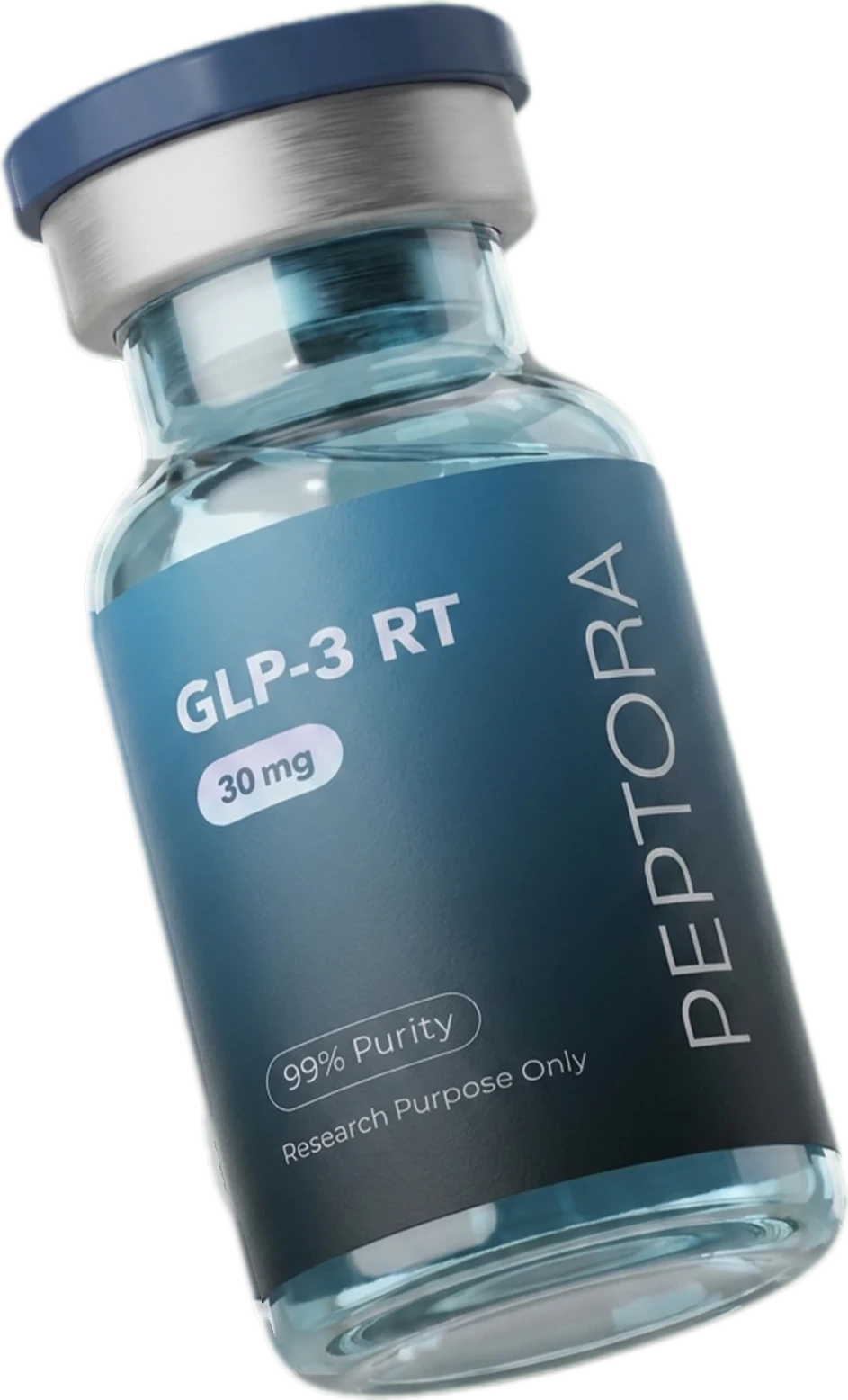
GLP-3 RT — 99%+ pure, a certificate of analysis with every batch, for laboratory research use only.
View GLP-3 RTWhat each of the three signals does
The three signals are all part of how the body responds to a meal. Two of them, GLP-1 and GIP, belong to a family called incretins — a word that simply means "gut signals released when you eat." The third, glucagon, is the odd one out, and it is the one that makes a triple agonist different from a dual one:
- GLP-1 — released from the gut after eating. Research links it to insulin release, to how quickly the stomach empties, and to the feeling of fullness.
- GIP — the other incretin, also released after a meal. Published work connects it to insulin and to how the body handles fat.
- Glucagon — not an incretin. It has been studied for its role in how many calories the body burns and in how the liver handles stored sugar and fat.
Here is the part that makes the design interesting: glucagon and the incretins pull in different directions. Glucagon on its own tends to raise blood sugar, while GLP-1 and GIP tend to bring it down. Preclinical studies have described this as a balancing act — the incretin activity is what keeps glucose in check while the glucagon activity contributes on the energy-burn side. Getting that balance right is most of the design work.
One lock, two locks, three locks
The simplest way to place any compound in this family is to count how many of the three locks it fits. That single number explains most of what separates them:
| Type | GLP-1 | GIP | Glucagon | Example studied in the literature |
|---|---|---|---|---|
| Single (mono) agonist | ✓ | — | — | SEMA |
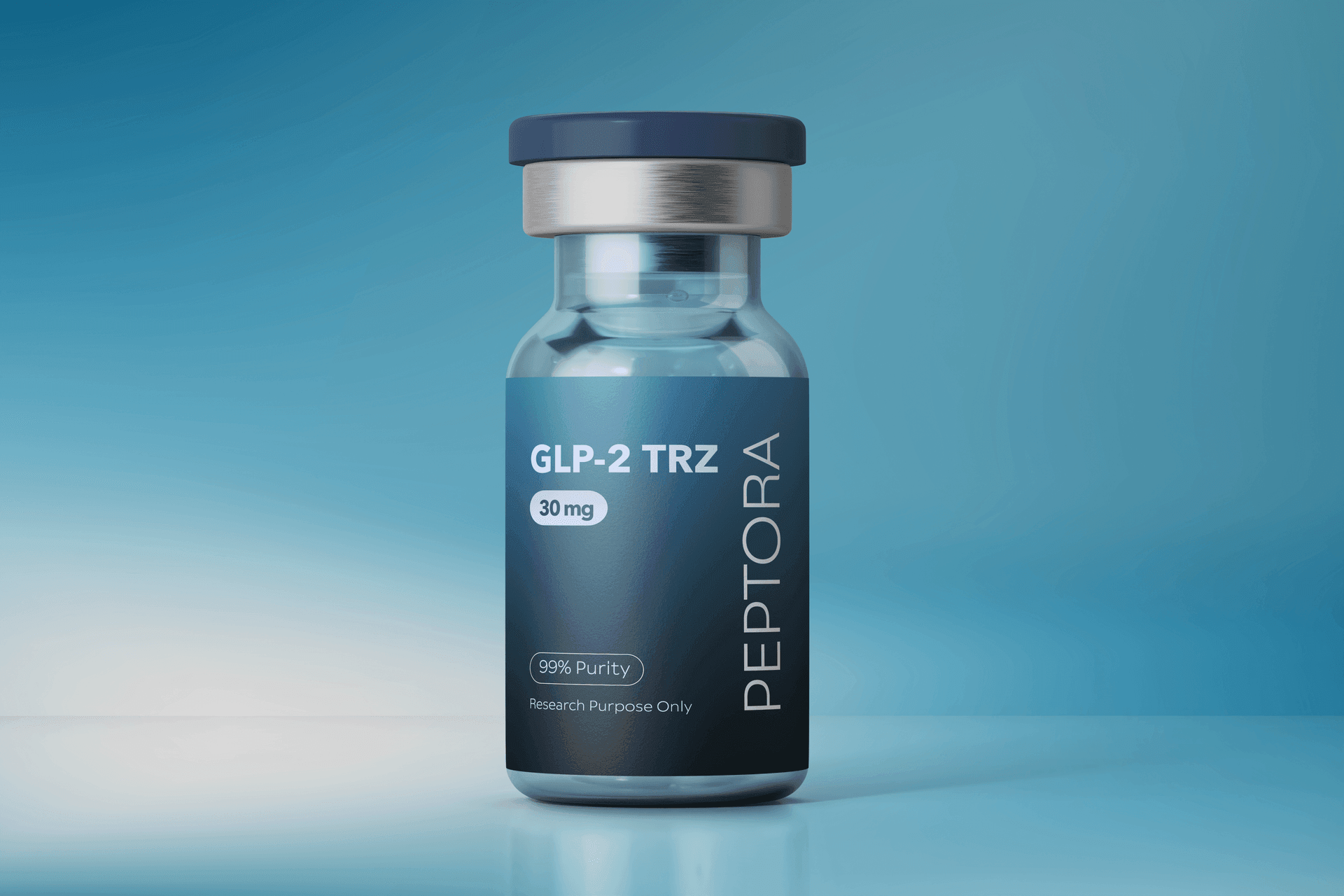
| Dual agonist | ✓ | ✓ | — | TRZ (Peptora's GLP-2 TRZ) |
| Triple agonist | ✓ | ✓ | ✓ | GLP-3 RT (Peptora's GLP-3 RT) |
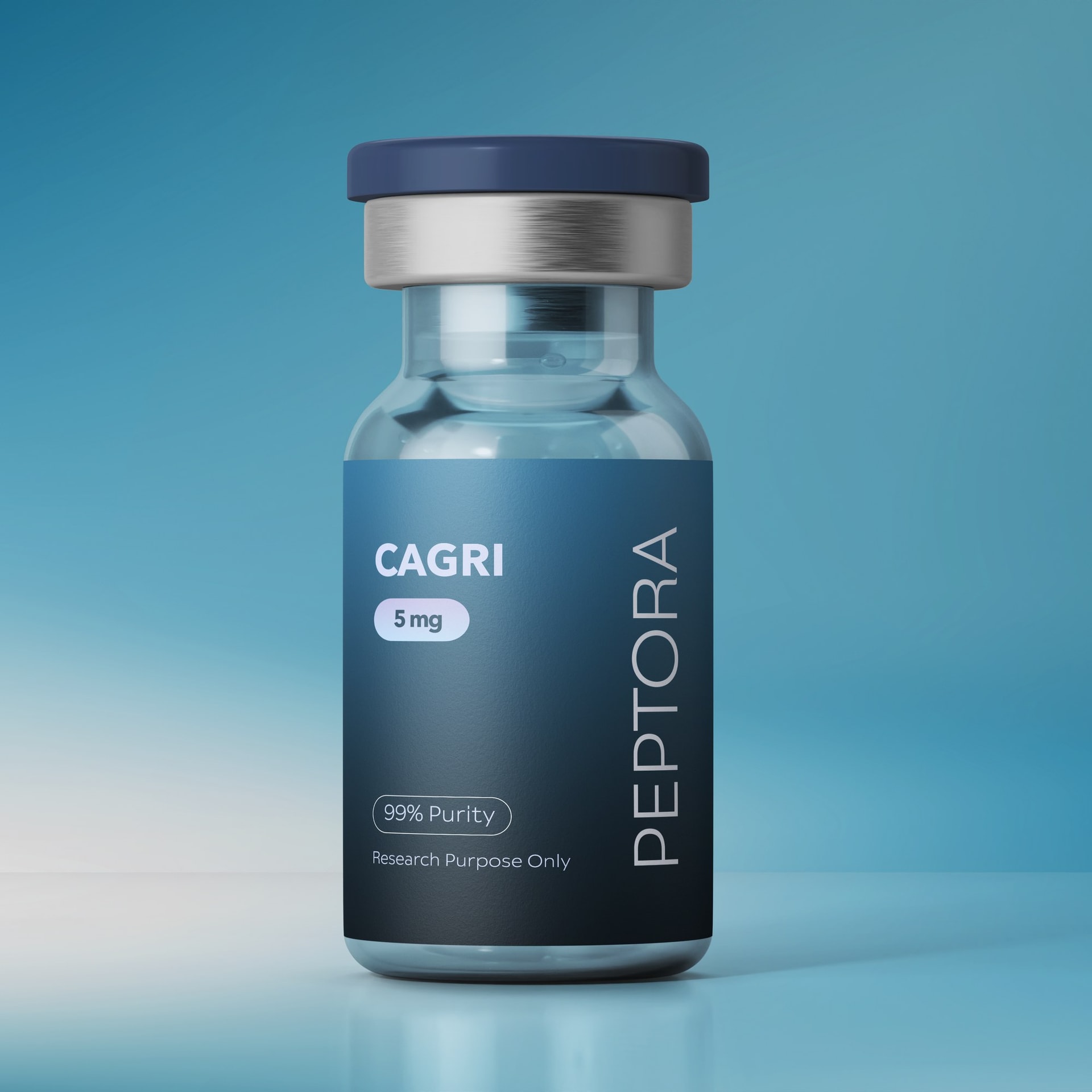
Peptora carries research-grade versions of several compounds in and around this family, including GLP-3 RT, TRZ (GLP-2 TRZ), and Cagrilintide (CAGRI), which works through a separate pathway called amylin. Deeper comparisons live in the RT vs TRZ vs SEMA guide.
Why build one molecule instead of mixing three
A fair question: if you want three signals, why not just combine three separate compounds? Published work gives a few practical reasons researchers favour the single-molecule approach:
- 1One molecule behaves as one molecule. It is absorbed, distributed, and cleared on a single timeline, so an experiment does not have to account for three different schedules at once.
- 2The ratio is fixed by chemistry. Chemists can tune how strongly the same peptide pulls on each of the three receptors, and that balance then stays the same everywhere it goes.
- 3It is easier to attribute a result. Because the activity ratio is built in, researchers can compare one triple agonist against a dual or single one and reason about which arm contributed what.
Preclinical studies have used loss-of-function designs to test exactly this — switching off one of the three arms and watching what changes. That approach is how the glucagon arm came to be described as the piece tied to energy expenditure, separate from what the two incretin arms contribute.
What scientists actually study it for
In the published literature, triple agonism comes up in a handful of connected areas:
- Metabolism — how activating all three receptors at once changes the way cells and tissues handle sugar and fat in lab models.
- Appetite signals — the fullness pathways that the GLP-1 arm is associated with.
- Body weight — weight and body-composition measurements in animal models, and in clinical trials run by the companies developing these compounds.
- Energy expenditure — the glucagon arm, which is the piece that distinguishes triple agonists from dual and single ones in preclinical work.
- Liver fat — clinical trials are investigating how these compounds affect fat stored in the liver.
Why purity matters for this kind of research
A compound whose whole point is a balanced ratio across three receptors is only as good as the material in the vial. If the peptide is degraded or contaminated, the balance the chemists designed no longer holds — and the experiment measures something other than what it intended. Every batch of Peptora's triple-agonist research peptides is checked to 99%+ purity by HPLC, confirmed by a second test (LC-MS) that proves it is the right molecule, and run through a full quality-control panel before it ships, with a certificate of analysis (COA) for that exact batch.
To learn what the numbers on a certificate actually mean, see the guide on the certificate of analysis. For handling, the reconstitution guide covers mixing freeze-dried powder with bacteriostatic water.
Scientific references
Triple agonism began as a chemistry idea in academic and industry labs and is now being tested in human clinical trials by several companies. The papers below are the primary literature, from PubMed. They describe research on the compounds and the receptor biology themselves — not the laboratory research products Peptora supplies.
- 1Finan B, et al. A rationally designed monomeric peptide triagonist corrects obesity and diabetes in rodents. Nat Med. 2015;21(1):27-36. doi:10.1038/nm.3761 (PMID: 25485909).
- 2Coskun T, et al. LY3437943, a novel triple glucagon, GIP, and GLP-1 receptor agonist for glycemic control and weight loss: From discovery to clinical proof of concept. Cell Metab. 2022;34(9):1234-1247.e9. doi:10.1016/j.cmet.2022.07.013 (PMID: 35985340).
- 3Knerr PJ, et al. Next generation GLP-1/GIP/glucagon triple agonists normalize body weight in obese mice. Mol Metab. 2022;63:101533. doi:10.1016/j.molmet.2022.101533 (PMID: 35809773).
- 4Folli F, et al. Mechanisms of action of incretin receptor based dual- and tri-agonists in pancreatic islets. Am J Physiol Endocrinol Metab. 2023;325(5):E595-E609. doi:10.1152/ajpendo.00236.2023 (PMID: 37729025).
- 5Del Prato S, Gallwitz B, Holst JJ, Meier JJ. The incretin/glucagon system as a target for pharmacotherapy of obesity. Obes Rev. 2022;23(2):e13372. doi:10.1111/obr.13372 (PMID: 34713962).
- 6Anastasiou IA, Argyrakopoulou G, Dalamaga M, Kokkinos A. Dual and Triple Gut Peptide Agonists on the Horizon for the Treatment of Type 2 Diabetes and Obesity. An Overview of Preclinical and Clinical Data. Curr Obes Rep. 2025;14(1):34. doi:10.1007/s13679-025-00623-1 (PMID: 40210807).
Explore a research-grade triple agonist
GLP-3 RT — 99%+ pure, a certificate of analysis with every batch, fast U.S. shipping, for laboratory research use only.
View GLP-3 RTKey takeaways
- A receptor is a docking spot on a cell and an agonist is a key that switches it on — so triple agonism is one molecule cut to fit three different locks at once.
- The three locks are GLP-1, GIP, and glucagon. GLP-1 and GIP are gut signals released after eating (incretins); glucagon is not, and is the one tied to how much energy the body burns.
- Counting locks is the simplest way to sort these compounds: single agonists fit one, duals fit two, triples fit all three.
- Glucagon and the incretins pull in opposite directions on blood sugar, so balancing the three arms in a single molecule is most of the design work.
- Researchers build one molecule rather than mixing three because a single peptide has one timeline and a ratio fixed by chemistry, which makes results easier to attribute.
- These are laboratory research compounds only — not medicines, and not for use in people or animals.
Frequently asked questions
This article is intended solely as an educational summary of publicly available scientific literature. Products offered by Peptora are supplied exclusively for laboratory research purposes and are not approved for human or veterinary use. The information presented should not be interpreted as medical advice, treatment recommendations, or clinical guidance.