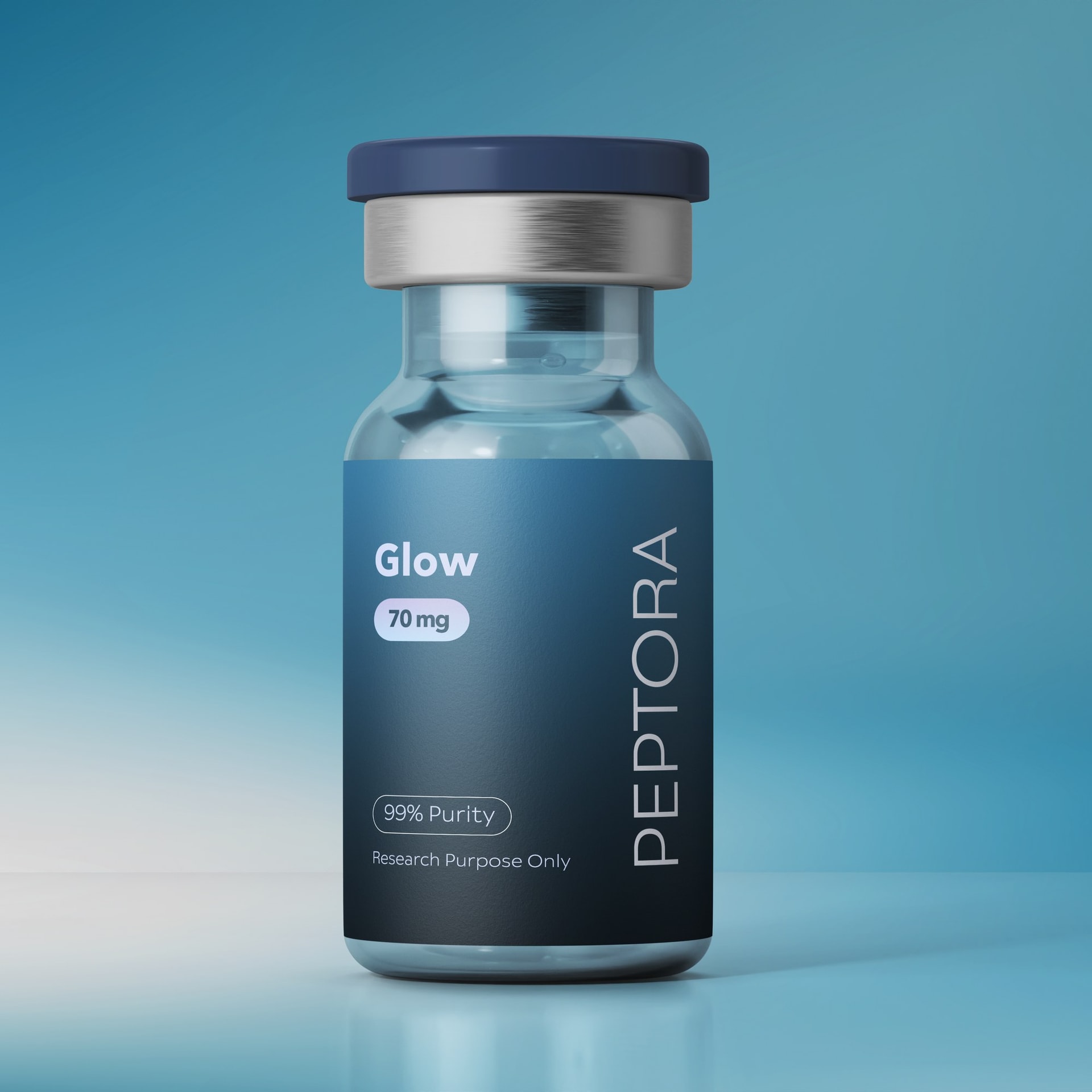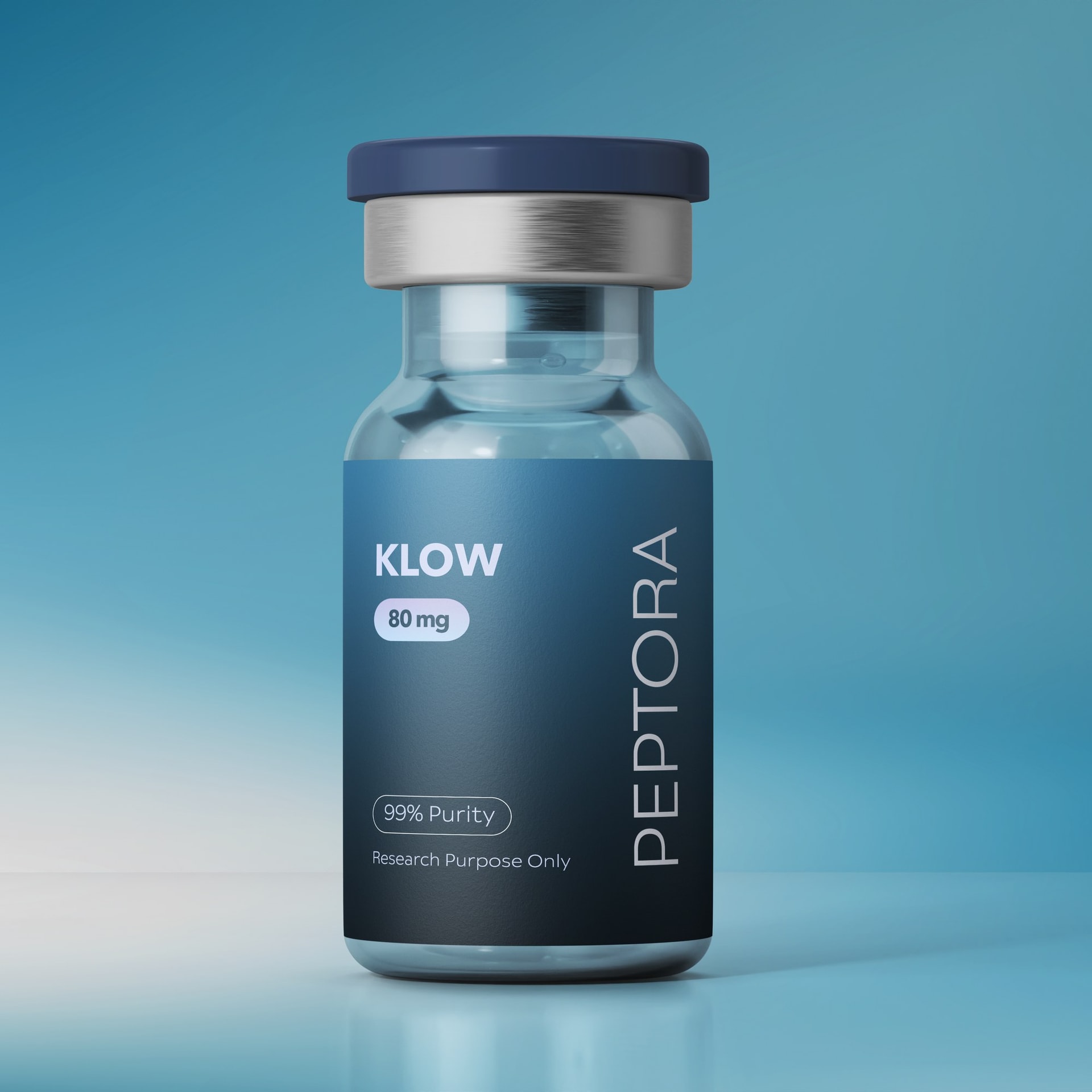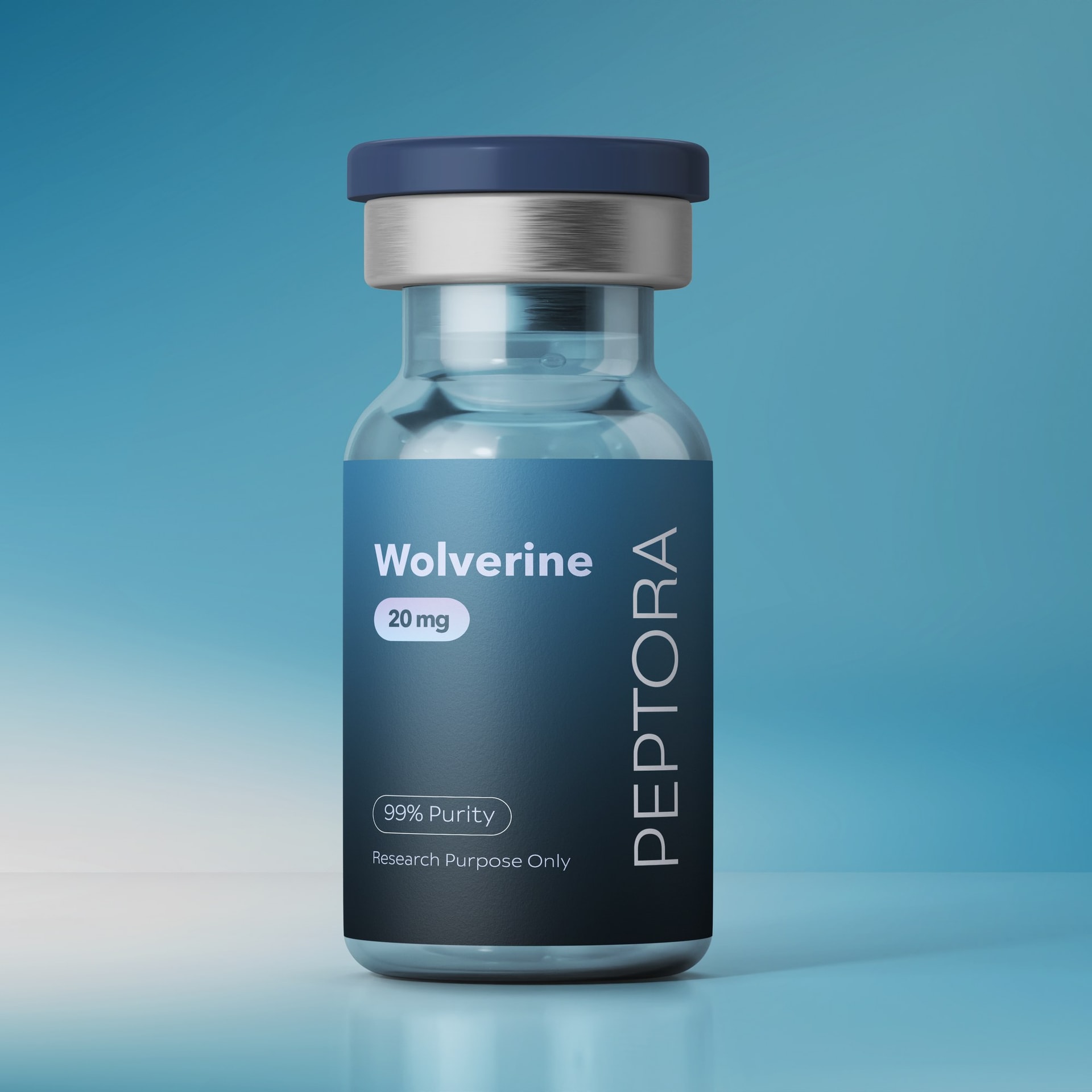

What GLOW, KLOW, and Wolverine actually are
All three are research blends — single freeze-dried vials that hold more than one peptide (a peptide is just a tiny protein) mixed together at a set ratio. The easiest way to picture the three side by side is as a base recipe with add-ons. Wolverine is the two-ingredient base. GLOW is that same base plus one more peptide. KLOW is GLOW plus one more again. Two, three, four — same core, growing team.
One important note up front: all three are research chemicals for the laboratory only. They are not medicines, and they are not for use in people or animals. Researchers reach for a blend when they want several related signals present together in one controlled experiment, rather than weighing out and mixing separate powders by hand.
The three blends at a glance
Wolverine — the two-peptide base
BPC-157 + TB-500. Two of the most-studied peptides in tissue-repair research, together in one vial.
GLOW — base plus the copper peptide
Wolverine's two, plus GHK-Cu, the copper-carrying peptide studied in skin and collagen research.
KLOW — the four-peptide version
Everything in GLOW, plus KPV, a tiny peptide studied in inflammatory-signaling research.
Same standard across all three
Every finished blend is checked by lab testing (HPLC + LC-MS) and ships with a certificate for that exact batch.
Explore Peptora's research blends
99%+ pure, a certificate of analysis with every batch, fast U.S. shipping — for laboratory research use only.
View GLOWThe four peptides that make up all three blends
Between them, the three blends draw on just four peptides. Once you know what each one is, every blend becomes easy to read. Each has its own full guide if you want to go deeper:
- [BPC-157](/research/bpc-157) — a peptide with 15 tiny parts, first identified in stomach fluid. Preclinical (animal and cell) studies have evaluated it in models of tendon, ligament, muscle, and gut-lining repair.
- [TB-500](/research/tb-500) — a lab-made copy of a piece of a natural protein called thymosin beta-4. Research suggests it plays a role in cell migration (cells moving to where they're needed) and the growth of new blood vessels.
- [GHK-Cu](/research/ghk-cu) — a natural human peptide made of three parts (glycine-histidine-lysine) that carries a copper atom. It has been investigated in published lab studies on collagen, skin structure, and tissue remodeling.
- [KPV](/research/kpv) — a three-part peptide (lysine-proline-valine) that is the tail end of a natural body signal called alpha-MSH. It has been studied mostly in cell and animal models of inflammatory signaling.
Side by side: what's in each vial
The clearest way to see the difference is a simple checklist. Reading down the columns shows how each blend builds on the one before it:
| Peptide | Wolverine | GLOW | KLOW | Most-studied research area |
|---|---|---|---|---|
| BPC-157 | ✓ | ✓ | ✓ | Tendon, ligament, muscle, and gut-lining models |
| TB-500 | ✓ | ✓ | ✓ | Cell movement, blood-vessel growth |
| GHK-Cu | — | ✓ | ✓ | Skin, collagen, tissue remodeling |
| KPV | — | — | ✓ | Inflammation signals |
| Peptides per vial | Two | Three | Four | — |
Peptora carries all three blends — Wolverine, GLOW, and KLOW — plus each of the four peptides on its own, including BPC-157, TB-500, and GHK-Cu. Each one ships with its own certificate of analysis.
How the three differ, in plain terms
Because the blends are nested, the differences are easy to describe. Each step adds one new research angle rather than replacing anything:
- 1Wolverine is the narrowest. Two peptides, BPC-157 and TB-500, both studied in tissue-repair research. It is the simplest of the three, which makes it the most focused when a study is only interested in that one area.
- 2GLOW adds GHK-Cu. GHK-Cu brings a different body of published research — copper transport, collagen, and skin structure — alongside the two shared peptides, BPC-157 and TB-500.
- 3KLOW adds KPV, which is studied in inflammatory-signaling research. KPV's published work sits mostly in cell and animal models of inflammatory signaling, a separate line of research from the tissue-repair or collagen literature.
Because each blend is a fixed ratio from a single certified batch, the three are not interchangeable. A study designed around one of them would need that specific blend, not a substitute. Beyond that, there is no published research on the mixtures themselves — all of the science below is on the individual peptides.
Purity and testing (why the certificate matters)
In research, your results are only as trustworthy as the material you start with — and a blend adds a second job: confirming that every peptide in the vial is actually there, in the right amount. Each batch of Wolverine, GLOW, and KLOW is checked to 99%+ purity by HPLC, confirmed by a second test (LC-MS, which proves the molecules are what they should be), and run through a full quality-control panel before it ships. Every order comes with a certificate of analysis (COA) for that exact batch.
That paperwork is standard here, not an add-on. To learn what the numbers on a certificate actually mean, see the guide on the certificate of analysis.
How they're handled in the lab
All three ship as a freeze-dried powder (the technical word is lyophilized, which just means the water was removed to keep it stable). Before research use, the powder is reconstituted — mixed back with bacteriostatic water, a special sterile water sold separately. The handling is the same for all three, and a little care keeps every peptide in the vial intact:
- 1Let the sealed vial warm up to room temperature before opening it.
- 2Add the water slowly down the side of the vial, then swirl gently — don't shake.
- 3Wait until the powder is fully dissolved before drawing anything out.
- 4Keep the mixed solution in the fridge, away from light.
Step-by-step details are in the reconstitution guide. Doing these the same way every time is one of the easiest ways to keep research consistent — especially with a blend, where several peptides have to survive the same handling.
Scientific references
There is no clinical trial on any of these three mixtures — each blend is a research product, not a studied drug. The papers below are the primary literature on the four individual peptides, from PubMed. Much of it is preclinical (cell and animal) work. These studies describe research on the compounds themselves — not the laboratory research products Peptora supplies.
- 1McGuire FP, Martinez R, Lenz A, Skinner L, Cushman DM. Regeneration or Risk? A Narrative Review of BPC-157 for Musculoskeletal Healing. Curr Rev Musculoskelet Med. 2025;18(12):611-619. doi:10.1007/s12178-025-09990-7 (PMID: 40789979).
- 2Vasireddi N, et al. Emerging Use of BPC-157 in Orthopaedic Sports Medicine: A Systematic Review. HSS J. 2025;21(4):15563316251355551. doi:10.1177/15563316251355551.
- 3Goldstein AL, Hannappel E, Sosne G, Kleinman HK. Thymosin β4: a multi-functional regenerative peptide. Basic properties and clinical applications. Expert Opin Biol Ther. 2012;12(1):37-51. doi:10.1517/14712598.2012.634793.
- 4Pickart L. The human tri-peptide GHK and tissue remodeling. J Biomater Sci Polym Ed. 2008;19(8):969-988. doi:10.1163/156856208784909435 (PMID: 18644225).
- 5Luger TA, Brzoska T. alpha-MSH related peptides: a new class of anti-inflammatory and immunomodulating drugs. Ann Rheum Dis. 2007;66 Suppl 3:iii52-iii55. doi:10.1136/ard.2007.079780 (PMID: 17934097).
- 6Brzoska T, Böhm M, Lügering A, Loser K, Luger TA. Terminal signal: anti-inflammatory effects of alpha-melanocyte-stimulating hormone related peptides beyond the pharmacophore. Adv Exp Med Biol. 2010;681:107-116. doi:10.1007/978-1-4419-6354-3_8 (PMID: 21222263).
Explore Peptora's research blends
Wolverine, GLOW, and KLOW — 99%+ pure, a certificate of analysis with every batch, for laboratory research use only.
View GLOWKey takeaways
- The three blends are nested: Wolverine has two peptides, GLOW has those two plus one, and KLOW has those three plus one. Same core, growing team.
- Wolverine = BPC-157 + TB-500. GLOW adds GHK-Cu. KLOW adds KPV on top of GLOW.
- Each addition brings a different body of published research: tissue-repair research (BPC-157, TB-500), skin and collagen research (GHK-Cu), and inflammatory-signaling research (KPV).
- There is no published research on the mixtures themselves — every study cited here is on one of the four individual peptides, and much of it is preclinical.
- All three are for laboratory research only — not medicines, and not for people or animals.
- Every batch of every blend is 99%+ pure (checked by HPLC and LC-MS) and comes with a certificate of analysis.
Frequently asked questions
This article is intended solely as an educational summary of publicly available scientific literature. Products offered by Peptora are supplied exclusively for laboratory research purposes and are not approved for human or veterinary use. The information presented should not be interpreted as medical advice, treatment recommendations, or clinical guidance.